

Use the Wellness Compass to Achieve Your Senior Games Personal Best
By Andrew Walker, MPH; NSGA Director of Health & Well-Being
Last month’s health and well-being blog focused on adopting a whole-person mindset that positively impacts athletic performance. The Wellness Compass tool was shared as an easy-to-use method for assessing overall well-being.
Now, let’s take a deeper dive into the benefits of completing this resource and following it up with the SMART Step Worksheet. The Worksheet guides you in creating a well-being goal, which can help you in reaching your Senior Games personal best. Both resources are linked at the end of this post.
Understanding the purpose behind an assessment is essential. Many people feel uneasy or resistant when asked to complete tests or evaluations. The Wellness Compass encourages personal growth without judgement.
It highlights your strengths and provides an opportunity to select an area for improvement in a supportive way. The assessment is simply a snapshot of where you are right now, offering encouragement and insight into your potential for growth.
Benefits of Using the Wellness Compass
Taking time to slow down and complete the assessment can increase self-awareness and help you focus on healthy changes. According to the designers of the tool, additional benefits include:
- Scores are not labeled as “good” or “bad”
- Promotes self-awareness and insight
- Identifies areas of well-being that may need more attention
- Shows how different aspects of wellness are interconnected
- Reveals opportunities for growth
How the Assessment Works
The Wellness Compass explores eight areas of wellness. After responding to all the questions in the digital tool, your results will automatically tally and generate a visual summary. You can also manually add your scores if using a printed version.
Take Action with the SMART Step Worksheet
The SMART Step Worksheet helps you choose an area to improve. Enhancing one area positively impacts others. A practical approach is to select an area you feel motivated to work on within the next 30 days. Applying the SMART Step process helps you create goals that are:
- Specific
- Measurable
- Achievable
- Relevant
- Time-Limited
This process also asks you to consider potential roadblocks and to identify an accountability partner to support your progress.
Completing the Wellness Compass assessment and making a change in just one area will increase your whole person well-being. Put yourself on the best path to a Senior Games personal best performance by using the Wellness Compass and the Smart Step Worksheet links.
- Published in Health & Well-Being
Journey to Gold: How This Athlete Pivoted Through Setbacks
January 2026 Athlete of the Month
By Del Moon, NSGA Storyteller
James “Jim” DeGoey, 76
Fitchburg, Wisconsin
Recumbent Cycling
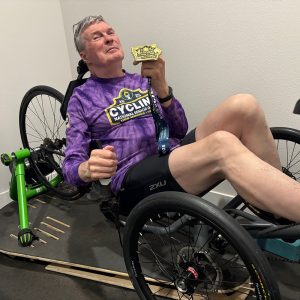
Image courtesy Jim DeGoey.
Recumbent Cycling Time Trials were introduced to the National Senior Games in 2022, providing a way for cyclists with physical limitations a way to compete using specially designed low-profile bikes.
76-year-old Jim DeGoey, a veteran of more than 150 competitive races since he took up cycling in midlife, is grateful to have this alternative pathway after a horrific hit-and-run accident nearly five years ago.
“On an early morning training ride, I was struck by a kid on an electric scooter and thrown over the handlebars. My helmeted head impacted the asphalt trail surface,” Jim recalls. “I suffered fractures in my neck and upper back, along with four fractured ribs. Subsequent spine surgery fused 15 vertebrae that left me with slouched shoulders and an immobile neck, but thankfully, no paralysis. It took almost a year of failed attempts to realize that I would no longer be able to ride my road bike, let alone race my time trial bike.”
The First Pivot: Runner to Cyclist
While Jim enjoyed riding his Schwinn bike as a kid, it was running that captured his imagination at 15. “The first race I ran was a two-mile cross-country race at the boarding school my parents sent me to,” he says. “I broke the school record by a minute and a half, and that ignited me to be a runner.”
Jim made his varsity cross-country and track teams, but says bad coaching turned him off. “The joke at the time was that he was practicing a training method called PTA – pain, torture and agony,” he says with a laugh. “The coach sat under a tree, chain-smoking cigarettes while we were doing hill repeats.” He quit the team and did not try to join any teams while attending the University of Wisconsin-Milwaukee.
He did, however, continue to run. A lot.
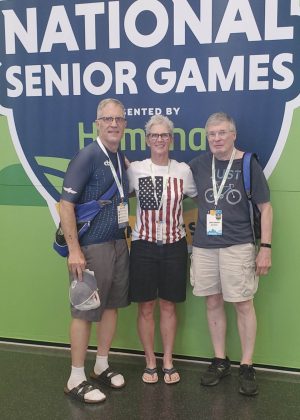
Right to left: Jim DeGoey, Tracy Drews (Jim’s coach), and Paul DeGoey (Jim’s bother). Image courtesy Paul DeGoey.
“I just ran just for exercise, and it got to the point that I was doing 100 miles a week,” he says. After becoming a freelance commercial graphic artist, Jim began competing in local road races. “I had no training. I had no coach. It was just the sheer joy of running.”
Jim only paused his pace to serve five years in the Army and four more as an active reserve. When he settled in Northern Virginia he hit the roads and trails again. “I didn’t compete at all. I was just running for fitness and fun for 20 years,” he explains.
As he approached 50, Jim had to pivot. “I developed a hiatal hernia, and my GP said my running was done and suggested I get on a bike. So I did, and when I went out on the bike trails, I’d get passed by ‘the hammerheads,’ the guys that were going as fast as they can. And I thought I can do that.”
Just like that, a competitive cyclist was born.
Jim initially self-coached and gradually joined a local bike team. Despite not finishing some races and rarely making the podium for a decade, he was determined to keep improving. By 2013, he reached a milestone and won his first cycling race, 50 years after his high school running triumph. Topping the podium fueled Jim to qualify for the 2015 National Senior Games presented by Humana with a goal of eventually winning a national championship.
Then, everything changed again with the crash.
A Life-Altering Setback and Ultimate Victory
Jim was determined to overcome his disability and new challenges. “Because I have a fused neck, I needed help to guide me across road intersections. If I want to look to the left or the right, I have to move my entire body,” he explains. “My regular bike just didn’t work out.”
There are two- and three-wheel recumbent designs, and the trike version turned out to be best for Jim, who quickly found the same joy of movement. “I started training in May 2022, and I’ve already logged 1,166 training sessions and almost 19,000 miles on it. It’s a part of my life.”
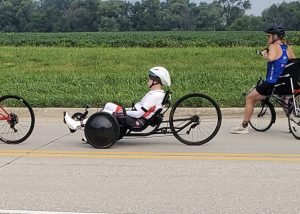
Jim lining up for the a Cycling Time Trial at the 2025 National Senior Games presented by Humana. Image courtesy Paul DeGoey.
With help and support from his brother Paul and coach Tracey Drews, Jim finally won his national championship when he captured gold in the Men’s 75-79 10K Recumbent Time Trials at the 2025 National Senior Games presented by Humana in Des Moines. He’s also working on a new goal: to write a book about his experiences.
“It’s titled ‘50 Years Between Victories,’ and it’s basically about how to resume an athlete’s lifestyle later in life,” he says with a hint of excitement.
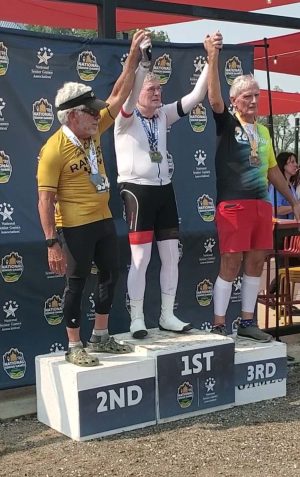
Jim topping the podium at the 2025 National Senior Games presented by Humana. Image courtesy Jim DeGoey.
“I’m getting my ACE certification as a health coach. I’m a former USA Cycling coach, but I’m not building training plans. The reality is that it is not about reliving the glory years; It’s about finding a new game plan. If you want to reignite your passion for activity, you have to look at it differently than you did in your 20s. You’ve got the opportunity now to use the wisdom of your more advanced age.”
Jim plans to make the free e-book available by mid-2026 and hopes it will help many people in the future. “As an advertising designer, my work may last for a month, and then it disappears,” he observes. “This is a lifelong legacy that I can share with my family, friends and acquaintances. That drives me more than just setting records or winning races.”
- Published in Athlete of the Month
Ready to Play? Explore the 2027 National Senior Games Sports Lineup
Note: Blog updated on March 23, 2026, to reflect the addition of Dance and Shooting.
The National Senior Games will offer more than 25 sports for athletes ages 50 and over when the event is held in Tulsa, Oklahoma, June 30-July 11, 2027.
Whether you thrive on adrenaline or prefer a strategic challenge, there’s a sport for every interest. See the full list of offerings at the end of this post.
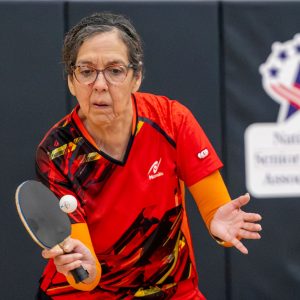
New Sports and Events
New sports for 2027 include Bocce, Climbing, Flag Football, Dance and Shooting.
New events include Recumbent Cycling for the Cycling Road Races, Triathlon and Triathlon Relay as well as adjustments to the Golf Scramble categories. The 1500-Meter Power Walk event will now be 1-Mile.
Race Walk, Racquetball and Hammer Throw will not return for the 2027 event.
Qualifying vs. Open Sports: What’s the Difference?
Qualification rules vary by sport, so it’s important to check the rulebook. There are two types of sports at the National Senior Games: qualifying and open.
Qualifying Sports require athletes to receive a certain placing (example: 1st-4th) in that sport at a State Senior Games in 2026. This makes them eligible to compete in that sport at Nationals in 2027.
Open Sports do not require qualification. The only guideline is that athletes must be at least 50 years of age by Dec. 31, 2026.
Learn more about qualification here.
How Many Sports Can I Compete in?
Athletes can compete in up to two individual Qualifying Sports, two team Qualifying Sports and an unlimited number of Open Sports. Open Sports are a great way to try something new!
Check the Rulebook for Changes to Your Sport(s)
If you’re a returning competitor, check the 2027 rulebook to see if any modifications were made to your sport’s rules. Visit NSGA.com/rules-regulations to view the most up-to-date rulebook.
Tip: A summary of significant changes is listed at the end of the rulebook.
Sports Offered at the 2027 National Senior Games*
*As of 1.5.26. Subject to change.
| Sport | Qualifying or Open Sport/Event |
|---|---|
| Archery | Qualifying |
| Badminton | Qualifying |
| Basketball & Basketball Shooting Skills | Basketball - Qualifying Basketball Shooting Skills - Open |
| Beach Volleyball | Open |
| Billiards | Open |
| Bocce | Open |
| Bowling & Non-Ambulatory Bowling | Qualifying |
| Climbing | Open |
| Cornhole & Non-Ambulatory Cornhole | Open |
| Cyling | Non-Recumbent - Qualifying Recumbent - Open |
| Dance | Open |
| Disc Golf | Open |
| Flag Football | Open |
| Golf & Golf Scramble | Golf - Qualifying Golf Scramble - Open |
| Pickleball and Non-Ambulatory Pickleball | Pickleball - Qualifying Non-Ambulatory Pickleball - Open |
| Powerlifting | Open |
| Power Walk | Open |
| Road Race | 5K and 10K - Qualifying 1-Mile - Open |
| Shooting | Open |
| Shuffleboard & Non-Ambulatory Shuffleboard | Qualifying |
| Softball | Qualifying |
| Swimming | Qualifying |
| Table Tennis | Qualifying |
| Tai Chi | Open |
| Tennis | Qualifying |
| Track & Field | Qualifying |
| Triathlon, Triathlon Relay, Triathlon (Recumbent), Triathlon Relay (Recumbent) | Triathlon - Qualifying Triathlon (Recumbent) - Open Triathlon Relay & Triathlon Relay - Open |
| Volleyball | Qualifying |
- Published in News and Events