

Running in Style

Photo: Greta Rybus
Running in Style – Ann McGowan, 92, Providence, Rhode Island
It’s always good to look your best. For Ann McGowan, it’s essential, even when she’s competing as a senior athlete. That’s because Ann was a hairdresser, cosmetology instructor and salon owner for more than 40 years. As a youngster, she discovered her love and aptitude for hair styling when she was inspired by glamorous stars in the movies and then begged her sister to let her replicate the designs she saw. While not at it full-time anymore, she still styles her own hair and has her tools at the ready to help others.
If we had to describe Ann in one word, it would be “survivor.” Through the course of our conversation with her below, she describes family crises going back to early childhood, and later with the untimely death of her husband while she was still raising her children. Everything she achieved came through patience, persistence and hard work. After starting a family, she successfully obtained her GED and attended trade colleges, where her career path opened.
The same passion and determination that drove her to succeed also brought the love of sports back to her in midlife. She started running again, largely as an activity to work through the loss of her husband and the stress of adjusting to a new life. When she heard there were games for people her age, she immediately signed up and a long journey commenced.
Ann McGowan is grateful to be one of a handful of people who have managed to compete in every National Senior Games. Besides the health benefits she has gained, Ann most enjoys meeting people and the longtime friendships and camaraderie that people find when they participate. Many have been inspired by her journey and example, including her granddaughter, who knew Ann had dreamed of running the Boston Marathon and did it herself to raise money for charity in Ann’s name. That’s the beauty of pursuing your Personal Best, because your journey has a positive impact on others to do the same for themselves.
Ann, you are from the smallest state, and yet among only eight people who have been to every National Senior Games.
I’ve lived in Providence all my life. I’m the oldest original homeowner in this neighborhood. That could be due to some stubbornness. [Laugh] Looking back now, I can’t imagine how I made it to all of those games. There were all the things I had to do to get by-paying bills, working, keeping up with my children. Lo and behold, we’ve gone all these years, and here we are!
Sounds like you’ve had your share of challenges.
As a youngster, I learned how to survive. My mother passed away when I was five, and two years later we had a step-mother who came in with her own three children. I became an independent person from that time on to get along and move along.
My husband Bill died when I was 49 – he had angina and didn’t make it through the bypass operation. At the time, my daughter was finishing college and my son was still in high school. It was untimely, and a very difficult situation because we were a very close family and my kids were still dependent on their dad. I had two choices- to sit in the corner and end it all, or get up and keep going. I had to survive and learn what to do to cope with my responsibilities. I can talk about it now at the ripe old age of 92.

Ann (right) takes on competitors
How did you become such a sports nut?
I’ve played many sports in Senior Games, but also when I was growing up. We played on a community playground. That was where we were sent to keep us out of the kitchen. I played hardball baseball with the boys in the neighborhood whenever they would allow. That was usually when they didn’t have enough players.
I learned to swim in the Woonasquatucket River near my house. You either swam or you got swept away. I got interested in competing in sports in high school. They never encouraged girls to pursue the world of sports back then, but I did all the sports they would allow me to do. Gymnastics was one of my favorites.
My husband played many sports like football and baseball in school. We were an active family and went skiing, ice skating, and roller-skating – things like that.
Were you a stay at home mother?
I did not finish high school or go to college at first. I had to take a job to help the family to pay expenses. There were six children in the house by then. After I was married, I decided I should go to college. I went at night to get my GED, and then studied industrial education at Rhode Island College. I then did well in cosmetology school and became an instructor. I taught senior classes in hairdressing and became the manager of the beauty school for the owner.

Back in the day…
In 1981, one of my students encouraged me to look at a beauty salon that was up for sale. I took my daughter with me to the bank to get a loan. Remember, I was a widow and in those days, you had to have the husband who supported you go to the bank with you. The lady we met with was nice enough to hear my story and told me, “I’m going to gamble and give you the loan.” I got the salon!
I still taught at the beauty school early in the day and go to my salon and stay until 10:30 at night, then get up and do it again the next day. I did that for ten years until we had a devastating fire in the complex that had five businesses in it including mine. The whole thing burned to the ground. That ended my beauty salon, but I still taught and did hairdressing out of my home.
Later on, I needed to have gall bladder surgery and took some time off. I visited the Cherry Hill nursing home five minutes from the house, and they offered a job assisting the nurses. So, I got my white dress and shoes and helped out. After some months, they told me they could use another person in their beauty salon. I stayed there for 27 years. The families all wanted their loved ones to look and feel good, so I made the ladies and men look their best.
Are you retired now?
People ask when I’m going to retire and my answer is, “The time I retire is when I go to bed and don’t get up.” After I left the nursing home, I haven’t done it much, but I still do it for shut-in people, those who are home bound. I still cut, tint and style my own hair. I’m 93, and I’m available. Have scissors, will travel! [Laugh]
When did you find the opportunity to return to sports?
After Bill died, I started running. Early on Sundays, I would go up to the college nearby with my pocket radio and walk around that track all morning long. I’d do a little running too. That helped me to cope with what I was going through.
One day, I heard on the radio about Senior Games going on at Brown University for people who were 50 or older. I signed up for the race walking and the 100-meter race. That’s how it all began. I made a lifetime friend, Virginia O’Connor, at those first games. There were other games in Connecticut, Massachusetts, New Hampshire and Maine. So, we got around to all of those. Virginia and I heard about the national games and decided to go together in 1987. Oh, my gosh. It was a new world of wonder for both of us. There were more men than women at first. I enjoyed competing with all the other women, and we would look forward to seeing who would come back for the next ones.
What sports have you played in national competition?

Ann with 1987 “Silver Fox” mascot souvenir
I ran the 100, 200 and 400 meter races. At that time, there was this girl Pat Peterson who was a college coach and the fastest runner in my group. I was always just a step behind. Always the bridesmaid, never the bride! Also, I watched the field events, and decided to take them on to go along with my track running.
Someone who knew I played softball in high school asked me to join The Golden Girls, a team from Colorado. I was put in as a catcher and substitute base runner- they knew I was a good runner! We won a silver medal at the second games in St. Louis in 1989.
There weren’t any basketball teams in Rhode Island, so Virginia and I got on with a team in Connecticut and played with them at Nationals for a few years. It was fun. We also competed in volleyball in for the National Senior Games in Syracuse in 1991 and came in second. I made one shot that went up into the rafters and wouldn’t come down! [Laugh]
I stopped doing team sports at Nationals after Orlando in 1999. I kept running, and had picked up the long jump, javelin, discus and hammer throw. In the early Senior Games, only the men did the hammer. I went out and bought a hammer and asked to do it at the local games so I could qualify to do it at Nationals. There was only myself and another woman who threw hammer when they offered it the first time at the San Antonio games in 1995.
Looking back now, what are your feelings about your experiences?
I’ve had such a glorious time with this. It helped me survive through my troubles in the beginning. I’ve made so many friends, both women and men. There’s a group of us from New England who stayed in the same hotels, worked out transportation and went sightseeing together. Through the years, we got to be like a family. The camaraderie is wonderful. Some are retired or home bound now, but there’s about eight of us still doing local games, and a few still go to Nationals. Because of my work, I’ve been able to continue to pay my way.
I’m grateful and fortunate. The aging process is fine. Getting older is just a number. I try to help people in any way I can help them. For me, to be around to assist other people is the name of my game.

Have you had health challenges?
In 1991, I developed a lump in my left breast. The doctor told me what I expected, that it was cancer. I had a mastectomy and was left with one breast. I asked my physician if he would remove the other one. He said, “I can’t do that, you’re not having a problem with it.” I said, “Well, I’m asking you to please do it, because I don’t want to be back in here in another year or two to have this done all over.” To my thinking, it wasn’t so much worrying about the cancer returning, it was how it would affect my sports! [Laugh] I didn’t want to wear the prosthesis. It would be an extra weight I’d have to carry when I ran. The operation was in April and I managed to get to The Games that summer, and I had a good time.
Then, in the past few years, I started having back and spine problems that made it hard for me to run. I had cortisone shots for the pain a couple of weeks before I would compete. I was told I needed to replace some disks with a rod to support my back. It’s not easy to get back surgery like that at my age. But the surgeon said, “Mrs. McGowan, because of the lifestyle you’ve had, your body is in good enough shape that I think we can do it, if you’re game.” I came through with flying colors.

The surgeon said it would take a year, if not more, for me to be completely healed. He wanted me to keep up with physical activity, but advised against competing in The Games. I was very cautious, but I knew my body and made it my games in the New England states.
The Games made me appreciate what life has to offer. You get to meet new people who are interested in the same things. It has motivated me to keep going. It passes on to generations of children. My granddaughters are into track and running, and I am so proud of them!
The way I feel right now I think I can do the events I’ve qualified for. But even if I can only do one event I’ll go. I want to keep up with my friends. My granddaughter Liz says she will chaperone me.
Liz told us that you always wanted to do a marathon, so she ran in the Boston Marathon and raised money for charity in your name.
I’ve only done one 5K, back in 1999. My longest race is the 400. I was so proud that Elizabeth would tackle something like that. She worked very hard to raise that money for charity. That was quite an accomplishment.

Ann with granddaughter Liz Vinci in 2015
My other granddaughters, Annie and Bonnie McGowan (Annie was named for me) went on to be track stars of their high school in Virginia, Both girls helped their team win in both indoor and outdoor track at the state level. They were both on the same relay team for national competition. I so much enjoyed going to their track meets to cheer them.
Since you are a hairdresser, we suppose you’ve never at a loss for words. What do you tell people about fitness?
Yes, I’m a talker. I think that’s my problem! [Laugh] I enjoy talking with people. I like to hear what they have to say, and I enjoy the camaraderie.
I found through my years of experience that people don’t like to be told what to do. However, if you suggest it in a storytelling way they are more accepting. I talk about my experiences to encourage them.
What movie star would you want to make yourself look like for the next National Senior Games?
[Laugh] Well, I always wanted to be [Olympic figure skater and film star] Sonja Henie and look like the movie stars when I was young. I would study their hair when I went to the theater, and talked my sister into letting me style her hair in the way I saw in the movie.Maybe Marilyn Monroe. I used to have a red dress like she wore in that movie [Gentlemen Prefer Blondes]. But I do my style to fit my own facial features. I want to look like Ann McGowan, so my friends will recognize me! [Laugh]
- Published in 2017 PB, Personal Best Featured Athletes
Roy’s Run

Photo: Doug Mills – New York Times

Roy Englert, 94, Springfield, Virginia
For a man who didn’t start running until after he was 50, Roy Englert has made up for lost time. In fact, the level of fitness he has achieved as a senior athlete has undoubtedly added to his time on earth. At 94, the retired U.S. Treasury employee isn’t contemplating anything but continued running and competing to achieve his Personal Best.
Roy was not an athletic type in his youth, though three years of Navy service (including participating in D-Day) during World War II helped to keep his trim form. In his 40s Roy picked up Dr. Ken Cooper’s book “Aerobics,” which advocated running as good exercise, and the path ahead opened.
Within a few years of running casually, a nearby masters track meet caught his attention, and he enjoyed the experience of competing against others of his age. When he got word of a new national multisport event for seniors being organized in St. Louis in 1987, he had to go. Thirty years later, Roy has kept coming for every National Senior Games, and eagerly awaits toeing the line in Birmingham for the 2017 National Senior Games presented by Humana.
Along the way, Roy has steadily racked up more than two dozen USA Track & Field masters championships and has won an armload of National Senior Games medals, mostly in mid-distance track events and road races. In 2013, Roy set a masters indoor record in the men’s 90-94 3000 meter race, and in 2014 he was part of a relay team of runners in their 90s who set three world records at the USATF Masters Outdoor Championships. Their accomplishments were publicized worldwide-check out this New York Times feature about Roy for more background. Since then, Roy has run his way to #1 in National Senior Games all-time rankings for men’s 90-94 for both 5K and 10K events.
However, medals, publicity and accolades are not the great motivators for Roy Englert, who doesn’t display his awards in his house. He literally runs for his life. Competing in sports is the most fun way he has found to motivate himself to maintain optimum health and well being through fitness. Sounds to us like a Personal Best plan to smash the 100 age barrier!
Roy, we have to ask you this first. We notice your email address starts with “Frodo49.” Are you a fan of J.R.R. Tolkien’s Lord of the Rings books?
[Chuckle] Thirty years ago, when my kids were in high school, all the young people were reading the Rings books, and I picked up on it. Besides the email, I had a personalized license plate for years that said Frodo 49. Frodo is for the book character, of course. The 49 is for the three years I spent in the Navy on LST 49 in World War II. We went to Southern France, participated in the Normandy Invasion, and then went on to Okinawa in the Pacific. They said “Join the Navy and see the world.” So, I’ll never forget 49.
Thank you for your service. Before we talk about running, tell us a bit more about your history.
I grew up in Nashville, Tennessee. I graduated from Vanderbilt University in 1943 and went directly into the Navy. After that, I went back to Nashville and went to work for National Life and Accident Insurance Company, which owned the WSM radio station which broadcast the Grand Ole Opry. In the early days, not many people paid attention to the country people coming into town on Saturday nights. Then it got much bigger. I regret I did not become a country singer and get rich. [Laugh]
From there I got a law degree from Columbia University, and then landed a job with the US Treasury in Washington D.C. in 1951. I still live in Virginia 12 miles away from the capital.
Were you an athletic kid?
No, I was very small and never competed in anything until I started running casually in my late 50s. I never did any set thing to stay fit, but I’ve always kept active, chasing my kids around you know. [Laugh]
I started running when I read Dr. Kenneth Cooper’s book Aerobics, which said exercise was good for you, and that running was good exercise. He was my inspiration to try it. So, I began running around my basement, which was pretty large back then. I couldn’t go a quarter mile without getting winded. But I kept at it and graduated up to local high school tracks to run on.
How did you take the step from running for fitness to competing on the track?

My first competition was when I was 60. The Senior Games hadn’t started yet. There was a regional masters track meet at Georgetown University, which was close by. Once I got going, I realized I wasn’t a sprinter, so I have mainly concentrated on the longer races like the 400 and 800 meters and the road races. I’ve done the mile also. So, I ran the 400 and 800 at this meet, and there were only two in my age group. I won a silver in one, and in the other one the guy pulled up lame and didn’t finish, so I got the gold. [Laugh]
My son had been going to national championships in judo, and he’s now an international referee for the sport. He encouraged me to do the masters national track championships. I thought, “Well, I got nothing to lose, I’ll go try it.” It was fun, so I just kept going.
This was in the mid-80s. How did you find out about the first National Senior Games, and what kept you coming back for every one since then?
I think I read about it in National Masters News. The first one had track events at Washington University in St. Louis. There weren’t nearly as many people there as are in it now.
I like to compete against others. I compete against myself and my times, but it’s not as much fun if there’s no competition. I don’t go to as many races now because sometimes there’s no competition in my age division. In Minnesota in 2015, there was only Joe Barger and me in our age group for the 10K race.
In Birmingham, I’ll do the 5K and the 400 this time. “God willing, and if the creek don’t rise,” as they say.
I’ve had a lot of fun doing it. The best thing was it gave my first wife, Helen, an excuse to travel. She was my cheerleader. We went all over the country, places I never would have gone. Like Baton Rouge, Louisiana. We went there twice. It’s a delightful town. I think that first one in St. Louis and Baton Rouge stand out.
I was married to Helen for 65 years before she died a few years ago. Last year I got married to Maureen, who I’ve known for 15 years. She travels with me now. I’ve been really lucky.
Looking at your results from the past two Nationals, we see Joe Barger keeps coming in right behind you.
Well, the other times I’ve competed against him in the masters track events he has beaten me. Funny, I didn’t even know he was in the 10K with me in Minnesota. There’s so many folks lining up there, you know. I passed him not long before I made the finish line. I’m sure he was surprised to see me. But that’s what it’s all about.

You finally made it to the top, though. You are #1 all time in National Senior Games for men 90+ in the 5K and 10K. You also made a mark in 2014 as part of the 90+ relay team that set age records in masters track competition. How did that come together?
One of the people with the Potomac Valley Track Club came up with the idea. He noticed there were no records for the 90-year-old and up in three relays- the 4×100, 4×400 and 4×800 meter races. He suggested we get together and go set the world records. And that’s what we did.
I enjoyed running with those guys. There were five on our team. Besides me, it was Charles Boyle, Charlie Ross, Goldy Champion and Orville Rogers. Orville is a real phenomenon.
Do you think the relay team will get together again?
There’s no reason to do it again once you’ve set the record. Charlie Ross said afterwards that somebody would come along and break it. All records get beaten sooner or later.
The media reported about it all over the world.
I got enough publicity at the time. The New York Times called me up out of the blue and the lady wrote up a nice story. What was funny at that time involved a friend of my daughter’s who knew I ran but did not know I had been part of that. He saw my picture in the Times and told his wife, “There’s a 90-year-old runner. I’ll bet Mr. Englert can beat him.” Then he looked closer and said, “It IS Mr. Englert!” [Laugh] But really, I don’t care much for publicity.
Do people call you an inspiration for them?

People do that, but I don’t consider myself that much of an inspiration. I’m a slow runner. But I guess I’ve outlasted almost everybody. It gets easier to win when there’s not as much competition around.
Turning back to our Games, do you consider yourself lucky to have made it for every National Senior Games?
Oh, yes. Over 30 years a lot of things can happen to you. I’ve just been fortunate. I’ve never been injured from running. I just keep on going. I’m sittin’ here knocking on wood now. [Laugh]
I have good genes, but I’ve also not abused my body. I’ve never smoked or drank to excess. A positive attitude is very important also. For the last 30 years, I’ve gone to Johns Hopkins for an annual physical. They usually say, “Call us if you need us. Otherwise, come back in a year.” As I’ve said, I feel fortunate.
No doubt, you’ll keep running as long as you can do it.
I’ve made some speeches about running and aging and I make the statement that people make themselves older. They keep telling themselves, “I’m too old to do that,” and pretty soon they are old. The point is that to some extent it’s a mental thing. Of course, you gotta have a little luck in this life as well.
I get slower every year, but I don’t know why. I know it’s because of aging, but what is it about aging that causes you to get slower if you’re still active?
I’ve been a participant in a study on the aging process at the National Institute on Aging. I go to a hospital in Baltimore every year for three days and they run all kinds of tests on me. This is my eighth year to do it. One of the other relay record team members, Charlie Boyle, is part of it too.
They always ask me a bunch of questions. One of the researchers asked if I ever get depressed. I just laughed, and they asked me why. I told them, “I don’t have time to get depressed. I keep busy!”

Photo: Doug Mills – New York Times
What do you do now to keep in shape and train?
I run. We live in a retirement community, and I run on the treadmill there. It’s an acceptable substitute but it’s really not the same. I don’t run on the street except in competition, and they don’t let folks run on the high school tracks around here anymore. But there’s an indoor track in Fairfax County that I go to when I closer to a competition.
Maureen is a power walker. We’ll sometimes go out to the lake park where there’s a path that goes about five miles. She’ll power walk and I run out and back to her. We have a lot of fun doing that.
What other things help you to stay busy and active?
I’m a Washington Redskins fan, though maybe not as much as when they were pretty good. [Laugh] My son and I got to go to the Super Bowl in 1991, which was fun. I’m also a great opera fan. I’ve been a longtime subscriber to the Kennedy Center Opera Series for many years, and I’m also a fan of the Virginia Opera Company.
I don’t have any problems keeping busy. I’m on a lot of committees here in my retirement community, and I was on the board of directors at one time. I still have an office where I go regularly to do all of my paperwork.
Maybe your military training has contributed to your “go go” attitude through life.
That may have something to do with it. Discipline is very important.
So, keeping an office helps you maintain a routine and be more organized?
Absolutely. It also keeps me out of my wife’s way all the time. Too much of a good thing can be too much. [Laugh] Don’t quote me on that! [Laugh]
- Published in 2017 PB, Personal Best Featured Athletes
The Long Run – February 2017
 Association News
NSGA Annual Conference Highlights
By all accounts, attendees to the 2017 NSGA Annual Conference, held In Dallas from January 25-28, found a wealth of useful information, spirited networking opportunities, and renewed energy at our gathering of Senior Games organizers and partners from around the country and Canada.
The conference featured stellar presenters and information-packed meetings, capped off with the Annual Meeting of the Association where Members heard reports and participated in board elections. Highlights include:
- Briefing on venues and preparations for June’s 2017 National Senior Games presented by Humana in Birmingham, and updates from representatives of Albuquerque, host city for the 2019 Games.
- Inaugural presentation of male and female “NSGA Athlete of the Year” awards. Honorees were Richard “Dick” Naslund of Oshkosh, Wisconsin, and Deb Smith of Portland, Maine.
- Expert presentations on both organization development and health and wellness topics, including an inspiring visit by Dr. Kenneth Cooper, “the father of aerobics.”
- NSGA Member Organization Awards
- Board of Directors election
To find more details on these and other activities, please click on the link below to read our news release with all the details from a very busy and productive week.
2017 Annual Conference Highlights
 Game On!
Transportation Update: Shuttle Service Will Be Available to Key 2017 Sport Venues
NSGA is pleased to announce that a complimentary NSGA Courtesy Transportation Shuttle Service will run to specific sport venues from the Birmingham Jefferson Convention Complex (BJCC) in downtown Birmingham. The serviced venues include the Birmingham CrossPlex, Samford University and Birmingham Southern College. The specific sports being serviced are Race Walk (1500M), Swimming, Tennis, Track & Field, and Volleyball. Times for shuttle services are broken down by sport and venue. The transportation page also has a parking map for the BJCC, which will be the hub of activity for The Games.
Click here for more information and sport-specific shuttle schedules
Early Registration Discount Ends February 28
All qualified athletes have now been notified, and the registrations are rolling in! Remember that the early registration and discount deadline is February 28, with the final registration deadline on April 2.
Find all of your sports and competition information at NSGA.com under the National Games tab. Athletes are giving positive feedback about the Travel and Lodging page and are making use of the Team and Partner Finder page you will find there as well.
Birmingham Welcomes You!
2017 Venue Snapshot: Cycling Maps Are Now Posted
Cyclists will enjoy the competition venues and routes that have been prepared for 2017:
- 5K and 10K Time Trials will be held at Oak Mountain Park 30 minutes south of downtown in Pelham, the same park where our triathlon competition will take place.
- 20K and 40K road races will be staged at Shelby County High School in Columbiana, 45 minutes south of Birmingham. The terrain is an open country road with little elevation, and the course features several shaded stretches to provide relief from the sun.
- Course maps and complete details are now posted on the Cycling Page at NSGA.com.
National Senior Games is Now on Instagram! 
Instagram is a free online mobile photo-sharing application that allows users to share pictures and videos on the app, as well as on other social networking platforms such as Facebook and Twitter. You can download it to your smartphone on your mobile app store to set up an account.
The National Senior Games is now on Instagram! Follow us at @SeniorGames1 for updates, special 30th anniversary content, and inspiring stories from fellow athletes. The exciting part is that athletes can post their own photos and videos of their training and activity while at The Games in Birmingham. This will allow our participants to see what’s going on with other athletes, while sharing their own images with everyone. Check it out – we look forward to seeing your posts and sharing ours!
HUMANA Heroes: Athlete of the Month
Bringing The Heat
Ronnie Lakatos has always promoted physical fitness, both as an individual and through a long career as a coach and parks and recreation manager in south Florida. Five years ago, with retirement approaching, she started talking up the idea of having a senior basketball team with her friend and center Mattie Lenhardt.
“Mattie and I had always wanted to form a team and do Senior Games when we got to be 50,” she recalls. “Mattie knew a lot of people in the Miami-south Dade area, and I recruited some of my recreation and coaching friends from Broward County.”
The result was The Broward Heat, a name that gives a nod to the NBA team they root for. Among the roster of team members with fitness careers are: Ida Montgomery, a youth sports basketball coordinator for Broward County Parks and Recreation; Diane Foli, a PE teacher; Jackie House, a special needs PE teacher; Lisa Ingram, a Broward County special education PE teacher and after-school care worker for Ft. Lauderdale Parks and Recreation, and Gale Peterson, an elementary school teacher who referees through the Miami Athletics Association. Team members enjoyed basketball in their youth, and some were college scholarship players, including Kim Land, who is in Indiana University’s hall of fame.
“Our mindset was to compete again in a game that we grew up loving as young ladies,” Ronnie says. “I have been a manager all of my life, and that’s really my strength. I do all the things you have to do to keep the team going, from getting uniforms and bags donated, to organizing the team activities. Somebody’s got to do that.”
The Broward Heat has made its mark, winning gold in annual Florida Senior Games play. After two appearances at National Senior Games, the team has bronze medals to show for their efforts in their competitive age division, and it has only increased their determination to take it all in 2017. “Because we’re spread out and busy, we don’t get to practice together as much as we’d like to. But we know each other, blend well, and know how to read each others’ game.”
Ronnie adds that their motivation goes beyond the competitive nature of the team. “Part of the reason was to keep us in shape, and to have quality of life physically and mentally,” she explains. “I think we help lift our opponents up and make it fun for everyone. It’s about fellowship and having a good time after the game is over.”
Another motivation for the Broward Heat gym rats is to expand participation in their region, and get other women to return to the court. “Over the past two years, we’ve been picking up some players younger than us. As this team is aging up to the 55-59 group, I would like to be able to expand the program and have a second 50-54 team, and then grow to three teams as we grow older. We do it for the love of the sport, to bring basketball back to the senior community. Once people get back in it, they’re hooked.”
(l to r) Ronnie Floyd, Alabama Senior Olympics, Marc T. Riker, NSGA CEO, Dr. Kenneth Cooper, Andrew M. Walker, NSGA Health and Wellness Manager
Dr. Kenneth Cooper, “Father of Aerobics,” Speaks at NSGA Conference
One of the high points of the recent 2017 NSGA Annual Conference in Dallas was an enlightening presentation by Dr. Kenneth H. Cooper, preventive medicine pioneer and “father of aerobics,” that received a standing ovation from the attendees.
“NSGA is honored to have Dr. Cooper come speak to us,” NSGA Health and Wellness Manager Andrew M. Walker said. “Many of our senior athletes have told us his aerobics books inspired them to begin running and other fitness activities in midlife, and that they are senior athletes today due to his inspiration.” Walker added that NSGA’s history reveals that Warren Blaney, widely credited as the founder of the first multi-sports senior event, was also inspired by Cooper’s work.
Dr. Cooper is founder and chairman of the renowned Cooper Aerobics Center in Dallas, the home of seven health and wellness companies and The Cooper Institute. NSGA is grateful to Ronnie Floyd with Alabama Senior Olympics for arranging the visit from his longtime friend. Follow the link below to read more and to find a link to the screen presentation.
NSGA Online Merchandise Store
If You’ve Got It, Flaunt It!
You work hard to stay fit and to train for Senior Games. When you look good, you feel good. Wearing something that shows your affiliation will let everyone know you are a senior athlete on a mission, and that will make you feel good!

There are new designs on our online store for the 2017 National Senior Games presented by Humana. It’s easy to order at our online store. Simply click on either the NSGA or 2017 logo to find the various apparel types, then click “Personalize” to position and add the artwork you want onto your selection.
- Published in Newsletter
2017 NSGA Annual Conference Highlights: Gathering of member games’ organizers produces positive energy
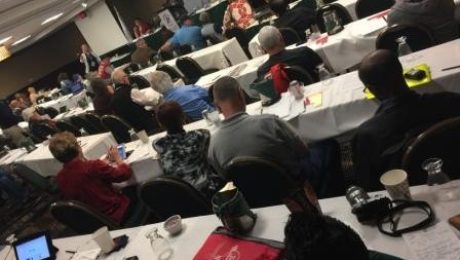
DALLAS, Texas- By all accounts, attendees to the 2017 National Senior Games Association (NSGA) Annual Conference found a wealth of useful information, spirited networking opportunities, and renewed energy at the gathering of Senior Games organizers and partners at the mid-country meetings held from January 25-28.
Conference sessions featured technical assistance related to games planning and operations, but also to health and wellness topics that serve NSGA’s core mission to promote active lifestyles to all people 50 and over. Presenters included vendors, NSGA staff and invited special guests. Highlights included:
- Kenneth Cooper, “father of aerobics,” gave an informative talk entitled “Medical Benefits of Exercise from Evidence-Based Research” that generated a standing ovation. Read about his visit here.
- Kyle Conway of Dallas-based The Sponsor Bureau gave tips and advice on sponsorship and marketing tailored to the scope of state games.
- Becca Jordre, associate professor at the University of South Dakota, shared data from her ongoing Senior Athlete Fitness Exam (SAFE) research program that has been conducted at all National Senior Games and selected state games since 2011.
- Andrew M. Walker, NSGA Health and Wellness Manager, spoke about NSGA’s partner collaborations and gave members ideas for enhancing their efforts by engaging like-minded partners in their states.
- NSGA staff and Birmingham representatives provided a comprehensive overview of sport venues and other updates for the 2017 National Senior Games presented by Humana that will take place June 2-15 in “The Magic City.”
- National Travel Systems (NTS), NSGA’s housing and travel partner, provided an update on hotel bookings and travel opportunities, reporting that the online reservations and travel options platform is operating smoothly for athletes registering for The Games in June.
- Representatives from Albuquerque provided an overview of planning that has begun for the city to host the 2019 Games. They also hosted a welcome reception “fiesta” that included a mariachi band to set the mood for what athletes can expect in “The Land of Enchantment.”
- Special breakout sessions were held for regional games coordinators to share ideas, and for smaller and larger size member games to hold discussions about common challenges and opportunities.
A new element of the conference was the Awards Gala dinner, which featured presentation of the first-ever male and female NSGA Athlete of the Year awards. Richard “Dick” Naslund of Oshkosh, Wisconsin, and Deb Smith of Portland, Maine were honored as the inaugural recipients. Read more about the event and the athletes here.
The Gala also featured the annual NSGA Media Awards, which recognize best practices by members to promote their Games. The 2017 winners, decided by voting of the attending members, were:
- Website- Nevada Senior Games
- Medals- Texas Senior Games
- T-Shirt- New Mexico Senior Olympics
- Sponsorship Package ($50,000 and over) – New Mexico Senior Olympics
- Sponsorship Package ($49,999 and under) – Rocky Mountain Senior Games (CO)
- Wellness Program- Huntsman World Senior Games (UT)
Finally, the conference concluded with the NSGA Annual Meeting of the Board of Directors, where membership heard reports about the organization’s activities, and board elections were held. Retiring board members Stephen Rodriguez (Florida, Board Chair), Monica Paul (Texas, Board Treasurer) and Jerry LeVasseur (Maine) were honored for their service, and the membership welcomed several new faces and renewed the terms of others. Board election results were:
- Renewed Terms- Kate Amack (Colorado- Coordinator, extended term), Steve Kearny (Colorado-At Large), John White (Wisconsin- At Large)
- Newly Elected Terms- Carla Carmichael (Washington, DC-At Large), Davis Cox (Massachusetts-At Large), Kate Fisken (Maryland-At Large), John Shinnock (Ohio-At Large), and J.D. Wood (Texas- Coordinator).
- New Officers Election- Kate Amack, Board Chair; Kyle Case, Vice Chair, Mark Schmitz, Treasurer.
“We are pleased to see our Annual Conference continue to grow and improve, and that attendees are giving us positive and helpful feedback,” NSGA CEO Marc T. Riker said. “We’ve listened closely to membership about what they want and need to take away from this annual opportunity, and it’s rewarding to hear that they are learning new things, gaining new ideas and are taking advantage of the opportunity to interact with each other on common interests. This will undoubtedly help all of our member games to improve the athlete experience and attract new participants to The Senior Games Movement.”
####
About NSGA
The National Senior Games Association (NSGA) is a nonprofit Multi-Sports Council member of the United States Olympic Committee that promotes health and wellness for adults 50 and over through education, fitness and sport. NSGA governs the biennial National Senior Games, the largest qualified multi-sport event in the world for seniors. NSGA is comprised of 53 Member Games across the country and in Canada who conduct multi-sport competitions which serve as qualifying events for the National Senior Games. The 2017 National Senior Games presented by Humana will be held in Birmingham, Alabama from June 2-15, 2017. For more information, please visit www.NSGA.com.
- Published in News and Events
“Bringing the Heat” – February 2017 Athlete of the Month

Ronnie Lakatos, 56, Ft. Lauderdale, Florida
Ronnie Lakatos has always promoted physical fitness, both as an individual and through a long career as a coach and parks and recreation manager in south Florida. Five years ago, with retirement approaching, she started talking up the idea of having a senior basketball team with her friend and center Mattie Lenhardt.
“Mattie and I had always wanted to form a team and do Senior Games when we got to be 50,” she recalls. “Mattie knew a lot of people in the Miami-south Dade area, and I recruited some of my recreation and coaching friends from Broward County.”
The result was The Broward Heat, a name that gives a nod to the NBA team they root for. Among the roster of team members with fitness careers are: Ida Montgomery, a youth sports basketball coordinator for Broward County Parks and Recreation; Diane Foli, a PE teacher; Jackie House, a special needs PE teacher; Lisa Ingram, a Broward County special education PE teacher and after-school care worker for Ft. Lauderdale Parks and Recreation, and Gale Peterson, an elementary school teacher who referees through the Miami Athletics Association. Team members enjoyed basketball in their youth, and some were college scholarship players, including Kim and, who is in Indiana University’s hall of fame.
“Our mindset was to compete again in a game that we grew up loving as young ladies,” Ronnie says. “I have been a manager all of my life, and that’s really my strength. I do all the things you have to do to keep the team going, from getting uniforms and bags donated, to organizing the team activities. Somebody’s got to do that.” She notes that the team has been able to grow due to a local sponsor, Tarpon Bend, that has supported them for five years.
The Broward Heat has made its mark, winning gold in annual Florida Senior Games play. After two appearances at National Senior Games, the team has bronze medals to show for their efforts in their competitive age division, and it has only increased their determination to take it all in 2017. “Because we’re spread out and busy, we don’t get to practice together as much as we’d like to. But we know each other, blend well, and know how to read each others’ game.”
Ronnie adds that their motivation goes beyond the competitive nature of the team. “Part of the reason was to keep us in shape, and to have quality of life physically and mentally,” she explains. “I think we help lift our opponents up and make it fun for everyone. It’s about fellowship and having a good time after the game is over.”
Another motivation is for the Broward Heat gym rats is to expand participation in their region, and get other women to return to the court. “Over the past two years, we’ve been picking up some players younger than us. As this team is aging up to the 55-59 group, I would like to be able to expand the program and have a second 50-54 team, and then grow to three teams as we grow older. We do it for the love of the sport, to bring basketball back to the senior community. Once people get back in it, they’re hooked.”
- Published in Athlete of the Month