

Considering Senior Games? “Don’t Wait Until You Feel Ready”
Are you looking for a new challenge or spark after 50? Do you want to make a change for your health or find community?
During National Senior Games Week sponsored by CareScout, we’re sharing the stories of two athletes – Mark and Stefanie – who found more than they ever imagined through Senior Games.
Their stories may inspire you to take the leap to find or return to a sport you love. It’s never too late!
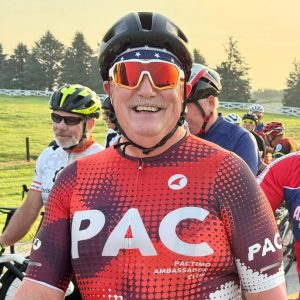
Image courtesy Mark Smith.
“I never dreamed retirement would be so fun.” – Mark Smith, Cycling
Mark Smith took up cycling again in his mid-50s after a 20-year break. He was struggling with his weight and type 2 diabetes, and the increase in physical activity improved both.
Retirement a few years later opened the door for Mark to double down on cycling and his health. The first year, he rode 10,000 miles; the following two years, 17,000 miles!
Another door opened when Mark saw a post about the Alabama Senior Olympics. He had missed the registration deadline, but committed himself to training for the next year. In 2024, Mike competed and qualified for the 2025 National Senior Games presented by Humana.
His eyes were locked on the new goal of competing at Nationals, and he increased his mileage even more. The work paid off – Mark earned 8th place in his age group for the 10K Time Trial.
“The health benefits of cycling have had a major impact in my life, but the wonderful people I have met along the way have been a true blessing. That family of people grew so much through both the Alabama Senior Olympics and the National Senior Games,” Mark shares.
“I love racing, but it is the friends I have made that will bring me back again. I never dreamed retirement would be so fun.”

Image courtesy Stefanie Batiste.
Don’t Wait Until You Feel “Ready” – Stefanie Batiste, Basketball
Like many young athletes, Stefanie Batiste dreamed of competing in the Olympics.
“…I imagined what it would feel like to represent something bigger than myself, to push my body to its limits, and to stand proud knowing I gave it everything I had,” she says. “I never imagined that at 60 years old, that dream would finally come true. Yet here I am, having competed in three Senior National Games, and my life has been forever changed.”
How did she get there?
Stefanie played a variety of sports growing up and competed in kickball nationally as an adult. In her mid-50s, she decided it was time to find a new sport. Or in this case, sports! Basketball and track & field were her picks.
She found a basketball team and competed in her first National Senior Games in 2022 in Fort Lauderdale, Florida. “That experience was unforgettable. Two weeks on the beach, surrounded by competition and camaraderie, reminded me why I loved sports so much,” Stefanie recalls.
Hungry for more, Stefanie formed a new team – the ATL Lady Hawks. She’s invested her heart, soul and financial resources in building the group, which now has teams in three age groups. Most recently, the ATL Lady Hawks overcame challenges and had a strong showing at the 2025 National Senior Games presented by Humana, finishing 1st, 4th and 6th.
For Stefanie, joining Senior Games changed her entire perspective.
“Competing again reminded me who I was at my core. It shifted my focus completely toward my health, my well-being, and living with intention. I train with purpose now. I eat better. I take care of my body. More importantly, I take care of my spirit.”
Her advice to others who are considering trying Senior Games?
“Just start. Don’t wait until you feel “ready.” Ready comes after you begin. You don’t have to be the fastest or strongest to belong if the desire is there; that’s enough. The bravest step is simply deciding to try. Once you do, confidence and strength will meet you along the way.”
Well said! Learn how to start your Senior Games journey at NSGA.com/start-here.
- Published in News and Events, Senior Games Blogs
Women of the Senior Games: Strong at Every Age
Breaking barriers is second nature for women who compete in Senior Games.
Many of them grew up before Title IX, with little to no opportunities to participate in sports as youth. Today, as older adults, they’re defying the narrative that they’re “too old” to compete in sports.
You’ll find them tearing up the community track, logging laps at the neighborhood pool and challenging themselves with new sports. They’re putting in the work to achieve their personal best.
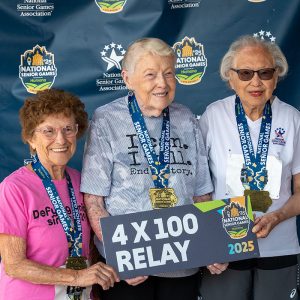
Photo by: Dave Fujii
In honor of National Girls & Women in Sports Day, we celebrate the incredible female athletes who participate in Senior Games.
They’re strong. They’re resilient. They’re committed.
They create a welcoming community for other women. They inspire us.
To these athletes: Thank you for showing the next generation of girls and women that sport belongs to them — at every age.
- Published in Senior Games Blogs
From “Misfit Farm Kid” to Super Senior Athlete
By Del Moon, NSGA Storyteller
Don Phillips, 94
Sioux Falls, South Dakota

Don racing at the 2023 National Senior Games presented by Humana.
Some people assume that most National Senior Games competitors are lifelong athletes. In reality, we estimate that over half of Senior Games athletes either returned to a sport or took up new ones in midlife, and some discover hidden abilities as they progress.
Don Phillips is inspiring because he is a humble, ordinary guy who, at age 56, decided to find new ways to stay active, leading him to the Senior Games. He began competing in national competitions in 1993 and has navigated twists and turns, including a string of medical issues from 2001 to 2011 that only allowed him to do the South Dakota Senior Games when he felt well.
Don persevered and had his breakthrough year in 2015 when he won his first gold medal at the National Senior Games — actually, SIX of them.
The past decade has been one of growth and success for Don. He added field events to his running repertoire of the 50-800m races. In 2023, Don won seven gold and one silver, and in 2024, he was listed as Top Ten in the world in six events by World Masters Athletics records.
Not resting on these laurels, Don decided to add Cornhole and Powerlifting to his competition schedule for the 2025 National Senior Games presented by Humana. Don’s workout routine now involves more whole body and weight training, so he’s curious to see what it’s like to compete as a super senior at 94.
In the edited conversation below, Don shares that he earned a degree at Iowa State University and is excited to return after 65 years to run on the track at Cyclone Sports Complex. Read on to learn about Don’s rural upbringing with limited athletic options, how he stayed active as a large animal veterinarian and when he realized he needed to be more active to stay healthy. We’re delighted he found Senior Games as his path to follow.
Don Phillips is living proof that anyone can improve their life by getting involved in an activity and sticking with it. This “misfit farm kid” has found his Personal Best journey and encourages you to find yours!
Don, let’s start where you are and work back to how you got here. You are a longtime competitor and a podium topper in the Senior Games and the world. In 2024, you earned six Top Ten rankings in World Masters Athletics records for men 90-94. For a guy who started later in life, you are posting some great results. Are you surprised you’re doing so well?
I am. Never in my wildest dreams did I think I would be doing this. I really feel blessed that I’ve been able to do it. I just grew up as a misfit farm kid and I look back and wonder, ‘How did I ever get this far?’ I still feel it, that was my start.

Don growing up in rural North Dakota. Image courtesy Don Phillips.
You are from the rural heartland. Are you a South Dakota native?
No, but close. I grew up in Forbes, North Dakota. It was right on the North Dakota side of the state line. At the last census I looked at, there’s 39 people there.
I graduated from high school in ‘48 and I didn’t have any idea what I wanted to do, but my mother wanted me to go to this teacher’s college. So I went there one year, and I didn’t want to go back. I wasn’t interested in anything at that time, so I taught country school for one year, and then I was drafted into the Army in 1951.

Image courtesy Don Phillips.
That was during the Korean War. How long were you in the service?
I served two years. I took infantry basic, and then I was fortunate when they pulled out a few of us to go to counterintelligence school in Fort Holabird in Baltimore. Then I was sent to Tokyo for 13 months in an office job.
I used the GI Bill to go to North Dakota State and got a bachelor’s degree in animal husbandry, and then I applied for veterinary school at Iowa State, and I graduated from Iowa State University in 1960.
IOWA STATE? Track & Field for the 2025 National Senior Games is there. Talk about full circle!
Yes, I’m excited the track and field is at Cyclone Stadium. I graduated from Iowa State 65 years ago, and to be able to compete in that stadium is going to be a little extra special.
Did you have any dreams of playing sports in college?
No, no, it never entered my mind to compete on the college level or much of anywhere else for that matter. My high school was small, and basketball was the only sport we had there. We did a lot of hunting back then, but I didn’t really do other sports for many years. I started golfing later on, but I was really tied down with my practice.
So, you became a veterinarian?
Yeah, I had a large animal veterinary practice for about 35 years in Colman, South Dakota, about 30 miles from Sioux Falls. When I came back from spending 13 months on a desk job I helped bale hay with a farmer and I couldn’t believe my physical condition was that bad. I decided I’m not going to spend my life at a desk anymore. For most of my working career I was on my feet and moving all day. I think that helped keep me healthy.

Image courtesy Don Phillips.
It’s great that you had that epiphany at a younger age, and that it helped you find a career that kept you fit. So when did Senior Games enter your life?
Here’s how it started. My neighbor came home from the doctor one day and I met him out in the yard. He told me he had to change his diet and get some exercise. Well, he was overweight, he was diabetic, his knees were bad. It was good advice, but it was way too late for him. And I thought, ‘You know, maybe a person should start doing that when they still can do it.’
So I started just going out walking every morning. Then I started jogging a little bit. And one day I jogged a mile without walking. I started running 5Ks and 10Ks when I could, and that fall I saw the results of the South Dakota Senior Games in the paper. I decided I’m going to enter that next year and I did. I’d never been to a track meet before that, so it was a learning experience. I’ve done the South Dakota state games most years since.
The next big step was the National Senior Games, which you started in Baton Rouge in 1993. But we see you disappeared in 2001 and returned in 2011. What happened in that lost decade?
I had some health issues. I had both knees scoped, then I had a bug with pneumonia and then had some shoulder and rotary cuff operations. It was like one thing would happen, and then another thing would happen, and then another thing would happen.
It’s like, I just can’t get into a rhythm, and I admit I just kind of lost motivation with those things going on. I was still doing some of the smaller games, but not like a regular thing.
What got your mojo to go back to Nationals?
I looked at my times in the State Games and at the National Games, and I decided maybe I can be competitive again at this age. So I started back again at 81, and I got a few medals in Houston and Cleveland. And then in 2015 in Minneapolis I was 85 and did all the running events from the 50 through the 800. I won six gold medals. Wow! Those are the first gold medals I ever got.
Congrats, Don! Are the medals a motivation to keep going?
Well, they help. You know, you like to win the medals, but after you get the medal, that part is kind of over with and the rest of it is a camaraderie and the stuff that really lasts. You meet some great people in these games.

Don competing in shot put at the National Senior Games in 2023. Image courtesy Don Phillips.
The next big chapter for you was adding field events to your running, and you have performed amazingly well for being a super senior “newbie.”
The first time I did field events was 2022 when I started in the 90 to 94 group. I think I was about 87 or 88 when I started working into those. I bought a discus, a shot put, a javelin and hammer to throw. The other guys gave me some tips and it’s worked out.
We saw that you have added even more events for 2025. You are signed up for Cornhole and Powerlifting. Most people half your age couldn’t do this much!
The National Veterans Golden Age Games were in Sioux Falls three years ago and they had a powerlifting demonstration, so I decided to give it a try. Structure wise, I’ve always been kind of scrawny, but most of my exercises are strength exercises now. I used to run a lot, but I don’t sprint like yesterday. I started doing push ups and chin ups and more full body exercises. I work with weights two to three times a week. I’m very curious to see how powerlifting is done in the 95 age group.
Don, you are sharp-minded and even-tempered. Do you think your physical activity helps with your emotional and mental stability?
Yes. They all fit together. One benefits and helps in the other areas of your life.
So what is your advice to others to live a successful life?
You just have to keep moving. Start an exercise program and stick with it. After a few years, I got to the point where doing exercise became a part of my lifestyle as much as eating and sleeping. And I think it’s just as important.

Don and Laverla. Image courtesy Don Phillips.
A good family life is important too, right?
Oh yes. Laverla and I celebrated 71 years of marriage last year, and we have three daughters – Diane, Linda, Lisa. Laverla has been very, very supportive and has been to most of the Senior Games with me until she had back surgery a few years ago. It’s difficult for her to travel but I know Diane will be in Des Moines.
Don, let’s end our chat with a softball question: if you weren’t doing all of this, do you think you’d still be as healthy now at your age?
I’m pretty sure I wouldn’t even be here. I really believe that!
We agree, and we’re happy you are with us on your journey. We will be celebrating with you when you get on the track at Iowa State!
Thank you.
- Published in Personal Best Featured Athletes, Senior Games Blogs
P is for Perseverance…and Patsy
By Del Moon, NSGA Storyteller
Patsy Lillehei, 81
Edina, Minnesota

Image courtesy Patsy Lillehei.
Life is full of unexpected twists and turns. Some people face more obstacles than others, and it’s easy to give in and leave dreams and goals on the shelf. Not Patsy Lillehei.
This might have been a lifetime athlete story as evidenced by her intense effort and passion for swimming and triathlons for more than a decade. However, there were no opportunities in sports for girls in the small Kansas town Patsy was born in. Even when the family moved to Edina in the Twin Cities area of Minnesota all she could get involved with in the pre-Title IX era was lifeguard lessons. The memory of enjoying the water stayed with her as she entered adulthood, got married and took on a highly demanding career as a financial advisor. Exercise was sporadic until after she retired.
The competition bug bit Patsy in a very personal way in 2008 when her daughter, who had been diagnosed with multiple sclerosis five years before, asked her to ride in a MS cycling fundraiser. That propelled Patsy to keep cycling and also pursue her love of swimming. She competed in her first triathlon the same year. She then discovered Senior Games and competed in her first national triathlon in 2011. She has since done many tris and joined U.S. Masters Swimming but says going to National Senior Games is her guiding star.
Patsy, who has a beaming smile and bubbly, outgoing personality, just seems to uplift others around her, and she was delighted to be one of two hometown athletes selected to carry the torch across the Mississippi River bridge in Minneapolis for the Flame Arrival Ceremony of the 2015 National Senior Games presented by Humana.
However, underneath all the positivity has been a series of challenges. Patsy has endured the heartbreak of seeing her daughter, a former college star pitcher, lose her physical ability to multiple sclerosis, and has devoted much time to her ongoing care. Then, in 2019 more heartbreak as her son was also diagnosed with MS. To date Patsy happily says he has been able to manage the disease and remain active.
As you will read in the following edited conversation, Patsy has also had medical challenges to overcome. In fact, NSGA had a story interview planned with her in 2021, but she called to cancel and apologized because she had suffered a heart attack that day! In our recent chat, she details what kept her from attending the last two National Senior Games, but she just keeps persisting and is now in good health and won medals, many gold, in three different 2024 qualifying games. There’s no athlete that will be more excited to be in Des Moines for the 2025 Games.
Patsy Lillehei is emblematic of many other senior athletes who never give up and find ways to persevere and keep moving. Her spirit is an inspiration to all of us to pursue our own Personal Best. We’re happy to finally complete her profile. Go Patsy!
Patsy, it’s a delight to chat with you again. Your name, speech and mannerisms suggest that you are a native Minnesotan with family roots in Northern Europe.
No, there’s no Scandinavian at all in me. I married into it! [Laugh] I actually was born in Junction City, a little town in Kansas. I went to grade school in Clay Center, Kansas, and then in junior high, we moved to Minnesota.
It’s clear you have fully embraced the culture. We see you always smiling and encouraging others, and you exemplify the ‘Minnesota Nice’ spirit the state is proud of.
Oh, thank you. I will tell you that my travels in life really have been dominated by my opportunities to play in the Senior Games. And as I’ve done it, I’ve seen such beauty where I’ve been, but I always come back to Minnesota and say, ‘We got them all beat.’
Were you active in sports in your youth?
Well of course not, there was nothing to do. I enjoyed physical activity, but it was before Title IX and there was no opportunity where I lived. I came from a class of 16 in Clay Center, Kansas, and moved to Edina, Minnesota, with 450 kids. When I was in eighth grade, we were all asked to swim at the high school and see who qualified to have an opportunity to be a lifeguard. I didn’t know that I had swimming skills at that stage but I loved it.
Did you have a sport or activity as an adult?
No, I was married at 20 and became a financial advisor for over 30 years. I worked for Morgan Stanley first and then retired from Wells Fargo. I succeeded in my profession. And I took a lot of tests, a lot of tests. There was no time for exercise in my mind. They called me the janitor because I opened up the office and I closed it up at night. [Laugh]

Patsy and her daughter, Birgit.
You tell people you got active when your daughter was diagnosed with multiple sclerosis. How did that happen?
It was 2003 when Birgit went to Mayo Clinic and had the true MS diagnosis at the age of 35. But she discovered it much earlier when she was a fast pitch pitcher at Augsburg College. She still has three records at Augsburg that nobody has broken. So, she knew there was something wrong when the ball was hitting her in the chest and she wasn’t catching it.
She was still the warrior and was doing the annual Duluth to Minneapolis MS charity 150-mile bike rides for as long as she could. Birgit is the reason why I’m in Senior Games because she got me started doing my fitness with her. It was five years later in 2008 that she asked me to do the ride because she realized she was going too slow to keep up with her friends. She didn’t really ask us. She said, ‘Mom and Dad, I signed you up.’ [Laugh]
You’ve been Birgit’s caregiver for 30 years?
I have. I am thankfully one of the core friends and family that she allows in her care circle. And I wished she would let me do more, but, you know, she is an independent person. She says stuff like, ‘Mom, I can lift that wheelchair, you shouldn’t do that. You’re over 80.’
Incredibly, your other child has MS too.
Yes, our son Brooks was diagnosed with MS in 2018. He has a different severity of MS than Birgit. His symptoms are referred to as “invisible.” For example, one of the symptoms is numbness and tingling in his legs. He is selective about sharing his MS story and passionate about helping others afflicted with MS to live their best life.
I don’t know what Brooks’ journey is going to be like, but he’s not in a chair. He is ambulatory and getting around well. He is actually coaching downhill skiing at a private school here in the city. He did not give up one ounce when he got diagnosed. Since then, he and his wife have traversed the Grand Canyon Rim to River three times. Last October, he ran the Twin Cities Marathon then, two weeks later, ran Surf the Murph 50K. He’s over 55 now and never did those kinds of foot-powered adventures before. He’s just going to keep going!
That shows that he’s got the same resolve that you have and he’s not going to give up.
Yes, I’m proud of them. But it’s an emotional thing to see both of your kids get diagnosed with something like this.
The silver lining, if you want to call it that, is that you found a path for your own health and well-being. How did doing a charity bike ride turn into being a competitive swimmer and triathlete in Senior Games?
I have been doing the Lake Nokomis Triathlon every year starting in 2008. I hadn’t known there was such a thing as Senior Games. In 2010 it was announced that Minnesota was going to be the host for the 2015 National Senior Games. I immediately wanted to know, how can I do it? I learned it was every two years and I had to qualify every time. I went to Houston, Texas, for my first triathlon at Nationals in 2011. I did not do swimming events because I missed the qualifying.
You did both swimming and tri in 2013 in Cleveland. You stayed longer and experienced more of the event. What was your impression?
Well, that’s when I first saw all these other wonderful people that I’ve been able to reunite with from year to year. That was the biggest thing.

Patsy running with the torch at the 2015 National Senior Games presented by Humana. Photo courtesy Patsy Lillehei.
Then, you got a surprise when the 2015 National Senior Games presented by Humana came to your backyard. Because of your positive spirit you were selected to run the torch across the Mississippi River bridge to the cauldron for the Opening Ceremony.
It was cool and I felt very proud. I’d have to say it was a highlight of my life.
The Senior Games are a beacon for me. Small steps in the right direction are turning out to be the biggest steps toward a healthy life for me.
Perfect tie in to running the torch! So you returned for 2017 and 2019. For the next Games you were registered but did not make it to Fort Lauderdale. What happened?
What happened was I was ready to go. My suitcase was packed. But I got COVID. I was depressed for a little while after that.
Many athletes know that frustration of training hard and then not being able to compete. You were also registered but missed The Games in Pittsburgh in 2023. What happened then?
I actually got COVID again just before it was time to go. It was clearing up, but I was still not confident of being among a lot of people.
Wow, bad timing, but you keep on smiling. Thanks for your consideration of others, Patsy. We’re glad to see you are ‘all systems go’ to compete in Des Moines in July. But we know you’ve had more to overcome in the last three years.
Yes, I know because I actually had a story interview scheduled with you but I had a heart attack that same day. April 21, 2021. While I was swimming I didn’t feel good. I had felt weak for like three days. It turns out I had a 98% blockage in flow. They call it the widow maker. They put in two stents, and it took me a long time to understand what I can and I can’t do.
I didn’t really have a mentor that could help me and the people at the hospital where I did the physical therapy never, ever approved me to swim. I thought, this is so silly because they had me working hard on elliptical machines and treadmills and running. And I thought, ‘I don’t get this tired swimming.’ I finally just decided swimming is meditative for me. I had to start swimming again. Sometimes I even fall asleep when I’m swimming. [Laugh] So I went against their orders and started swimming.
Let me explain that doctors do their best, but they don’t always get it exactly right. And so, you know, what a lot of people miss is that you have to kind of be your own doctor and listen to your own body. Right?

Patsy, far right, and her relay teammates at the Minnesota Senior Games.
Almost hate to ask if anything else has jumped in your way since then.
Well, a lens in my eye from a failed cataract surgery came loose and I couldn’t focus. So I could not wear glasses and couldn’t travel at night when I wanted to go to the pool. Seven months later, another retinal specialist took out the lens that was floating in my eye and sewed in a new lens.
Did it help?
Well, when I went to church and looked at the minister standing in the pulpit, I saw two ministers and two baptismal fonts and eight people at the baptismal font. [Laugh]
This was 2022. It took two years for the doctor to finally say, ‘Okay, I think you’ve got enough good going for you. Let’s get you some glasses.’
So, you know, at any point, you know, any one of these setbacks could have turned you away but you never gave up. What drives you?
First of all, I love it. I enjoy it. I feel good when I’m swimming, and I meet so many wonderful people that are like-minded individuals who are striving to do their best individually. I call them the kindred spirits that actually make you feel you’re in the right place right now. I always feel like I’m good enough when I’m around them.
And then another reason it’s really, really important to me is that I have to stay healthy. I want to be healthy for my daughter.
You’ve made a nice comeback and Des Moines is finally in your sights. You crushed every swimming event at your qualifying games in Iowa and Minnesota last year. You must be excited.
I just feel good about myself. I also did the masters national open water swim in Lake Stillwater, Minnesota. You were supposed to do the mile swim in an hour to do this nationally. It took me one hour and one minute. [Laugh] They were kind and gave me a third place medal. But it was beautiful, I did a one-mile open water swim this year. Wow!

Patsy and her former trainer, Kym Zest, at a YMCA triathlon in 2024. Photo courtesy Patsy Lillehei.
Your main love is swimming, are you still going to do the triathlon?
I am certainly going to do the triathlon. Since 2008 I’ve never missed the triathlons at Lake Nokomis hosted by Lifetime or my Southdale YMCA in Edina.
Minnesota gets a lot of U.S. Masters swimming events and they help keep me going too. I do my five individual events, and then I do relays and medleys with my group called the Relaykers. We have four of us now over 80 and we have set record after record for Minnesota. Our 75+ mixed group of Relaykers swam at the 2024 Masters Spring Nationals in Indiana and accomplished second for Minnesota with our medley race.
You are obviously a strong competitor who wants to win, but clearly that is not what really motivates you the most.
I’m just going to give you a huge yes. I always say that my expectations are higher than my realizations, but I have really high expectations. So that keeps me going – it’s the carrot that keeps hanging in front of me.
And I’ll tell you, it became different for me when I turned 80. It was like a door opened and there was a light that said, ‘I’m over 80 and I can still do this.’ And I think – no, I know – that it’s inspiring for others.
I was inspired to swim with Charlotte Sanddal in Albuquerque. She was like 95 and still swam until she was 100. I want to just be there at 100 years old and inspire all others who love to swim.
Thanks and good luck, Patsy. Glad we are finally telling your story!
- Published in Personal Best Featured Athletes, Senior Games Blogs
Digging Out
By Del Moon, NSGA Storyteller
Monique Wilson, 61
Redondo Beach, California

Photo courtesy Monique Wilson.
Any parent will tell you that losing a child is one of the most difficult tragedies to overcome. Finding a pathway to return to everyday life is complex and can bring depression and other health issues.
Monique Wilson’s family was devastated when her son Erik died suddenly at age 29 after he took what he thought was medicine, but it was laced with fentanyl. The schoolteacher took the rest of the school year off and ultimately retired to allow herself to heal. However, Monique still lacked a direction to help her move forward.
A phone call from an old friend she had played volleyball with provided a ray of light, and that has led to a revived passion for volleyball and eventually to the 2023 National Senior Games presented by Humana. People might think going to play games would not be more than a distraction from grief. But, Monique found purpose and a team of women who supported and helped her get back on the court as a senior athlete and start enjoying life again.
In the following poignant edited interview, Monique shares her journey through a nightmare and how participating in sports has carried her to a new perspective and a forward-facing outlook. As expected, she says things will never be the same, but the tragedy no longer keeps her from living her best life.
As we talked, it was clear that it was very difficult for Monique to share details of her experience. She agreed to the interview because she had herself sought out stories of other mothers who lost a child on the Internet. These stories showed her that her feelings and emotions were normal, and now she wants her story told with the hope that it will help someone else in a similar situation.
Overcoming the challenges and obstacles everyone faces with a positive outlook and by pursuing a healthy and active lifestyle is a huge characteristic of living your Personal Best. Senior Games often provide a way for people to remake or improve their quality and duration of life, and we’re grateful that Monique Wilson has found a caring family and a meaningful activity with new friends.
Monique, thanks for agreeing to share your story with us. Let’s get some background. Were you always athletic and was volleyball your main sport?
Yes, my parents were more into the arts, but I was the only one out of seven kids that went into sports and athletics.
I did play volleyball. I’m tall, so when I was young, probably around the eighth grade, there were some PE teachers and coaches at the high school that saw the tall girl always playing sports on the playground, and they started recruiting me. They could see that I was athletic as well as tall, and I do have a competitive spirit. Straight out of Central Casting. [Laugh]
Did you play in college?
I did go to college, and I was offered to play but chose not to. I wanted to just get into the college scene, so that’s probably not a very good quote, but I played intramural volleyball and other sports.
I met my husband, Brad, when I was 17. I was a senior in high school. He was two years out at 19. He was an athlete, too, and played football, baseball and volleyball. He doesn’t play Senior Games, however. He has some knee and shoulder issues that prevents him from playing some sports, but he does kickboxing almost every day.
How many children did you have, and did you promote sports to them?
I had two children. We introduced both our kids to all the sports when they were young, and then they picked a few as they got older.
My daughter, Danielle, played sports through high school and college. She played volleyball and softball. She’s currently 37. My son Erik played football, baseball and golf. His goal was to letter in as many sports as he could. He ended up playing football for the University of Washington.
Erik played for Coach Steve Sarkisian. He was on the team for four years, most of the time as the quarterback for the scout team.

Right to left: Monique, Erik (son), Brad (husband), Danielle (daughter), Colton (son-in-law). Photo courtesy Monique Wilson.
That’s a big job because you have to mimic the opponent’s quarterback each week, and you also get beat up.
Oh, yeah. The defense is going hard, so there was no letting up. He did suffer some concussions. He also suffered a knee injury and had a back issue. But he loved it. [Pause] It rocked our world when he passed away at only 29.
That’s tragic, Monique. We are so sorry for your loss. What happened, if you don’t mind sharing?
It was traumatic. He had just broken up with a girlfriend and moved home. Because of COVID, he had nowhere else to go.
He had just got a new job and was preparing to start the following week. And then Monday morning, we found him in his room. He had taken half a pill that looked like Xanax, but unfortunately, was laced with fentanyl. It was determined that he died immediately after taking it.
That is horrific. So many people have suffered because of that drug. Of course you were devastated to lose your son.
Our whole family spiraled into this tailspin of overwhelming grief. My daughter and son were very, very close. In fact, she and her husband were with him the night before he died. It definitely rocked our world, and we experienced all the grieving you would expect. We couldn’t eat, we couldn’t sleep and we gave up on exercise.

Monique with her 2019-2020 class. Photo courtesy Monique Wilson.
How did you finally start to feel coming out of it?
Well, we still grieve. After the funeral, I thought I’d go back to teaching to get my mind off of things. He died in April, so I took the rest of the school year off. I went back in August, and then my mother passed away a month into the new school year. She was 94 years old and ailing so it was expected, but still, this made things more difficult.
I spiraled again, and one day, I collapsed. I always had low blood pressure and a low heart rate, but it got dangerously low, because I wasn’t eating or exercising properly. I wasn’t living my normal life like before. I ended up in the hospital. My blood pressure and my heart rate dropped so drastically low that I now have to take medication to keep everything working properly. Now they’re saying I need to get a pacemaker.
That had to be your lowest point. How did you pull out of it?
It started with the kindness of my workmates. I was a schoolteacher and taught mostly fourth grade for my entire career. After I had collapsed, the teachers at work were generous and donated their sick days to get me through the rest of the year, so I could continue to heal. I ended up retiring because they happened to be offering a golden handshake at that same time. At this point, I was still kind of moping around, not really getting back to my old self.
Now, that was when Senior Games changed your trajectory, right?
Yes. A girlfriend who I used to play volleyball with called me and told me she is playing in an open gym league down in Orange County. She said, ‘I think you should play- it would be really fun.’ I was so reluctant and didn’t want to go down there. But then my husband said, ‘No, you need to go. You need to go.’ So I went down there and I ended up playing horribly. They played five games that day, and I could barely get through three. I was out of breath; my knee and lower back were hurting. I literally had to step off the court.
But it was definitely an eye-opening experience. I woke up the next morning thinking, ‘What the heck has happened to me? I need to start working out again.’ I began lifting weights and getting out to walk again. I was so sore, but just started to build from there.
My girlfriend got into pickleball and quit volleyball, so I thought I wasn’t going to be able to play in Orange County anymore. I didn’t really know any of these girls, but my husband encouraged me again, saying, “Just go by yourself. Who cares?’ So, one morning, I got dressed and went down there, and it opened up a whole new world. These ladies were just so nice. They didn’t know my story but were so encouraging and wanted me to come back and play.
Then, one of them called me and asked me to play on her Senior Games team. I had no idea this even existed. but it looked like something I might want to do, so I went to a tournament in Sonoma. I didn’t play great, but we did win the gold.
From there, I started lifting more weights, walking more and doing jump squats, and I got myself back in shape. We started playing more tournaments together. And now we play almost every month.

Monique and her teammates at the 2023 National Senior Games presented by Humana. Photo courtesy Monique Wilson.
You played in your first National Senior Games in Pittsburgh in 2023, less than three years after the tragedy. How surprised are you that going out and playing a game is what was going to heal you?
100% surprised. And the healing is not over, I will always grieve for Erik. When I went to my first games in Sonoma, I needed my own hotel room because I literally went to my room every night and cried because it was the first time away from my family.
But my gosh, these girls helped me. They are amazing. It’s great to be involved in a team sport because the camaraderie on and off the court and the relationships are unbelievable. That’s what saved my life. When you play on a team, you get close fast when you’re staying in the same place. Soon everyone learned my story and these women have all been incredibly supportive.
Now, if I hit a ball and get a kill someone will shout, ‘There’s an Erik Wilson hit!’
What would you tell someone else who’s reading this and going through a similar kind of tragic situation?
When I was going through the worst of my grief, I would search and read other people’s stories online. Before I knew it, my feed was filled with these kinds of stories.
It made me feel like I wasn’t alone. And it gave me some inspiration to wake up and keep moving every day. I hope that people will read my story and know that they aren’t alone, too.
I’ve learned that you have to give yourself grace. I am not always going to have upbeat, perfect days. I still have periods of time to this day where these waves of grief take over, and I just cry. Reading other people’s stories taught me that it is completely normal.
Well, now you have something to look forward to, and you’ve got volleyball sisters who are helping you through a new journey. You’re going to be doing this for a long time, right?
Yes, that’s the goal. As long as I can stay in shape. It’s funny because when I went to my first tournament, I looked around the room and thought wow, there’s a bunch of old people. [Laugh] And I’m one of them. Then I quickly saw that these ladies are amazing athletes. It’s eye-opening to see the 80-year-old teams play.
Once, when I came home from a tournament, I told my husband, ‘Don’t let the gray hair fool you.’ Because these ladies are great athletes. I want to keep on playing until I can’t, that’s literally my goal now. I want to be that 80-plus person still playing and moving on the court.
Monique, we know this has been difficult to recount, but you know how much sharing your story may help somebody else, and we are proud to have you in our family.
Well, thanks for that. Like I said, other stories have inspired me, so it’s important to share mine.
- Published in 2024 PB, Personal Best Featured Athletes, Senior Games Blogs
A Cycling Champion Spins Off a Family Legacy
By Del Moon, NSGA Storyteller
Luigi Fabbri, 89
Eva Fabbri, 82
Lake Worth, Florida
Gabriella Fabbri, 60
Riviera Beach, Florida

The Fabbri family at the 2023 National Senior Games presented by Humana. Right to left: Luigi Fabbri, Eva Fabbri, Gabriella Fabbri and Phillippe Mailleaux. Photo courtesy Gabriella Fabbri.
Those who know Italian-born Luigi Fabbri will agree that cycling is at the heart of his being. He has been competing and raking in medals and championships internationally for 45 years, and he is still hungry for more at 89 years young.
Luigi also has a greater passion – his family. The evidence is that he took a two-decade pause midway in his racing career to work and support his family, but the wheels were always spinning in his head. Cycling is also rooted in the family with Luigi’s wife, Eva, racing on velodrome tracks in many countries and having a Pan American Games championship in her accomplishments.
Luigi was grateful to find Senior Games when he brought the family to Florida from Uruguay, and he has been a fixture at the Florida Senior Games qualifiers and at National Senior Games since 1997. Luigi was honored with a Florida Senior Games Lifetime Achievement Award in 2021 for his state participation. Other athletes delight in just listening to his thick accent and dry wit.
Now, a new Fabbri generation is rising as their daughter, Gabriella, took up Luigi’s suggestion and pedaled her first competitive 5K and 10K time trials at the 2022 National Senior Games presented by Humana in Fort Lauderdale. Then, she added the 20K road race for her second Nationals in Pittsburgh last year.
As you will discover in the following Personal Best conversation with the three Fabbris, Gabriella caught the fever from dad and “recruited” her husband, Belgian-born Phillippe Mailleaux, to also enter the field in 2023. Gabriella’s twin brother, Renzo, and sister, Anissa, have also raced, and the elders are proud to see their granddaughter, Anyssa, hop in the saddle to ride with the wind hoping to be the next Fabbri champion.
Our chat reveals Luigi’s colorful history as he recalls how his family escaped from Italy to avoid political persecution and ended up in Uruguay, where Luigi met Eva and started his cycling adventures. Then we learn about the Fabbri’s transition to America, where Luigi continued his work as a craftsman restoring vintage furniture in a workshop he built. He only recently retired but maintains a regimen of riding 20 miles at Okeeheelee Park in West Palm Beach almost every day.
Luigi now enjoys the health benefits from his fitness, sharing with us publicly for the first time that he has battled and contained Parkinson’s disease in recent years and that he feels good about continuing as he approaches 90. He often hears he is an inspiration, but the fire to compete has not subsided and he is excited to have a lane where he can still ride and compete with his peers. His passion is tempered with caution as when he encourages others to safely train and compete in cycling. While he has had many falls, he has yet to break a bone and does his best to advise others on safe racing.
He wasn’t thinking about it all along, but when Luigi clipped onto a bike in 1952 he set a legacy in motion that will continue through generations. We’re glad to have the Fabbri family among our ranks to show how much a Personal Best attitude can positively influence others. For that, Luigi deserves our whole-hearted “Grazie!”
Luigi, it’s great to speak with you and your family. You’ve been cycling in the Florida Senior Games for nearly 30 years since you moved here. How long have you been competing?
I have been cycling for a long time! I had to take a break to work and support my family during my life, but I have 45 years as a competitor.
You have been all over the world, and you are an Italian native who came to us through Uruguay. Tell us how you got here!
I was born in Rome during the war time. The only thing that was interesting when I was about 8 years old was the radio. And the radio was transmitting bicycle races. I liked the way they transmitted. They gave me a lot of…I don’t know how to explain, but…the radio made an impression on me and I got interested in racing.
My father was a political man. He fought against Mussolini, and they wanted to kill him. We had to flee Italy and went to France. In France he had the same problem, so we went to Argentina. He still had some problems, so we moved to Uruguay where we felt safe. I was in Uruguay for 20 years.
I used to work for a decorator as a craftsman. I did a lot of antique restoration. At one time my father was a restorer in the Museum of the Vatican. Sometimes we restored, and many times we made a copy. They would say, ‘Look, Luigi, I need a cabinet this size for a Louis XIV room.’ So…we make the cabinet.
But I didn’t want to work with my father and looked for other things to do. I bought a camera – a Leica, very good camera – and I worked as a photographer.

Snapshots from Luigi’s early racing days. Photos courtesy Fabbri family.
Did you start racing while you were working?
I raced for about 20 years when I was younger and I did well. Then I stopped because there was no money in the races, and I needed money because I was married, I had kids. Then I had a big crash and I gave up.
That brings in your wife Eva, who has a cycling history herself. Eva, how did you two meet?
Luigi used to live close to my older sister’s house. It was my 15th birthday, and you know the Spanish people celebrate with a quinceañera for girls. I have Italian ancestry but was born in Uruguay.
So I needed a photographer, and my sister talked to him because he was a photographer at the time. So he took my pictures. The rest is history.
Eva, you did some racing back then. Luigi must have inspired you.
EVA:
Well, it really wasn’t Luigi telling me to do it. I went to Italy with him to visit one of his teammates from Uruguay who lived on a mountain. His wife and I went all the way down to the town and back – she was impressed that I didn’t use a cane, and I didn’t stop to sit. So, she told me, ‘You have to race.’ I said, ‘I’m too old, I never raced in my life.’ But I tried and I like to ride the bike. I competed in Italy, in Ecuador, and I competed in Argentina in the velodrome. I like velodrome a lot.
LUIGI:
She won a Pan American championship while we were in Ecuador.
EVA:
Luigi was a world champion, a world record holder. He was a nominee to compete for Uruguay in the 1964 Olympics in Rome. But then the Uruguay federation didn’t have enough money to send cyclists.

Eva and Luigi on the medal stand over the years. Photos courtesy Fabbri family.
Wow, Luigi, it must have been tough to have to quit to support your family. But then you moved to Florida and started all over again. How did you get back on the bike?
LUIGI:
When I reached 50, I decided to do some exercise. And I was looking for a place and a group of cyclists to practice with, because it’s very dangerous to practice on the streets in Florida.
I found a velodrome near us to practice with others. I started beating people 20 years younger. I was impressed by what I was able to do and decided to race again. I rode on an old bike. I disassembled it and reassembled it the way I was thinking to make it my own track bike. And in a year or so, I was one of the fastest sprinters. I competed in the Pan American Games and won a sprint. And from that, I started racing all over the world again. I raced in England, Portugal, Italy and other places.
And you have been a fixture in National Senior Games since 1997. Eva has joined you for several Games, and in 2023 we saw a new Fabbri generation hop on. Gabriella, your parents say you didn’t start sooner because you are a workaholic.

Gabriella gets a hand with cycling training from her dad, Luigi. Photo courtesy Gabriella Fabbri.
GABRIELLA:
Yeah, unfortunately I am, but you know what? I inherited that. Both of my parents are workaholics. [Laugh]
Dad encouraged me and bought me a bike for my birthday. At the beginning, he trained me, and that’s when I did my best. It was like a bonding moment for us. Then he stopped training me because my schedule as a flight attendant was so messed up. I did much better when he trained me than when I was on my own.
I didn’t have any expectations, and it wasn’t something that I thought of doing. But once I started I enjoyed it. And I’m like, ‘I should have done this a long time ago.’
LUIGI:
I feel proud of her because she works a lot and has little time to practice. I don’t care if she wins or she becomes the last one in. As long as she doesn’t expect more than what she can do.
EVA:
I love that she’s doing it because it’s not only going to help with her health, but she’s also following in her father’s steps.
We’re always happy to see generations get involved in Senior Games. Gabriella, you competed in your first time trials in 2022, and there’s more to the story because your husband Phillippe also competed in cycling in 2023. How did he get involved?
GABRIELLA:
Well, I just went out and bought him a bike, and he had no choice. [Laugh]
At first, he’s like, ‘I’m not doing this.’ And I’m like, ‘But you’ll like it. I used to say the same thing.’ Now he trains more than I do, actually. I don’t have the time now to get into the road racing much. I like the time trials.
EVA:
Me too. I always race in time trial because I don’t have a lot of road experience. And I’m afraid to be in a group and make somebody fall. So, I always race just by myself.
Cycling road races do have more risk than time trials. It’s best to know your lane and be careful. I’m sure Luigi has had some spills in his racing career.
LUIGI:
Cycling is a dangerous sport. You have to prepare well. I have crashed over 40 times, but I have not broken any bones! I’m very careful. I like to race in front, between the first 10 people. Usually, it’s more safe.
Have any of your other children raced bikes?
EVA:
Yes. When we first came to the U.S. in 1974, we lived in Massachusetts, and Gabriella’s twin brother, Renzo, and our daughter, Anissa, entered a race and we watched them win. So everybody in the family is on the bike except Adriana. Adriana is not a sport person but supports us.
In Pittsburgh we had the whole family including grandchildren come to celebrate. It was beautiful, beautiful. Our granddaughter, Anyssa, was there and she is racing now, so we have four generations of cyclists. For me, the family is number one. And anything that we can do with the family, for me, is very enjoyable.
Obviously, cycling is a huge part of Luigi’s identity, but he had to set it aside for 20 years to support his family, which must have been hard. We can assume that family is even more important than cycling to Luigi.
GABRIELLA:
Well, maybe! [Laugh]
So Luigi, you are 89 as we speak and you don’t seem to be slowing down. You still ride 20 miles every day. There’s no doubt this keeps you in good shape. Besides your obvious love for the sport, is that why you do this now?

Luigi Fabbri cycling in the 20K Road Race at the 2023 National Senior Games presented by Humana.
LUIGI:
Yes, that’s why. There is one reason nobody knows, but I’m going to tell you. I found out I have Parkinson’s six years ago. The doctor told me to do some exercise, because it’s good to keep the Parkinson’s away. I started practicing harder. I don’t trust just the medicine. But by practicing hard I don’t feel to be worse now. On the contrary, I feel better.
EVA:
I’ve been telling him he had Parkinson’s for like 12 years. But he’s very stubborn and would not accept it. It took him some time to realize that there was something in there, but he’s keeping it under control through his intense exercise.
I worked many years with people with Parkinson’s and Alzheimer’s, so I have an idea how this disease progresses. He really hasn’t progressed that much, which is good.
LUIGI:
I feel strong, and I still race to win. I understand that with some people it’s not important to win. You don’t have to be there to try to win the medals. I like to win, but I’m also competing against myself and against my best time.
How do you feel about being a role model to these other athletes? They love you!
LUIGI:
I feel it’s something I have to keep doing because everybody tells me, ‘Luigi, you are my inspiration.’ So many people are looking at me. But I do this for myself first, not for other people. I don’t care about anybody else around me. I’m doing what I’m doing. I’m staying healthy.
You have to do it for yourself, because it’s not easy. And that’s what I try to tell people.
- Published in 2024 PB, Personal Best Featured Athletes, Senior Games Blogs