

Be Your Personal Best…FOR LIFE!
There’s another definition of “personal best” that anyone can achieve. It’s not about a peak time or distance in sports; it’s about overcoming obstacles, staying motivated throughout your life and inspiring others by your example. This results in greater longevity and a healthy, active lifestyle – and that is your Personal Best!
Click Here to learn more about the purpose of the Personal Best health and wellness initiative.
Use the search box to find athletes by name or year of feature.
This Running Couple is Still Going Steady
By Del Moon, NSGA Storyteller
Tim Vigil, 61
Rita Vigil, 58
Santa Fe, New Mexico
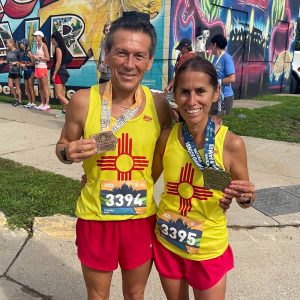
Tim and Rita Vigil pose with their medals after the 5K Road Race at the 2025 National Senior Games presented by Humana.
Tim and Rita Vigil love running almost as much as they love each other. They are living proof that you enjoy your best quality of life by doing all the right things, and they are still doing it together in their 35th year of marriage.
The prescription is deceptively simple: eat right, exercise regularly, have faith and maintain a positive outlook on life. It has served the couple well, as they have had few health issues and rebounded well from injuries in their running life.
Tim grew up in Colorado and became involved with track and cross-country in middle school. Rita, a New Mexico native, was prodded by her brother to start in high school. They met at Adams State College in Alamosa, Colorado, when both were on the cross-country team, and their friendship grew into a budding relationship. They married after college and continued running road races and marathons while pursuing careers and raising a family. Rita was a first-grade teacher and Tim became a district retail manager.
After the couple moved to Santa Fe, Rita’s brother once again urged them to compete in the New Mexico Senior Olympics in 2018. The couple made an immediate impact, racking up state medals with their performances in road races and mid-distance track events, often capturing gold and rarely missing a podium.
While they were overwhelmed with the magnitude of the 2019 National Senior Games presented by Humana held in Albuquerque, they were ready for the big stage. Since 2019, Tim has earned three gold, four silver and one bronze finish in national competition. Rita has done even better with four gold, four silver and five bronze finishes, and seems to be trending upward. At the 2025 Games in Des Moines, she streaked to first-place results in the 5K, 10K and 1500-meter races in the hotly-contested women’s 55-59 division.
Clearly, both are rising elite senior athletes bringing recognition back to New Mexico, and the couple was selected as the state’s flag bearers for the 2025 Parade of Athletes. As they tell us in the following edited conversation, Tim and Rita believe they were also chosen for their healthy outlook and the encouragement they give to their racing peers. That’s also why we selected them to be profiled, because they exemplify what pursuing your Personal Best life is all about!
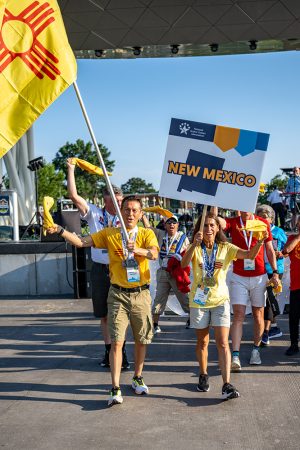
Tim and Rita Vigil proudly lead the New Mexico delegation during the Parade of Athletes at the National Senior Games in Des Moines, Iowa.
Tim and Rita, one thing that attracted our attention was your selection as New Mexico’s Flag Bearers for the 2025 Parade of Athletes in Des Moines. Why do you think you were chosen for the honor?
TIM:
When we came onto the senior scene in New Mexico, we recognized there are some really solid runners, but I don’t know that they had as many top finishes as we had, and we did it year after year in the state games and at the national games.
Overall though, I think they really felt like we exemplified New Mexico and the commitment to healthy aging. I’m 61 now and still running competitively, even against the younger guys. I mean, the top three finishers in my last 5K were 60-year-olds.
RITA:
It’s definitely an honor. I am glad to be involved with the Games, and I think we represent New Mexico very well, not just as athletes, but also helping and encouraging other senior competitors. Ceci Acosta, the New Mexico Senior Olympics director, can always count on us. It’s always an honor to represent New Mexico not only here but also at the National Senior Games. We love being involved and are always glad to help in any way we can.
Like Tim mentioned, there’s been a lot of different competitors throughout the years, but as far as I know, I don’t think there’s been that many New Mexican senior athletes that have placed as high in the road or track races as we have at nationals.
What was your impression of the National Senior Games and competing against the best people in your age group?
TIM:
Our first one was in Albuquerque in 2019, and it was absolutely fantastic. It was like being in a true championship with elite competition. I ran nationals in college and this was even beyond that. I was amazed, and honestly, super nervous because this was my first national competition since college. It was like I was a freshman in high school.
RITA:
We had not run track events since our college years, so I was kind of nervous and excited at the same time, too. It was a wonderful feeling to be back on the track and competing at the national level with some very competitive athletes. I prefer the road races, and that’s where I see myself placing in the top three, but I have started to really enjoy the track races. You have to compete against the best and that’s what we are up against every time we go to Nationals. There are some very talented senior athletes in every age group. I’ll be in the 60-64 age bracket at the next National Senior Games, and there are some tough competitors in that age group!
Everyone tells us you two were made for each other. How did you meet?
RITA:
We met at Adams State College in Alamosa, Colorado. Tim and I were part of the cross-country team there. I would see him on campus, sometimes in the computer lab, but mostly at practice. I was friends with his cousin, who was my roommate at the time. Tim invited us over just to have lunch at his little dorm apartment, and we became really good friends. After a few months, we started having feelings for one another and dated for three and a half years. We got engaged and then married right after I graduated from college. I married my best friend and love of my life, a match made in Heaven.
TIM:
Well, I was pretty introverted and started to break out of that shell in college. I wasn’t really looking for a relationship. But as we became friends, we started hanging out a lot more. I loved her big, beautiful smile – everybody compliments her on her smile. They compliment me on her smile. [Laugh] We really had a connection, and it just grew, and all of a sudden it was just like a rose blooming.
RITA:
We had a daughter a year after we got married, and we also had a son a few years later. I was a stay-at-home mom for 10 years. When my son was four, he was able to get into preschool, and that’s when I started my teaching career.
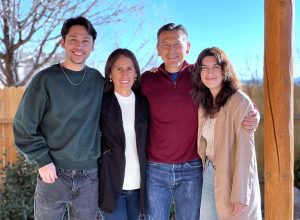
Vigil family photo. Courtesy Tim & Rita Vigil.
Did you always want to be a schoolteacher?
No, to be honest. My degree is in psychology with a minor in athletic coaching. It wasn’t until I was 32 that I decided to get my teaching certification. My kids were my priority. When they were old enough to attend school, that was when I started teaching. They attended the same school as where I taught, this was convenient and I loved that I could see them during the day.
I teach first grade and have also taught second grade. It makes me very happy when I see my students excited about learning, plus they keep me feeling young. I just like to see those ‘Aha moments’ when they get a certain concept or learn a new strategy. I tell them that they can do hard things when they work hard and not give up.
So you grew to love teaching and went back for your master’s degree. When was that?
In 2021. I decided I wanted to get my master’s degree so I can continue to improve as a teacher so I can better serve my students. I also wanted to move up to being a Level 3 teacher, which means a higher salary. I graduated this past May from New Mexico Tech with a Master of Science for Teachers degree. I am very proud of that!
Congratulations! Tim, where did your career run after college?
TIM:
My degree was going to be in math and computer sciences, and I had two classes left, but I had started working in convenience stores part-time to pay for college and to save money because we didn’t want to take out any loans to pay for our own wedding.
Right after our wedding, I got promoted to store manager for the Loaf n’ Jug convenience store chain, and we moved to Pueblo, Colorado. I was a district manager with Loaf n’ Jug until I left them and moved to Santa Fe in 2001. I was pretty much tired of convenience stores, so I accepted a job with a sports apparel company called Fans, which merged with Lids. I’ve been working under the Lids title for the last six years as a district manager.
Coaching has been an important part of your sports journey. Who has done it more?
I started while I was in college, and I was hired as an assistant coach at a high school in Sanford, it’s a small town in Colorado. The head coach there didn’t really know much about coaching track and field athletes. The next year, they asked me to be the head coach, and I did that for three more years.
When we moved to Walsenburg, I coached the cross-country team and was assistant track coach for three years there. Rita was my assistant cross-country coach for four years there. Then we moved to Santa Fe, and I helped Rita coach the junior high and high school cross-country and track teams here. Right now, I’m not doing any coaching due to my work schedule. I would do more if I could; I really enjoy developing young athletes.
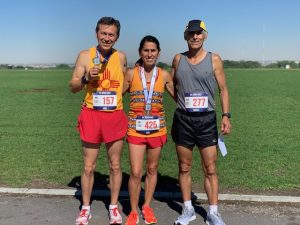
Tim & Rita Vigil with Rita’s brother, Senovio, who got the couple involved in Senior Games. Photo courtesy Tim & Rita Vigil.
You have your own senior athletic career to pursue, Tim, so you are devoting your time wisely. What’s your coaching experience, Rita?
RITA:
I started coaching when our son was in sixth grade. We both coached him through middle school and high school. I continued coaching at the high school level for 11 years. Tim was promoted at his work and due to his work schedule he was unable to continue helping me, so I had to hire another assistant coach.
I stopped coaching three years ago. It was a lot for me to be coaching while taking master’s classes, teaching full-time, and training for upcoming races. I do have a lot of free time now, and I can focus more on my training and prepare for upcoming races. I might consider coaching again if the right opportunity presents itself, but for now I’m really enjoying all this free time. [Laugh].
You’ve made many friends. Do you recognize that others are inspired by you?
TIM:
Absolutely. You know, the competitors I talk to are highly interested in the training that I do and what keeps me healthy. They follow me on Strava and Facebook so they can see my training, and I follow them back. So it’s just building those relationships. Every time we go to Senior Games or running events, we just enjoy spending time with them talking and getting caught up. It’s like, we’ve been friends since high school.
There’s something about this camaraderie thing.
You know, there’s always somebody out there that is in shape and ready to compete. You can learn and grow from meeting these new people, and I just enjoy seeing what they’re doing. I look at their training and compare it to mine and see what I can do to improve myself.
Do you feel you push each other as a couple to continue, or is it just because you love running and competing?
It’s a little bit of both. I’m on a seven-year streak without missing a day of running. I don’t want to say I’m motivated because motivation comes and goes, but it’s helped me build discipline in my training.
I would also say that if I had this kind of discipline when I was in high school and college, I would have been a much, much stronger and better runner. But that’s what keeps me going. And being able to talk to Rita about her training and how she feels. It’s just kind of self-supportive and influential between us both.
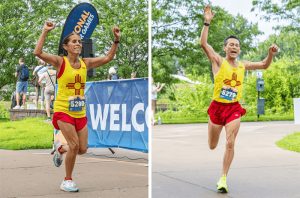
Rita and Tim’s finish line moments during the 10K Road Race at the 2025 National Senior Games presented by Humana.
Rita, would you agree that the reason why you guys haven’t been all that sick through the years is that you’ve been so active?
RITA:
Yeah, I think that is correct. Being active and eating healthy. You have to eat right in order to perform at your best. Most senior athletes don’t eat very healthy. And as you get older, you know, you really have to watch what you eat, you also have to incorporate strength training and listen to your body. Those little aches can turn into serious injuries.
Being disciplined and consistent is the key to running well when you’re in your 60s, 70s, 80s, 90s, even over 100. But for me, my faith is very important. I know God has given me a gift, and I want to use that gift to honor and to glorify His name. And a lot of people see that and are drawn to that, they come and ask for prayer or spiritual advice.
TIM:
I’m also a person of strong faith, and that’s what really motivates me and encourages me daily.
It’s a holistic thing, this aging. We don’t like to just talk about people’s athletic stuff because there’s a whole person there. And in order to successfully age, the activity is one part of it, but the social interaction is another part of it.
We totally agree, Tim. Everything you mention helps create a positive mental attitude, including your faith. So what would you tell people about the importance of putting this all together?
You know, I have a lot of great friendships with guys from college. When I see them today, some of them can barely even walk – they’re overweight and fell into bad habits. I just want people to understand that if you stay active, make healthy choices, stay positive, then your senior years don’t have to be in a wheelchair or a cane, or sedentary. Be out there, stay active! I put God first.
It doesn’t matter if you’re an elite runner, in the middle of the pack or the last one across the finish line. The bottom line is that you came across the finish line. How many people haven’t even started or are sitting on the couch?
We saw a nice quote on your Facebook page: “Commitment doesn’t happen in a day, it happens daily.” Is that your saying?
It’s a saying that’s been around a long time. Anybody can say I’m committed to doing this, but you know, three months later they’ve stopped. The only thing that builds that commitment is discipline, and discipline happens only when you do it regularly. Habits are built by doing it day after day after day.
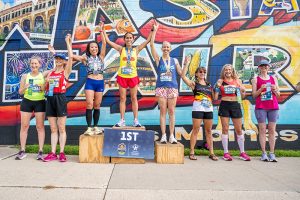
Rita Vigil atop the podium for the 5K Road Race at the 2025 National Senior Games presented by Humana.
Rita, do you have a fave expression?
RITA:
Yes. ‘The will to win means nothing without the will to prepare.’ We all want to run great races and post great times, but you have to put in the work if you want to win races. As a coach, I would always hear my athletes tell me, ‘I want to qualify for the state meet,’ and I would tell them, ‘You have to put in the work, show up every day, trust your coach, and trust the process.’ There are no shortcuts, and it’s not going to be handed to you.
Obviously, you both plan to be standing on the podium in about 20 years still doing this, right?
TIM:
That’s the beauty of Senior Games. You know, your ordinary person kind of dreads hitting that next age number. To me, it’s a new challenge going to a new age category. There’s always new opportunity!
- Published in News and Events, Personal Best Featured Athletes
Born to Coach
By Del Moon, NSGA Storyteller
Donald Widener, 68
Suffolk, Virginia

Donald Widener at his induction ceremony for the Black Tennis Hall of Fame. Courtesy Donald Widener.
Not everyone knows what they want to do with their life as a young teen, but Donald Widener did – with a little help from his sister and a perceptive coach.
Donald almost didn’t make it out of the hospital – he was a premature baby and the doctors discussed euthanizing him. Coming from a poor Black area of Cleveland, the standards for care were different before the Civil Rights Act. However, Donald’s mother and grandmother would have none of that and brought him home in a shoe box.
Early youth was difficult as Donald fought to overcome numerous issues with delayed development of walking, speech and learning abilities. He doggedly progressed and was playing basketball and touch football as a pre-teen. A horrific leg break while playing football affected his ability to jump and shoot. That’s when his younger sister Carmen encouraged him to come play with her in a summer tennis camp. As you will discover in the following edited conversation with Donald, she had a humorous ulterior motive.
But going to tennis camp was a big thing and he leaned into learning the sport, interacting with the other kids and practicing longer after sessions. That’s when the coach told 13-year-old Donald he saw something in him and offered him a job to coach that same camp the next summer. At that moment he knew he wanted to play and coach tennis professionally one day.
Donald made good on the dream, playing tennis throughout a 27-year Navy career, often starting programs wherever he was based. He became a certified coach and launched his own coaching business while also working at a string of coaching opportunities, including directing one of Arthur Ashe’s initiatives called An Achievable Dream serving underprivileged kids in Newport News, Virginia, and tennis teaching pro for five years at the University of William & Mary. While there, he brought the ACEing Autism program to the school, which helps children with autism grow through tennis. He is currently coaching at a high school in Suffolk, Virginia, and coaches youth to compete in United States Tennis Association (USTA) Junior Nationals. He proudly speaks of his team winning a championship in 2024.
When a friend steered Donald to Senior Games, he felt a path had opened. He had taken students to national events but never played in one himself. He fell in love with the people and atmosphere at the 2017 National Senior Games presented by Humana and is excited to continue to attend for as long as he can play.
Donald Widener’s journey is remarkable as he found that the best way to improve himself was to teach and serve others, many from difficult backgrounds like his. He has transformed a profession into a purpose-driven mission. For that, he was recently recognized with induction into the Black Tennis Hall of Fame. (Of course, his sister nominated him!) It’s a testimony to a man who has pursued his Personal Best for a lifetime and sees more to do ahead. Be like Donald!
Congratulations on your induction into the Black Tennis Hall of Fame, Donald! In your nomination bio, your sister, Carmen, says that you were a premature baby and the doctors actually talked about euthanizing you. What happened in your early life?
I think you ought to recognize the times then. Our American medical system was not always fair for folks. Remember the Tuskegee experiment and different modalities of how we treated some with grace and care and others with not so much. So I think at that gestation period, 1957, I was a preemie and considered to be a Black boy who wasn’t going to make it. They told my mom, ‘He’s not going to be of any credit to you. You will take care of him for the rest of your life and he won’t be of any societal gain.’
So she said nope, nope, nope. My mom at that point was 15 years old, but she had enough wisdom and foresight. My grandmother, who stood about three feet tall, was a giant in what she said and what she did and what she meant. So they said no, and they brought me home in a shoe box and my grandmother started administering the things that we call hometown remedies.
I had a lot of issues with speech and language and developmental delays and things like that. I couldn’t walk, but over time I watched my sister do it and then I followed her lead.

Donald Widener and his sister, Carmen. Courtesy Donald Widener.
Your sister is a major influence on your life, since she states she first taught you to play tennis.
Yes, I was 13 and she was playing in a summer program that Arthur Ashe, Charlie Parserels and Sheridan Snyder started called the National Junior Tennis League at that point. Now it’s called National Junior Tennis and Learning. They wanted to bring tennis to underserved communities who otherwise wouldn’t see it, wouldn’t have it, wouldn’t have available options to get it.
The funny story is that she kept telling me, ‘Come to tennis, come to NJTL.’ But her real motive was that I was going to be there to help her pick up balls, because she was tired of chasing them. [Laugh]
I had already been playing basketball and thought I was pretty good at doing things with the ball. It was the same balance and eye coordination that helped me develop the ability to walk. But I also played touch football in the street and one day I caught a ball and was backing into the end zone when my left foot stepped into a sewer hole when I got pushed out of bounds. You know that cereal Rice Krispies, right? Snap, crackle, and pop is what I heard. My left leg was broken in three places and in a cast for eight weeks.
Ouch!
After I healed, every time I twisted my ankle, it took longer to heal. Jump shots were issues.
Basketball was not good. So that was when my sister said, ‘Come to tennis. Help me pick up balls.’
When I went there I found out there were girls there, and it was fun. I was in the sun and they gave us snacks. I got a free racket and a T-shirt. People were nice to me. The place was on a college campus in Cleveland. It was fun and I went back every day. So that’s how I got started playing, and I started coaching the next year.
What? You became a coach at 14?
Yes. I practiced a lot. I was there before everybody and I was still hitting on the wall when everybody left. The coach said to me, ‘Come back next year, I want you to coach.’ I said, ‘Coach what?’ [Laugh] He said, ‘Coach tennis. There’s something about you. Come and do a summer job. It’ll be fun, and you’re going to teach what you need to learn.’
I couldn’t wait for the summer to come. And I got this hunger for it. And I just wanted more and more and more.
Your enthusiasm recalling this makes us think you knew even then that coaching is what you wanted to do the rest of your life. Did that occur to you?
Yes. I wanted to be on the tennis court, having fun, working with kids. And the reality of it is that kids learn from kids best. And so when coach would teach me, I would take that and internalize it and say it in a kid’s way.

Donald in his element, coaching youth. Photo courtesy Donald Widener.
Did you get to play tennis in college?
I was not a good student in high school. Some days I went in the front door and out the back door. I still had educational delays and just felt like education was not something that I was good at.
I did finish high school, and community college scholarships were available for tennis and other sports. But you got to be in class. You got to be a B student. I wanted to play tennis, but I didn’t think I’m ready for that. So I talked to a Navy recruiter and wanted to be a submariner.
The Navy was my calling card to get out of Cleveland and do something bigger for my life and bigger in terms of service. John Kennedy said, ‘Ask not what the country can do for you, ask what you can do for your country.’ And that for me was a calling to my heart.
I rode in the Navy’s first ballistic nuclear submarine called George Washington. I realized it was fun, but it wasn’t what I needed to be. So I entered medical training with a specialty in tissue banking and dialysis, and I ran the Navy’s dialysis units. I did some dialysis work in the Persian Gulf War theater. I served in the Navy for 27 years.
Were you playing tennis all during that time?
Yes, I was playing tennis the whole time. Every base I went to, we always had tennis courts.
We had a program called MWR, which stands for morale, welfare and recreation. We had tennis courts, but no tennis programming. So every place I went I would start a tennis program. I had the passion for teaching.
Funny story is that I met my wife in California. She was also in the Navy and had finished her portion of medical training. I was an underclassman and she was dating somebody at the time. So we ran into each other again 3,000 miles away in Virginia and I told her we met before and she replied, ‘No we didn’t’ and was wondering ‘Who’s that guy?’ That was 42 years ago!

Donald Widener and his wife at the Veterans Golden Age Games. Photo courtesy Donald Widener.
After the Navy and getting married you got involved with a number of interesting tennis programs. Your bio mentions you participated in something called An Achievable Dream for the next nine years. What is that?
An Achievable Dream is one of Arthur Ashe’s initiatives that helped grow tennis. I was a USTA certified pro and they called me to come work the program in Newport News, Virginia.
They would take 100 kids out of elementary school, not all good kids, not all bad kids, for the summer program. We give them education and lunch. The kids who were problematic in school went back into the school institution, same school, with no problems. They were in class.
The whole goal is beyond tennis, it’s elevating the human condition via education, culture and soft skill stuff. You know, yes or no, shaking hands, taking kids on trips. The area that these kids grew up in was a tough area. Michael Vick and Alan Iverson came from there. It’s important for these kids to have their own individual achievable dream.

Donald with professional tennis players Serena Williams, James Blake and others at an Achievable Dream event.
From there you were at the University of William & Mary from 2013 to 2018. What was your job there?
They wanted me to be the assistant coach for men’s varsity tennis, and at first I felt that that wasn’t my calling because a lot of the kids that go there are privileged and they would ask me the same questions – ‘Where’s your degree? Who did you play for?’ But I did know that I needed to do something different. So I went there for five years as the head teaching pro.
The U.S. Tennis Association also had a thing called early development centers. USTA felt that tennis was behind because we didn’t have the track of developing any younger players in a consistent fashion.
I asked about bringing some kids in that can’t afford to be in the school. My boss said we could have one or two, but he said we don’t want to make this a YMCA and don’t want a whole bunch of people running around who can’t pay. And I was like, well, we’re a public university and should serve the community. So I was able to do that program while there.
Your bio also mentions you ran a program called ACEing Autism during that time. We assume you brought that program to the university. What was it like working with those students?
Yes, ACEing Autism was a national tennis program for young people with autism, and mine was the first in Virginia. [Coaching] is different. When you share information with them, how they translate that may be different than what you intended. So you have to [speak intentionally] and do more [demonstrations].
A child with autism may be with you in a moment and the next second they’re somewhere else. But when they’re engaged, they’re engaged. So patience is paramount.
Donald, it’s amazing how you overcame your challenges and made yourself better by dedication to helping and teaching others.
Yeah. I say all the time, we’ve got to figure out ways to take care of each other better. We do it either proactively or reactively, but we’ve got to do what we can to better the human condition.
We’ve got to do what we can. Arthur Ashe said it best – do the best you can with what you got, where you are.

Coach Donald and his championship-winning team. Courtesy Donald Widener.
So we finally talk about Senior Games where we first saw you compete in 2017 in Birmingham.
I heard about it through a friend and I had never been in a national competition in my life. I’ve been to national events with kids that I coached but never done it for myself.
In coaching, we got to remember what it feels like to be on the field of competition and what it feels like to embrace the W or L, and to just understand you’re winning because you’re there.
It’s great seeing folks at all The Games, to converse with them, have laughs, travel, and say I’ll see you in two years. That’s beautiful, and it gives me something to look forward to, rather than sitting in the now and not having an answer for what’s happening tomorrow.
It’s just a beautiful pathway to be forever young. I think somebody made a song about that, right?

Courtesy Donald Widener.
Yes, Rod Stewert appreciates you recalling his song. In that spirit, there was a recent study that states tennis can extend life expectancy by 10 years for people who play it regularly. Do you feel like you’re 10 years younger than your age?
Yes. I tell people my age, and they don’t believe me.
In the medical component, you’ve got to have movement for your joints. For example, women who have no weight-bearing activities have osteoporosis later in life because they just didn’t do enough walking or weightlifting or enough sports that challenge the body and the skeletal system to perform, to improve.
Clearly, your philosophy goes beyond the physical into the social and emotional benefits as well.
So the whole thing is not just coaching the mechanics. It’s the holistic, always whole-person. I need to know how you best learn before I can offer you anything.
I play for the passion of it, for the fun of it, and I really want to win, never in a disparaging manner. We always win or lose with the same grace. We can teach people how to share and how to be more connected in life via sport. How beautiful is that?
It’s amazing how far you’ve come and what you’ve been able to do for others – and what it’s done for you. You communicate very well given your past issues. You must feel terribly gratified.
I guess I don’t do badly for a kid with a speech impediment! [Laugh] There’s tremendous gratitude. I feel incredibly blessed to be able to have any of this happen in my life. My wife, our kids, the kids that we have come in contact with…we have a school system of 600 kids and they all call me dad because their biological fathers aren’t always active.
So I feel all this privilege, all that’s the grace of God. But He says to me, ‘I’m not done with you yet. There’s still more work to do.’
- Published in Personal Best Featured Athletes
From “Misfit Farm Kid” to Super Senior Athlete
By Del Moon, NSGA Storyteller
Don Phillips, 94
Sioux Falls, South Dakota

Don racing at the 2023 National Senior Games presented by Humana.
Some people assume that most National Senior Games competitors are lifelong athletes. In reality, we estimate that over half of Senior Games athletes either returned to a sport or took up new ones in midlife, and some discover hidden abilities as they progress.
Don Phillips is inspiring because he is a humble, ordinary guy who, at age 56, decided to find new ways to stay active, leading him to the Senior Games. He began competing in national competitions in 1993 and has navigated twists and turns, including a string of medical issues from 2001 to 2011 that only allowed him to do the South Dakota Senior Games when he felt well.
Don persevered and had his breakthrough year in 2015 when he won his first gold medal at the National Senior Games — actually, SIX of them.
The past decade has been one of growth and success for Don. He added field events to his running repertoire of the 50-800m races. In 2023, Don won seven gold and one silver, and in 2024, he was listed as Top Ten in the world in six events by World Masters Athletics records.
Not resting on these laurels, Don decided to add Cornhole and Powerlifting to his competition schedule for the 2025 National Senior Games presented by Humana. Don’s workout routine now involves more whole body and weight training, so he’s curious to see what it’s like to compete as a super senior at 94.
In the edited conversation below, Don shares that he earned a degree at Iowa State University and is excited to return after 65 years to run on the track at Cyclone Sports Complex. Read on to learn about Don’s rural upbringing with limited athletic options, how he stayed active as a large animal veterinarian and when he realized he needed to be more active to stay healthy. We’re delighted he found Senior Games as his path to follow.
Don Phillips is living proof that anyone can improve their life by getting involved in an activity and sticking with it. This “misfit farm kid” has found his Personal Best journey and encourages you to find yours!
Don, let’s start where you are and work back to how you got here. You are a longtime competitor and a podium topper in the Senior Games and the world. In 2024, you earned six Top Ten rankings in World Masters Athletics records for men 90-94. For a guy who started later in life, you are posting some great results. Are you surprised you’re doing so well?
I am. Never in my wildest dreams did I think I would be doing this. I really feel blessed that I’ve been able to do it. I just grew up as a misfit farm kid and I look back and wonder, ‘How did I ever get this far?’ I still feel it, that was my start.

Don growing up in rural North Dakota. Image courtesy Don Phillips.
You are from the rural heartland. Are you a South Dakota native?
No, but close. I grew up in Forbes, North Dakota. It was right on the North Dakota side of the state line. At the last census I looked at, there’s 39 people there.
I graduated from high school in ‘48 and I didn’t have any idea what I wanted to do, but my mother wanted me to go to this teacher’s college. So I went there one year, and I didn’t want to go back. I wasn’t interested in anything at that time, so I taught country school for one year, and then I was drafted into the Army in 1951.

Image courtesy Don Phillips.
That was during the Korean War. How long were you in the service?
I served two years. I took infantry basic, and then I was fortunate when they pulled out a few of us to go to counterintelligence school in Fort Holabird in Baltimore. Then I was sent to Tokyo for 13 months in an office job.
I used the GI Bill to go to North Dakota State and got a bachelor’s degree in animal husbandry, and then I applied for veterinary school at Iowa State, and I graduated from Iowa State University in 1960.
IOWA STATE? Track & Field for the 2025 National Senior Games is there. Talk about full circle!
Yes, I’m excited the track and field is at Cyclone Stadium. I graduated from Iowa State 65 years ago, and to be able to compete in that stadium is going to be a little extra special.
Did you have any dreams of playing sports in college?
No, no, it never entered my mind to compete on the college level or much of anywhere else for that matter. My high school was small, and basketball was the only sport we had there. We did a lot of hunting back then, but I didn’t really do other sports for many years. I started golfing later on, but I was really tied down with my practice.
So, you became a veterinarian?
Yeah, I had a large animal veterinary practice for about 35 years in Colman, South Dakota, about 30 miles from Sioux Falls. When I came back from spending 13 months on a desk job I helped bale hay with a farmer and I couldn’t believe my physical condition was that bad. I decided I’m not going to spend my life at a desk anymore. For most of my working career I was on my feet and moving all day. I think that helped keep me healthy.

Image courtesy Don Phillips.
It’s great that you had that epiphany at a younger age, and that it helped you find a career that kept you fit. So when did Senior Games enter your life?
Here’s how it started. My neighbor came home from the doctor one day and I met him out in the yard. He told me he had to change his diet and get some exercise. Well, he was overweight, he was diabetic, his knees were bad. It was good advice, but it was way too late for him. And I thought, ‘You know, maybe a person should start doing that when they still can do it.’
So I started just going out walking every morning. Then I started jogging a little bit. And one day I jogged a mile without walking. I started running 5Ks and 10Ks when I could, and that fall I saw the results of the South Dakota Senior Games in the paper. I decided I’m going to enter that next year and I did. I’d never been to a track meet before that, so it was a learning experience. I’ve done the South Dakota state games most years since.
The next big step was the National Senior Games, which you started in Baton Rouge in 1993. But we see you disappeared in 2001 and returned in 2011. What happened in that lost decade?
I had some health issues. I had both knees scoped, then I had a bug with pneumonia and then had some shoulder and rotary cuff operations. It was like one thing would happen, and then another thing would happen, and then another thing would happen.
It’s like, I just can’t get into a rhythm, and I admit I just kind of lost motivation with those things going on. I was still doing some of the smaller games, but not like a regular thing.
What got your mojo to go back to Nationals?
I looked at my times in the State Games and at the National Games, and I decided maybe I can be competitive again at this age. So I started back again at 81, and I got a few medals in Houston and Cleveland. And then in 2015 in Minneapolis I was 85 and did all the running events from the 50 through the 800. I won six gold medals. Wow! Those are the first gold medals I ever got.
Congrats, Don! Are the medals a motivation to keep going?
Well, they help. You know, you like to win the medals, but after you get the medal, that part is kind of over with and the rest of it is a camaraderie and the stuff that really lasts. You meet some great people in these games.

Don competing in shot put at the National Senior Games in 2023. Image courtesy Don Phillips.
The next big chapter for you was adding field events to your running, and you have performed amazingly well for being a super senior “newbie.”
The first time I did field events was 2022 when I started in the 90 to 94 group. I think I was about 87 or 88 when I started working into those. I bought a discus, a shot put, a javelin and hammer to throw. The other guys gave me some tips and it’s worked out.
We saw that you have added even more events for 2025. You are signed up for Cornhole and Powerlifting. Most people half your age couldn’t do this much!
The National Veterans Golden Age Games were in Sioux Falls three years ago and they had a powerlifting demonstration, so I decided to give it a try. Structure wise, I’ve always been kind of scrawny, but most of my exercises are strength exercises now. I used to run a lot, but I don’t sprint like yesterday. I started doing push ups and chin ups and more full body exercises. I work with weights two to three times a week. I’m very curious to see how powerlifting is done in the 95 age group.
Don, you are sharp-minded and even-tempered. Do you think your physical activity helps with your emotional and mental stability?
Yes. They all fit together. One benefits and helps in the other areas of your life.
So what is your advice to others to live a successful life?
You just have to keep moving. Start an exercise program and stick with it. After a few years, I got to the point where doing exercise became a part of my lifestyle as much as eating and sleeping. And I think it’s just as important.

Don and Laverla. Image courtesy Don Phillips.
A good family life is important too, right?
Oh yes. Laverla and I celebrated 71 years of marriage last year, and we have three daughters – Diane, Linda, Lisa. Laverla has been very, very supportive and has been to most of the Senior Games with me until she had back surgery a few years ago. It’s difficult for her to travel but I know Diane will be in Des Moines.
Don, let’s end our chat with a softball question: if you weren’t doing all of this, do you think you’d still be as healthy now at your age?
I’m pretty sure I wouldn’t even be here. I really believe that!
We agree, and we’re happy you are with us on your journey. We will be celebrating with you when you get on the track at Iowa State!
Thank you.
- Published in Personal Best Featured Athletes, Senior Games Blogs
P is for Perseverance…and Patsy
By Del Moon, NSGA Storyteller
Patsy Lillehei, 81
Edina, Minnesota

Image courtesy Patsy Lillehei.
Life is full of unexpected twists and turns. Some people face more obstacles than others, and it’s easy to give in and leave dreams and goals on the shelf. Not Patsy Lillehei.
This might have been a lifetime athlete story as evidenced by her intense effort and passion for swimming and triathlons for more than a decade. However, there were no opportunities in sports for girls in the small Kansas town Patsy was born in. Even when the family moved to Edina in the Twin Cities area of Minnesota all she could get involved with in the pre-Title IX era was lifeguard lessons. The memory of enjoying the water stayed with her as she entered adulthood, got married and took on a highly demanding career as a financial advisor. Exercise was sporadic until after she retired.
The competition bug bit Patsy in a very personal way in 2008 when her daughter, who had been diagnosed with multiple sclerosis five years before, asked her to ride in a MS cycling fundraiser. That propelled Patsy to keep cycling and also pursue her love of swimming. She competed in her first triathlon the same year. She then discovered Senior Games and competed in her first national triathlon in 2011. She has since done many tris and joined U.S. Masters Swimming but says going to National Senior Games is her guiding star.
Patsy, who has a beaming smile and bubbly, outgoing personality, just seems to uplift others around her, and she was delighted to be one of two hometown athletes selected to carry the torch across the Mississippi River bridge in Minneapolis for the Flame Arrival Ceremony of the 2015 National Senior Games presented by Humana.
However, underneath all the positivity has been a series of challenges. Patsy has endured the heartbreak of seeing her daughter, a former college star pitcher, lose her physical ability to multiple sclerosis, and has devoted much time to her ongoing care. Then, in 2019 more heartbreak as her son was also diagnosed with MS. To date Patsy happily says he has been able to manage the disease and remain active.
As you will read in the following edited conversation, Patsy has also had medical challenges to overcome. In fact, NSGA had a story interview planned with her in 2021, but she called to cancel and apologized because she had suffered a heart attack that day! In our recent chat, she details what kept her from attending the last two National Senior Games, but she just keeps persisting and is now in good health and won medals, many gold, in three different 2024 qualifying games. There’s no athlete that will be more excited to be in Des Moines for the 2025 Games.
Patsy Lillehei is emblematic of many other senior athletes who never give up and find ways to persevere and keep moving. Her spirit is an inspiration to all of us to pursue our own Personal Best. We’re happy to finally complete her profile. Go Patsy!
Patsy, it’s a delight to chat with you again. Your name, speech and mannerisms suggest that you are a native Minnesotan with family roots in Northern Europe.
No, there’s no Scandinavian at all in me. I married into it! [Laugh] I actually was born in Junction City, a little town in Kansas. I went to grade school in Clay Center, Kansas, and then in junior high, we moved to Minnesota.
It’s clear you have fully embraced the culture. We see you always smiling and encouraging others, and you exemplify the ‘Minnesota Nice’ spirit the state is proud of.
Oh, thank you. I will tell you that my travels in life really have been dominated by my opportunities to play in the Senior Games. And as I’ve done it, I’ve seen such beauty where I’ve been, but I always come back to Minnesota and say, ‘We got them all beat.’
Were you active in sports in your youth?
Well of course not, there was nothing to do. I enjoyed physical activity, but it was before Title IX and there was no opportunity where I lived. I came from a class of 16 in Clay Center, Kansas, and moved to Edina, Minnesota, with 450 kids. When I was in eighth grade, we were all asked to swim at the high school and see who qualified to have an opportunity to be a lifeguard. I didn’t know that I had swimming skills at that stage but I loved it.
Did you have a sport or activity as an adult?
No, I was married at 20 and became a financial advisor for over 30 years. I worked for Morgan Stanley first and then retired from Wells Fargo. I succeeded in my profession. And I took a lot of tests, a lot of tests. There was no time for exercise in my mind. They called me the janitor because I opened up the office and I closed it up at night. [Laugh]

Patsy and her daughter, Birgit.
You tell people you got active when your daughter was diagnosed with multiple sclerosis. How did that happen?
It was 2003 when Birgit went to Mayo Clinic and had the true MS diagnosis at the age of 35. But she discovered it much earlier when she was a fast pitch pitcher at Augsburg College. She still has three records at Augsburg that nobody has broken. So, she knew there was something wrong when the ball was hitting her in the chest and she wasn’t catching it.
She was still the warrior and was doing the annual Duluth to Minneapolis MS charity 150-mile bike rides for as long as she could. Birgit is the reason why I’m in Senior Games because she got me started doing my fitness with her. It was five years later in 2008 that she asked me to do the ride because she realized she was going too slow to keep up with her friends. She didn’t really ask us. She said, ‘Mom and Dad, I signed you up.’ [Laugh]
You’ve been Birgit’s caregiver for 30 years?
I have. I am thankfully one of the core friends and family that she allows in her care circle. And I wished she would let me do more, but, you know, she is an independent person. She says stuff like, ‘Mom, I can lift that wheelchair, you shouldn’t do that. You’re over 80.’
Incredibly, your other child has MS too.
Yes, our son Brooks was diagnosed with MS in 2018. He has a different severity of MS than Birgit. His symptoms are referred to as “invisible.” For example, one of the symptoms is numbness and tingling in his legs. He is selective about sharing his MS story and passionate about helping others afflicted with MS to live their best life.
I don’t know what Brooks’ journey is going to be like, but he’s not in a chair. He is ambulatory and getting around well. He is actually coaching downhill skiing at a private school here in the city. He did not give up one ounce when he got diagnosed. Since then, he and his wife have traversed the Grand Canyon Rim to River three times. Last October, he ran the Twin Cities Marathon then, two weeks later, ran Surf the Murph 50K. He’s over 55 now and never did those kinds of foot-powered adventures before. He’s just going to keep going!
That shows that he’s got the same resolve that you have and he’s not going to give up.
Yes, I’m proud of them. But it’s an emotional thing to see both of your kids get diagnosed with something like this.
The silver lining, if you want to call it that, is that you found a path for your own health and well-being. How did doing a charity bike ride turn into being a competitive swimmer and triathlete in Senior Games?
I have been doing the Lake Nokomis Triathlon every year starting in 2008. I hadn’t known there was such a thing as Senior Games. In 2010 it was announced that Minnesota was going to be the host for the 2015 National Senior Games. I immediately wanted to know, how can I do it? I learned it was every two years and I had to qualify every time. I went to Houston, Texas, for my first triathlon at Nationals in 2011. I did not do swimming events because I missed the qualifying.
You did both swimming and tri in 2013 in Cleveland. You stayed longer and experienced more of the event. What was your impression?
Well, that’s when I first saw all these other wonderful people that I’ve been able to reunite with from year to year. That was the biggest thing.

Patsy running with the torch at the 2015 National Senior Games presented by Humana. Photo courtesy Patsy Lillehei.
Then, you got a surprise when the 2015 National Senior Games presented by Humana came to your backyard. Because of your positive spirit you were selected to run the torch across the Mississippi River bridge to the cauldron for the Opening Ceremony.
It was cool and I felt very proud. I’d have to say it was a highlight of my life.
The Senior Games are a beacon for me. Small steps in the right direction are turning out to be the biggest steps toward a healthy life for me.
Perfect tie in to running the torch! So you returned for 2017 and 2019. For the next Games you were registered but did not make it to Fort Lauderdale. What happened?
What happened was I was ready to go. My suitcase was packed. But I got COVID. I was depressed for a little while after that.
Many athletes know that frustration of training hard and then not being able to compete. You were also registered but missed The Games in Pittsburgh in 2023. What happened then?
I actually got COVID again just before it was time to go. It was clearing up, but I was still not confident of being among a lot of people.
Wow, bad timing, but you keep on smiling. Thanks for your consideration of others, Patsy. We’re glad to see you are ‘all systems go’ to compete in Des Moines in July. But we know you’ve had more to overcome in the last three years.
Yes, I know because I actually had a story interview scheduled with you but I had a heart attack that same day. April 21, 2021. While I was swimming I didn’t feel good. I had felt weak for like three days. It turns out I had a 98% blockage in flow. They call it the widow maker. They put in two stents, and it took me a long time to understand what I can and I can’t do.
I didn’t really have a mentor that could help me and the people at the hospital where I did the physical therapy never, ever approved me to swim. I thought, this is so silly because they had me working hard on elliptical machines and treadmills and running. And I thought, ‘I don’t get this tired swimming.’ I finally just decided swimming is meditative for me. I had to start swimming again. Sometimes I even fall asleep when I’m swimming. [Laugh] So I went against their orders and started swimming.
Let me explain that doctors do their best, but they don’t always get it exactly right. And so, you know, what a lot of people miss is that you have to kind of be your own doctor and listen to your own body. Right?

Patsy, far right, and her relay teammates at the Minnesota Senior Games.
Almost hate to ask if anything else has jumped in your way since then.
Well, a lens in my eye from a failed cataract surgery came loose and I couldn’t focus. So I could not wear glasses and couldn’t travel at night when I wanted to go to the pool. Seven months later, another retinal specialist took out the lens that was floating in my eye and sewed in a new lens.
Did it help?
Well, when I went to church and looked at the minister standing in the pulpit, I saw two ministers and two baptismal fonts and eight people at the baptismal font. [Laugh]
This was 2022. It took two years for the doctor to finally say, ‘Okay, I think you’ve got enough good going for you. Let’s get you some glasses.’
So, you know, at any point, you know, any one of these setbacks could have turned you away but you never gave up. What drives you?
First of all, I love it. I enjoy it. I feel good when I’m swimming, and I meet so many wonderful people that are like-minded individuals who are striving to do their best individually. I call them the kindred spirits that actually make you feel you’re in the right place right now. I always feel like I’m good enough when I’m around them.
And then another reason it’s really, really important to me is that I have to stay healthy. I want to be healthy for my daughter.
You’ve made a nice comeback and Des Moines is finally in your sights. You crushed every swimming event at your qualifying games in Iowa and Minnesota last year. You must be excited.
I just feel good about myself. I also did the masters national open water swim in Lake Stillwater, Minnesota. You were supposed to do the mile swim in an hour to do this nationally. It took me one hour and one minute. [Laugh] They were kind and gave me a third place medal. But it was beautiful, I did a one-mile open water swim this year. Wow!

Patsy and her former trainer, Kym Zest, at a YMCA triathlon in 2024. Photo courtesy Patsy Lillehei.
Your main love is swimming, are you still going to do the triathlon?
I am certainly going to do the triathlon. Since 2008 I’ve never missed the triathlons at Lake Nokomis hosted by Lifetime or my Southdale YMCA in Edina.
Minnesota gets a lot of U.S. Masters swimming events and they help keep me going too. I do my five individual events, and then I do relays and medleys with my group called the Relaykers. We have four of us now over 80 and we have set record after record for Minnesota. Our 75+ mixed group of Relaykers swam at the 2024 Masters Spring Nationals in Indiana and accomplished second for Minnesota with our medley race.
You are obviously a strong competitor who wants to win, but clearly that is not what really motivates you the most.
I’m just going to give you a huge yes. I always say that my expectations are higher than my realizations, but I have really high expectations. So that keeps me going – it’s the carrot that keeps hanging in front of me.
And I’ll tell you, it became different for me when I turned 80. It was like a door opened and there was a light that said, ‘I’m over 80 and I can still do this.’ And I think – no, I know – that it’s inspiring for others.
I was inspired to swim with Charlotte Sanddal in Albuquerque. She was like 95 and still swam until she was 100. I want to just be there at 100 years old and inspire all others who love to swim.
Thanks and good luck, Patsy. Glad we are finally telling your story!
- Published in Personal Best Featured Athletes, Senior Games Blogs
Digging Out
By Del Moon, NSGA Storyteller
Monique Wilson, 61
Redondo Beach, California

Photo courtesy Monique Wilson.
Any parent will tell you that losing a child is one of the most difficult tragedies to overcome. Finding a pathway to return to everyday life is complex and can bring depression and other health issues.
Monique Wilson’s family was devastated when her son Erik died suddenly at age 29 after he took what he thought was medicine, but it was laced with fentanyl. The schoolteacher took the rest of the school year off and ultimately retired to allow herself to heal. However, Monique still lacked a direction to help her move forward.
A phone call from an old friend she had played volleyball with provided a ray of light, and that has led to a revived passion for volleyball and eventually to the 2023 National Senior Games presented by Humana. People might think going to play games would not be more than a distraction from grief. But, Monique found purpose and a team of women who supported and helped her get back on the court as a senior athlete and start enjoying life again.
In the following poignant edited interview, Monique shares her journey through a nightmare and how participating in sports has carried her to a new perspective and a forward-facing outlook. As expected, she says things will never be the same, but the tragedy no longer keeps her from living her best life.
As we talked, it was clear that it was very difficult for Monique to share details of her experience. She agreed to the interview because she had herself sought out stories of other mothers who lost a child on the Internet. These stories showed her that her feelings and emotions were normal, and now she wants her story told with the hope that it will help someone else in a similar situation.
Overcoming the challenges and obstacles everyone faces with a positive outlook and by pursuing a healthy and active lifestyle is a huge characteristic of living your Personal Best. Senior Games often provide a way for people to remake or improve their quality and duration of life, and we’re grateful that Monique Wilson has found a caring family and a meaningful activity with new friends.
Monique, thanks for agreeing to share your story with us. Let’s get some background. Were you always athletic and was volleyball your main sport?
Yes, my parents were more into the arts, but I was the only one out of seven kids that went into sports and athletics.
I did play volleyball. I’m tall, so when I was young, probably around the eighth grade, there were some PE teachers and coaches at the high school that saw the tall girl always playing sports on the playground, and they started recruiting me. They could see that I was athletic as well as tall, and I do have a competitive spirit. Straight out of Central Casting. [Laugh]
Did you play in college?
I did go to college, and I was offered to play but chose not to. I wanted to just get into the college scene, so that’s probably not a very good quote, but I played intramural volleyball and other sports.
I met my husband, Brad, when I was 17. I was a senior in high school. He was two years out at 19. He was an athlete, too, and played football, baseball and volleyball. He doesn’t play Senior Games, however. He has some knee and shoulder issues that prevents him from playing some sports, but he does kickboxing almost every day.
How many children did you have, and did you promote sports to them?
I had two children. We introduced both our kids to all the sports when they were young, and then they picked a few as they got older.
My daughter, Danielle, played sports through high school and college. She played volleyball and softball. She’s currently 37. My son Erik played football, baseball and golf. His goal was to letter in as many sports as he could. He ended up playing football for the University of Washington.
Erik played for Coach Steve Sarkisian. He was on the team for four years, most of the time as the quarterback for the scout team.

Right to left: Monique, Erik (son), Brad (husband), Danielle (daughter), Colton (son-in-law). Photo courtesy Monique Wilson.
That’s a big job because you have to mimic the opponent’s quarterback each week, and you also get beat up.
Oh, yeah. The defense is going hard, so there was no letting up. He did suffer some concussions. He also suffered a knee injury and had a back issue. But he loved it. [Pause] It rocked our world when he passed away at only 29.
That’s tragic, Monique. We are so sorry for your loss. What happened, if you don’t mind sharing?
It was traumatic. He had just broken up with a girlfriend and moved home. Because of COVID, he had nowhere else to go.
He had just got a new job and was preparing to start the following week. And then Monday morning, we found him in his room. He had taken half a pill that looked like Xanax, but unfortunately, was laced with fentanyl. It was determined that he died immediately after taking it.
That is horrific. So many people have suffered because of that drug. Of course you were devastated to lose your son.
Our whole family spiraled into this tailspin of overwhelming grief. My daughter and son were very, very close. In fact, she and her husband were with him the night before he died. It definitely rocked our world, and we experienced all the grieving you would expect. We couldn’t eat, we couldn’t sleep and we gave up on exercise.

Monique with her 2019-2020 class. Photo courtesy Monique Wilson.
How did you finally start to feel coming out of it?
Well, we still grieve. After the funeral, I thought I’d go back to teaching to get my mind off of things. He died in April, so I took the rest of the school year off. I went back in August, and then my mother passed away a month into the new school year. She was 94 years old and ailing so it was expected, but still, this made things more difficult.
I spiraled again, and one day, I collapsed. I always had low blood pressure and a low heart rate, but it got dangerously low, because I wasn’t eating or exercising properly. I wasn’t living my normal life like before. I ended up in the hospital. My blood pressure and my heart rate dropped so drastically low that I now have to take medication to keep everything working properly. Now they’re saying I need to get a pacemaker.
That had to be your lowest point. How did you pull out of it?
It started with the kindness of my workmates. I was a schoolteacher and taught mostly fourth grade for my entire career. After I had collapsed, the teachers at work were generous and donated their sick days to get me through the rest of the year, so I could continue to heal. I ended up retiring because they happened to be offering a golden handshake at that same time. At this point, I was still kind of moping around, not really getting back to my old self.
Now, that was when Senior Games changed your trajectory, right?
Yes. A girlfriend who I used to play volleyball with called me and told me she is playing in an open gym league down in Orange County. She said, ‘I think you should play- it would be really fun.’ I was so reluctant and didn’t want to go down there. But then my husband said, ‘No, you need to go. You need to go.’ So I went down there and I ended up playing horribly. They played five games that day, and I could barely get through three. I was out of breath; my knee and lower back were hurting. I literally had to step off the court.
But it was definitely an eye-opening experience. I woke up the next morning thinking, ‘What the heck has happened to me? I need to start working out again.’ I began lifting weights and getting out to walk again. I was so sore, but just started to build from there.
My girlfriend got into pickleball and quit volleyball, so I thought I wasn’t going to be able to play in Orange County anymore. I didn’t really know any of these girls, but my husband encouraged me again, saying, “Just go by yourself. Who cares?’ So, one morning, I got dressed and went down there, and it opened up a whole new world. These ladies were just so nice. They didn’t know my story but were so encouraging and wanted me to come back and play.
Then, one of them called me and asked me to play on her Senior Games team. I had no idea this even existed. but it looked like something I might want to do, so I went to a tournament in Sonoma. I didn’t play great, but we did win the gold.
From there, I started lifting more weights, walking more and doing jump squats, and I got myself back in shape. We started playing more tournaments together. And now we play almost every month.

Monique and her teammates at the 2023 National Senior Games presented by Humana. Photo courtesy Monique Wilson.
You played in your first National Senior Games in Pittsburgh in 2023, less than three years after the tragedy. How surprised are you that going out and playing a game is what was going to heal you?
100% surprised. And the healing is not over, I will always grieve for Erik. When I went to my first games in Sonoma, I needed my own hotel room because I literally went to my room every night and cried because it was the first time away from my family.
But my gosh, these girls helped me. They are amazing. It’s great to be involved in a team sport because the camaraderie on and off the court and the relationships are unbelievable. That’s what saved my life. When you play on a team, you get close fast when you’re staying in the same place. Soon everyone learned my story and these women have all been incredibly supportive.
Now, if I hit a ball and get a kill someone will shout, ‘There’s an Erik Wilson hit!’
What would you tell someone else who’s reading this and going through a similar kind of tragic situation?
When I was going through the worst of my grief, I would search and read other people’s stories online. Before I knew it, my feed was filled with these kinds of stories.
It made me feel like I wasn’t alone. And it gave me some inspiration to wake up and keep moving every day. I hope that people will read my story and know that they aren’t alone, too.
I’ve learned that you have to give yourself grace. I am not always going to have upbeat, perfect days. I still have periods of time to this day where these waves of grief take over, and I just cry. Reading other people’s stories taught me that it is completely normal.
Well, now you have something to look forward to, and you’ve got volleyball sisters who are helping you through a new journey. You’re going to be doing this for a long time, right?
Yes, that’s the goal. As long as I can stay in shape. It’s funny because when I went to my first tournament, I looked around the room and thought wow, there’s a bunch of old people. [Laugh] And I’m one of them. Then I quickly saw that these ladies are amazing athletes. It’s eye-opening to see the 80-year-old teams play.
Once, when I came home from a tournament, I told my husband, ‘Don’t let the gray hair fool you.’ Because these ladies are great athletes. I want to keep on playing until I can’t, that’s literally my goal now. I want to be that 80-plus person still playing and moving on the court.
Monique, we know this has been difficult to recount, but you know how much sharing your story may help somebody else, and we are proud to have you in our family.
Well, thanks for that. Like I said, other stories have inspired me, so it’s important to share mine.
- Published in 2024 PB, Personal Best Featured Athletes, Senior Games Blogs
A Cycling Champion Spins Off a Family Legacy
By Del Moon, NSGA Storyteller
Luigi Fabbri, 89
Eva Fabbri, 82
Lake Worth, Florida
Gabriella Fabbri, 60
Riviera Beach, Florida

The Fabbri family at the 2023 National Senior Games presented by Humana. Right to left: Luigi Fabbri, Eva Fabbri, Gabriella Fabbri and Phillippe Mailleaux. Photo courtesy Gabriella Fabbri.
Those who know Italian-born Luigi Fabbri will agree that cycling is at the heart of his being. He has been competing and raking in medals and championships internationally for 45 years, and he is still hungry for more at 89 years young.
Luigi also has a greater passion – his family. The evidence is that he took a two-decade pause midway in his racing career to work and support his family, but the wheels were always spinning in his head. Cycling is also rooted in the family with Luigi’s wife, Eva, racing on velodrome tracks in many countries and having a Pan American Games championship in her accomplishments.
Luigi was grateful to find Senior Games when he brought the family to Florida from Uruguay, and he has been a fixture at the Florida Senior Games qualifiers and at National Senior Games since 1997. Luigi was honored with a Florida Senior Games Lifetime Achievement Award in 2021 for his state participation. Other athletes delight in just listening to his thick accent and dry wit.
Now, a new Fabbri generation is rising as their daughter, Gabriella, took up Luigi’s suggestion and pedaled her first competitive 5K and 10K time trials at the 2022 National Senior Games presented by Humana in Fort Lauderdale. Then, she added the 20K road race for her second Nationals in Pittsburgh last year.
As you will discover in the following Personal Best conversation with the three Fabbris, Gabriella caught the fever from dad and “recruited” her husband, Belgian-born Phillippe Mailleaux, to also enter the field in 2023. Gabriella’s twin brother, Renzo, and sister, Anissa, have also raced, and the elders are proud to see their granddaughter, Anyssa, hop in the saddle to ride with the wind hoping to be the next Fabbri champion.
Our chat reveals Luigi’s colorful history as he recalls how his family escaped from Italy to avoid political persecution and ended up in Uruguay, where Luigi met Eva and started his cycling adventures. Then we learn about the Fabbri’s transition to America, where Luigi continued his work as a craftsman restoring vintage furniture in a workshop he built. He only recently retired but maintains a regimen of riding 20 miles at Okeeheelee Park in West Palm Beach almost every day.
Luigi now enjoys the health benefits from his fitness, sharing with us publicly for the first time that he has battled and contained Parkinson’s disease in recent years and that he feels good about continuing as he approaches 90. He often hears he is an inspiration, but the fire to compete has not subsided and he is excited to have a lane where he can still ride and compete with his peers. His passion is tempered with caution as when he encourages others to safely train and compete in cycling. While he has had many falls, he has yet to break a bone and does his best to advise others on safe racing.
He wasn’t thinking about it all along, but when Luigi clipped onto a bike in 1952 he set a legacy in motion that will continue through generations. We’re glad to have the Fabbri family among our ranks to show how much a Personal Best attitude can positively influence others. For that, Luigi deserves our whole-hearted “Grazie!”
Luigi, it’s great to speak with you and your family. You’ve been cycling in the Florida Senior Games for nearly 30 years since you moved here. How long have you been competing?
I have been cycling for a long time! I had to take a break to work and support my family during my life, but I have 45 years as a competitor.
You have been all over the world, and you are an Italian native who came to us through Uruguay. Tell us how you got here!
I was born in Rome during the war time. The only thing that was interesting when I was about 8 years old was the radio. And the radio was transmitting bicycle races. I liked the way they transmitted. They gave me a lot of…I don’t know how to explain, but…the radio made an impression on me and I got interested in racing.
My father was a political man. He fought against Mussolini, and they wanted to kill him. We had to flee Italy and went to France. In France he had the same problem, so we went to Argentina. He still had some problems, so we moved to Uruguay where we felt safe. I was in Uruguay for 20 years.
I used to work for a decorator as a craftsman. I did a lot of antique restoration. At one time my father was a restorer in the Museum of the Vatican. Sometimes we restored, and many times we made a copy. They would say, ‘Look, Luigi, I need a cabinet this size for a Louis XIV room.’ So…we make the cabinet.
But I didn’t want to work with my father and looked for other things to do. I bought a camera – a Leica, very good camera – and I worked as a photographer.

Snapshots from Luigi’s early racing days. Photos courtesy Fabbri family.
Did you start racing while you were working?
I raced for about 20 years when I was younger and I did well. Then I stopped because there was no money in the races, and I needed money because I was married, I had kids. Then I had a big crash and I gave up.
That brings in your wife Eva, who has a cycling history herself. Eva, how did you two meet?
Luigi used to live close to my older sister’s house. It was my 15th birthday, and you know the Spanish people celebrate with a quinceañera for girls. I have Italian ancestry but was born in Uruguay.
So I needed a photographer, and my sister talked to him because he was a photographer at the time. So he took my pictures. The rest is history.
Eva, you did some racing back then. Luigi must have inspired you.
EVA:
Well, it really wasn’t Luigi telling me to do it. I went to Italy with him to visit one of his teammates from Uruguay who lived on a mountain. His wife and I went all the way down to the town and back – she was impressed that I didn’t use a cane, and I didn’t stop to sit. So, she told me, ‘You have to race.’ I said, ‘I’m too old, I never raced in my life.’ But I tried and I like to ride the bike. I competed in Italy, in Ecuador, and I competed in Argentina in the velodrome. I like velodrome a lot.
LUIGI:
She won a Pan American championship while we were in Ecuador.
EVA:
Luigi was a world champion, a world record holder. He was a nominee to compete for Uruguay in the 1964 Olympics in Rome. But then the Uruguay federation didn’t have enough money to send cyclists.

Eva and Luigi on the medal stand over the years. Photos courtesy Fabbri family.
Wow, Luigi, it must have been tough to have to quit to support your family. But then you moved to Florida and started all over again. How did you get back on the bike?
LUIGI:
When I reached 50, I decided to do some exercise. And I was looking for a place and a group of cyclists to practice with, because it’s very dangerous to practice on the streets in Florida.
I found a velodrome near us to practice with others. I started beating people 20 years younger. I was impressed by what I was able to do and decided to race again. I rode on an old bike. I disassembled it and reassembled it the way I was thinking to make it my own track bike. And in a year or so, I was one of the fastest sprinters. I competed in the Pan American Games and won a sprint. And from that, I started racing all over the world again. I raced in England, Portugal, Italy and other places.
And you have been a fixture in National Senior Games since 1997. Eva has joined you for several Games, and in 2023 we saw a new Fabbri generation hop on. Gabriella, your parents say you didn’t start sooner because you are a workaholic.

Gabriella gets a hand with cycling training from her dad, Luigi. Photo courtesy Gabriella Fabbri.
GABRIELLA:
Yeah, unfortunately I am, but you know what? I inherited that. Both of my parents are workaholics. [Laugh]
Dad encouraged me and bought me a bike for my birthday. At the beginning, he trained me, and that’s when I did my best. It was like a bonding moment for us. Then he stopped training me because my schedule as a flight attendant was so messed up. I did much better when he trained me than when I was on my own.
I didn’t have any expectations, and it wasn’t something that I thought of doing. But once I started I enjoyed it. And I’m like, ‘I should have done this a long time ago.’
LUIGI:
I feel proud of her because she works a lot and has little time to practice. I don’t care if she wins or she becomes the last one in. As long as she doesn’t expect more than what she can do.
EVA:
I love that she’s doing it because it’s not only going to help with her health, but she’s also following in her father’s steps.
We’re always happy to see generations get involved in Senior Games. Gabriella, you competed in your first time trials in 2022, and there’s more to the story because your husband Phillippe also competed in cycling in 2023. How did he get involved?
GABRIELLA:
Well, I just went out and bought him a bike, and he had no choice. [Laugh]
At first, he’s like, ‘I’m not doing this.’ And I’m like, ‘But you’ll like it. I used to say the same thing.’ Now he trains more than I do, actually. I don’t have the time now to get into the road racing much. I like the time trials.
EVA:
Me too. I always race in time trial because I don’t have a lot of road experience. And I’m afraid to be in a group and make somebody fall. So, I always race just by myself.
Cycling road races do have more risk than time trials. It’s best to know your lane and be careful. I’m sure Luigi has had some spills in his racing career.
LUIGI:
Cycling is a dangerous sport. You have to prepare well. I have crashed over 40 times, but I have not broken any bones! I’m very careful. I like to race in front, between the first 10 people. Usually, it’s more safe.
Have any of your other children raced bikes?
EVA:
Yes. When we first came to the U.S. in 1974, we lived in Massachusetts, and Gabriella’s twin brother, Renzo, and our daughter, Anissa, entered a race and we watched them win. So everybody in the family is on the bike except Adriana. Adriana is not a sport person but supports us.
In Pittsburgh we had the whole family including grandchildren come to celebrate. It was beautiful, beautiful. Our granddaughter, Anyssa, was there and she is racing now, so we have four generations of cyclists. For me, the family is number one. And anything that we can do with the family, for me, is very enjoyable.
Obviously, cycling is a huge part of Luigi’s identity, but he had to set it aside for 20 years to support his family, which must have been hard. We can assume that family is even more important than cycling to Luigi.
GABRIELLA:
Well, maybe! [Laugh]
So Luigi, you are 89 as we speak and you don’t seem to be slowing down. You still ride 20 miles every day. There’s no doubt this keeps you in good shape. Besides your obvious love for the sport, is that why you do this now?

Luigi Fabbri cycling in the 20K Road Race at the 2023 National Senior Games presented by Humana.
LUIGI:
Yes, that’s why. There is one reason nobody knows, but I’m going to tell you. I found out I have Parkinson’s six years ago. The doctor told me to do some exercise, because it’s good to keep the Parkinson’s away. I started practicing harder. I don’t trust just the medicine. But by practicing hard I don’t feel to be worse now. On the contrary, I feel better.
EVA:
I’ve been telling him he had Parkinson’s for like 12 years. But he’s very stubborn and would not accept it. It took him some time to realize that there was something in there, but he’s keeping it under control through his intense exercise.
I worked many years with people with Parkinson’s and Alzheimer’s, so I have an idea how this disease progresses. He really hasn’t progressed that much, which is good.
LUIGI:
I feel strong, and I still race to win. I understand that with some people it’s not important to win. You don’t have to be there to try to win the medals. I like to win, but I’m also competing against myself and against my best time.
How do you feel about being a role model to these other athletes? They love you!
LUIGI:
I feel it’s something I have to keep doing because everybody tells me, ‘Luigi, you are my inspiration.’ So many people are looking at me. But I do this for myself first, not for other people. I don’t care about anybody else around me. I’m doing what I’m doing. I’m staying healthy.
You have to do it for yourself, because it’s not easy. And that’s what I try to tell people.
- Published in 2024 PB, Personal Best Featured Athletes, Senior Games Blogs
Surviving the Roller Coaster
By Del Moon, NSGA PR Specialist
Dr. Vincent Pearson, 60
Owings Mills, Maryland

Dr. Vincent Pearson has a long list of accomplishments and passions, highlighted by a busy career as a pharmacist and a solid family life. The successful bowler has won amateur events, earned Senior Games medals, bowled on a PBA regional tour and coached. Along the way, he also became a tournament chess player, runner and licensed pilot.
With so many achievements, it may surprise you that Vincent has battled Seasonal Affective Disorder (SAD), a form of depression, since he was young. In the following edited conversation, he describes his life as a roller coaster each year, with thoughts of emptiness and desiring to be left alone coming in the fall and winter, then receding as spring advances. The cause of SAD is unknown, and treatment was not available when Vincent was growing up in the ’70s.
How did Vincent work through this potentially debilitating disorder? Read on to find out, but his bottom line was the voice in his mind that told him to take a step to do something. As a youth, he buried himself in solitary hobbies like model building to keep the dark thoughts at bay. As an adult, family and faith play a significant role in his support, and his hobbies and sports keep him moving forward.
Vincent happily reports that after a rough patch following the pandemic in 2022, he found the right combination of therapy and medication and feels the best he has in his life. Bowling remains a constant, and he looks forward to more PBA and Senior Games competitions. Vincent now enjoys social interaction and has found the lanes he can roll with to continue to live a fulfilling life.
That voice inside Vincent that said, ‘Do something,’ gave him the spark to persevere through challenges. This attitude signifies a Personal Best journey through life. His positive outlook and forward thinking will surely translate into the best years of his life. Listen to your voice, and keep moving!
We have a lot to unpack with as many things as you have done so far in your life. You just earned a medal at your first National Senior Games in Pittsburgh last year, so let’s start with your bowling history.

Photo courtesy Maryland Senior Olympics
I’ll give you the Reader’s Digest version. My first encounter on a bowling alley was at nine years old with my cousin and my brother. I was fascinated by the game and took it up at an intramural level in high school. I didn’t make the cut for the high school team, but still liked it.
I didn’t take it seriously as a competitive sport until after I got married. My wife also bowled, and we did doubles leagues for the first few years. It wasn’t until after our son was born in 1997 that we really got into it. Our daycare provider needed a couple to join her triples league team at the local bowling alley. So we said okay, we’ll give it a try. And it turns out people started saying, ‘Hey, you know what? This couple is pretty good. Especially Vince here.’
Long story short, I have done 25 years of elite league and amateur bowling and joined the PBA in April of 2020. I bowled on the Eastern Regional Tour for about a year and a half. I have won four titles on the amateur circuit, nine state senior Olympic medals and a National Senior Games medal. Oh yes, and two perfect games, although only one is sanctioned. The second one was at a holiday party. But it sold the concept to my wife and son that when you guys come to watch me bowl, good things happen.
However, I took some time away to get my own mental health squared away. Your mental health is just as important as your physical health. You can’t separate the body from the mind. If the mind is a mess the body is going to follow suit.
Are you dealing with mental health issues?
I have dealt with seasonal depression since childhood, and I waited for the spring and summer to come around to pull out of it. It was like a roller coaster. When school started, the depression would start and go deeper until it hit bottom around Christmas time. Then as it went towards springtime, the days get longer, and things just started to click again.
People were always asking me, ‘Vincent – you are doing so well here. What happened over here?’ I would never have a good explanation. How do you describe wanting to disappear from the rest of the world? How do explain you feel like you don’t exist and that you just want to be left alone?
I would be perfectly content sitting in the corner, by myself in the dark with a little light from the door crack. I felt like my spirit had a hole punched in it and my essence was flowing out the hole like water through a drain. I knew it was a bad thing, but I didn’t have the gumption to try to stop it.
Wow, this is an unusual turn. Where do you think this depression came from?
Oh, who knows? People are spending their entire careers trying to answer that very question. Back in the ‘70s children that had psychiatric disorders were not treated as they are now. Many of those children were usually kept at home or put into institutions. Nobody thought to ask, ‘Is this child really undergoing a psychiatric disorder?’ I mean, people didn’t think that way.
My condition is now called Seasonal Affective Disorder, but it was not made a defined diagnosis until about three years ago!
You sound like you’ve found some solutions and are moving forward. Is that how you feel?
That’s exactly right. It’s been a combination of things. I see my therapist about every six to eight weeks, I take light treatments, and I’m on prescription medication.
My depression was turning malignant around 2022 as we were coming out of the pandemic. When I was bowling on tour my nerves would get tied up in knots whenever I would go into a place I had never bowled before. And more often than not, I was there by myself, and my nerves would go completely haywire. I realized I gotta do something about this.
It’s taken quite a while and some experimentation with various things. Now, after going to therapy and being put on medication I’m probably mentally as best as I’ve ever been. I’m hoping to go back on the PBA regional tour this summer.
People with depression often struggle in their careers and relationships. How did you overcome your seasonal experience to go to school, become a pharmacist and pursue all these other hobbies?

Vincent with his wife, Crystall, and son, Terry.
I just had to get my mind to tell me to take the first step. I have three answers that will point you in the right direction. The first is for the patient to ask him or herself, ‘Do I want to get well?’ I knew I was in a bad spot, and it was getting worse, so I answered that question yes. You have to make the conscious decision in your mind.
The second thought is to recall the story of Jesus at the pool at Bethesda. He speaks to the man who’s been laying at the poolside for 38 years, waiting for somebody to put him in the water. Jesus said to this man, ‘Do you want to get well?’ and he says yes. Jesus replies, ‘Rise up, pick up your bed and walk.’ If you want to get well, you’re going to have to do something. The remedy is not going to fall out of the sky into your lap, you have to go and get it.
Now my next thought goes to the old saying the devil makes work for idle hands. If that’s the case, he’s not going to find them here. I said to myself, ‘I’m going to keep myself busy doing stuff, even if it’s puttering around the house, doing house chores, doing the laundry, vacuuming the stairs, cooking dinner, filling the bird feeder, stuff like that. If I stay busy, then I have no time to sit around and mope.’
Allow me to offer another point: If Jesus died on the cross for us to have an abundant life then by Jove, I’m going to have some of this life and have some fun. I’m going to be as big as bold and as loud as I know how to be!
That’s how you get out of that shell and realize that, hey, there are people out there who actually want to see you succeed. I said, ‘Okay, this works. I can work with this.’
When did you come to that recognition?
It was actually about 15 -20 years ago when I started my own journey into different therapies. I tried a course of St. John’s Wort, and it was as if a veil had been lifted off of my head. I said, ‘Wow, so this is what the world actually looks like.’
We’re happy you are part of the Senior Games family now. Let’s look back to how you got there. Did you do organized sports in your school years?
Oh, no, I did not. I was strictly lab test tube, notepad and calculator going through school.

Did you want to be a physician?
I knew that I was going to go into the health sciences, but medical school would have been for my father, not for me. He was an Army medic and wanted to go to medical school and he wanted me to become a physician.
I was interested in becoming a pharmacist when I learned that drugs are chemical compounds that can be synthetic and can be from natural sources. They also have an effect on what the body does and how it does it. Once I learned that I was sold right then and there on what I wanted to do.
And you persevered through the work and your seasonal depression to do it. What was next?
I met my wife, Crystall, in pharmacy school. We were in the same class in the fall of 1984. The sad truth is that they found lumps in her breast in my second year and she had to drop out. We continued to date while I was earning my doctorate, got engaged midway through my residency and married after I finished in 1990.
Did you have any hobbies while you were coming up?
I love chess and played at the tournament level since high school. I got into organizing events in the mid to late ‘90s. At one time I was “Mr. Chess” in the state of Maryland. I was president of the State Association and ran a club that met every Tuesday during the school year for tournaments, plus during the summer.
You certainly put everything into what you do. We hear you got a pilot’s license in recent years?
It came about at this time when I was a chess player and organizer. One night, when I came home from directing a tournament, my wife met me at the door with a look on her face that said, ‘We’re having an argument and you’re not winning.’ [Laugh]
Our son, Terry, at the time was only a toddler. Crystall had taken it upon herself to take care of him and not seek help from other people, even though my parents would have gladly come down and spent time with him so that we could have a break. You need to take time for yourself, especially if you’re new parents. Her bottom line was for me to get a new hobby that didn’t take so much of my time. So, I retired from playing and organizing right then and there.

Preparing for a night flight.
I prayed to the Lord that I had no problem giving up chess in order to help my family, but my identity had been wrapped up in chess since high school. I needed something else.
At that very moment, on comes a commercial on the TV for BeAPilot.com saying your first lesson is $49. Epiphany moment! I’m gonna learn how to fly. Financially, it was a big mistake because it nearly drove the family to bankruptcy. But, but the ability to get up and go pretty much at your leisure is a huge thing to have. You don’t have to go through security line at the big airport, deal with, the airline schedule or pay the fees for the bags.
So now tell me about Dr. Vincent Pearson the runner. How long have you been running?
Seven years. I was big into bodybuilding and hit the weight machines and free weights several days a week. My wife said I was building up a lot of muscles but didn’t have any stamina anymore. Running made sense so I put the Couch to 10K app on my phone in 2017 and have not looked back.
You have done some Senior Games races at the state level, but it’s mostly for exercise and fitness?
That’s correct. I joined a social running group in Baltimore called RunnersRun, and we are entered into a team challenge with all the other running groups in Baltimore City.
Is retirement in your near future?
I’m a pharmacist, I have worked retail, both the chains and independents. I’ve worked hospitals. I’ve taught. I’ve done research. I’ve worked for the state associations. This year will mark 38 years that I’ve been a licensed pharmacist, and quite frankly, I really don’t see myself doing anything else. I joined Ascension St. Agnes hospital back in January and it will probably be my final chapter as a full-time pharmacist.
Then it’s just more time for all this fun stuff.
Yep, that’s right. As long as I can get this house paid for and my son’s student loans taken care of, I think I can safely fly off into the sunset. [Laugh]
Well now, flying off into the sunset includes continuing to let bowling balls fly. You bowl at PBA Tour level where you have a higher level of competition. What benefits does Senior Games offer to you?
I want to play with them for two reasons. Number one, you want to bowl! The mere fact that you are as good as you are means that you spend a lot of time getting to that level. So you want to bowl and the Senior Games gives you an opportunity to bowl.
Number two is the people and the atmosphere. There’s not a lot of smack talking at the Senior Games. Now, talking smack may get a lot of people fired up at the tournament clubs and on the tour. But at Senior Games it is actually somewhat frowned upon. You are here to try to win, but at the same time you’re making friends and enjoying life.
Welcome to the Senior Games family!
Thank you very much! I appreciate the chance!
- Published in 2024 PB, News and Events, Personal Best Featured Athletes
The Fine Art of Running
By Del Moon, NSGA PR Specialist

Norma Minkowitz, 86
Westport, Connecticut
Norma Minkowitz has drive. She doesn’t know why or how she got it, but it pushed her from modest beginnings to attain world recognition as a fine artist. It also manifested when she took up running in midlife, found her way to masters track competitions and captured attention with a world record and Senior Games gold medal.
The child of Russian immigrants, Norma grew up in the Bronx of New York City. Her father was a concert and club pianist, and her mother was an aspiring singer. Norma says her brother, Paul, got all the music genes, because she spent her time sketching and doodling. She sat with her mother making stuffed dolls and crocheting on nights when her dad was performing. She dreamed of pursuing art.
Norma was fortunate to attend the prestigious Cooper Union School of Art on a full scholarship. She met her husband, Shelly, there, and her Cooper Union education earned her a job at a large art company as a textile colorist, taking original art and making color combinations of them. In the following edited interview, Norma relates she started selling some of her own designs and got a big break when she started showing craft pillows and other stitched and embroidered items at the American Craft Council’s Museum of Contemporary Craft in New York.
It was then that Norma Minkowitz elevated her work from crafting to fine art. Read on in her words how she has evolved her own style transforming crocheted fiber and found objects into intriguing art statements. Her works are now in the permanent collection of 35 museums internationally.
This is where the story takes its twist. Norma only played street games as a kid but loved to run and knew she was fast. In her 40s she wanted to get more exercise, and her husband bought her running shoes. She never looked back, entering three New York City Marathons in her 50s and learning the importance of training and coaching. She dropped back to shorter distance races and local races for several years, but that competitive drive to test her limits eventually led her to enter masters track and field and Senior Games in her 80s.
Last year Norma surprised everyone – including herself – when she set a world record in the W85-89 400 meter event, and a national record in the 800-meter race at the 2023 USATF Masters Indoor Championships. Incredibly, it was her first attempt at an indoor event, and she had to adjust to a banked track. She then went on to Pittsburgh and set an American record in her 400-meter event at the 2023 National Senior Games presented by Humana.
Norma is now both a world-renowned artist and athlete, a combination never seen before in Senior Games. While unusual, Norma says it makes sense because her activity complements her artistic endeavors. She now exhausts herself running and then can better sit and focus on the often-tedious creative work that has captured the imagination of millions.
Norma Minkowitz may be famous, but her example shows that anyone can improve and enhance their life and well-being by finding their own drive. In our conversation she shares that she is still learning how to fine-tune running and has gotten faster in recent years due to coaching and focused training. We can’t wait to see how she does in Des Moines in 2025. Competition, take notice. This lady is bringing her Personal Best drive!
You are a unique person in many ways, Norma. We are all fascinated that a fine artist has also become a world-record holding track runner!
I post some of my running news on my art page on Facebook and most never knew I did that. But I’ll tell you it’s a wonderful combination because my artwork is so tedious. Most artists work with heavy thread but I work with the thinnest possible threads, almost like sewing thread. That means many more stitches but a fine line effect as if I was drawing with pen and ink. So, I like to exhaust myself with running and then I want to sit and do this relaxing, meditative work.

That makes sense. We’ll ask about your track records later, but first we want to meet the Norma Minkowitz that is famous in the art world. Did you grow up around the arts?
Yes, but in music. I was born in 1937 and grew up in the Bronx. It was a low- to middle-income neighborhood of diverse religions and colors, and we all got along. Both my parents are immigrants from Russia. My father was a concert pianist. My grandfather was a composer and teacher and tried to teach me piano, but I wasn’t very good at it. My mother had ambition to be a singer and that attracted her to my father in New York.
My brother and I both went to the Music and Art High School for gifted children, he for music and me for art. I guess he inherited the music gene. I was always drawing and doodling and making pictures. I loved to draw and my favorite technique was drawing with pen and ink. I am attracted to the linear element that came out later in my fiber art because I consider fiber a line and it is connected to my drawings in pen and ink.
I also made stuffed dolls, wall hangings and detailed objects that my mother, Fania, taught me to make. We sat on the bed of our one-bedroom apartment in the evenings because my father played nightclubs and hotels. He had to give up his quest to be a concert pianist in order to feed his family. He played elite hotels like the Barclay and the Hotel Astor as Alexander Chigrinsky and his Continental Music. I remember he took us to the hotel for New Year’s Eve where he was featured.
How were you able to pursue your artistic leanings from there?
After high school I applied to Cooper Union and Pratt and was accepted to both. Cooper Union only accepts 100 art students, but I was able to get in, and it was free! My parents couldn’t afford to send me.
In my last year at school I met my husband, Shelly, who was an engineering student there. He got his first job at Sikorsky Aircraft in Connecticut and asked me to marry him. We got a garden apartment in Stamford and I kept myself busy wearing an apron and being the good wife at home. One day he asked, ‘Did you ever think about getting a job?’ [Laugh]
Ruh Roh! [Laugh]

Norma and her husband, Shelly.
My friend Barbara Kokot worked as a textile colorist, which involves taking an art design and creating three or four different color combinations. She suggested I get an interview, so I went to this big company called Cohn-Hall-Marx, and with my Cooper Union background they gave me a job. It paid $80 a week. I really didn’t know what I was doing at first. I later made some of my own designs which they bought. That was encouraging.
I quit when I got pregnant, and I started doing freelance work for another company, and they printed some of my work. That was my early art history as I started caring for my young son, Steven, and later my daughter, Karen. Shelly wanted a better living so he started a homebuilding company in Westport, Connecticut, with his friend Bill Kokot, Barbara’s husband, and they were very successful with it. We bought a house, and 16 years later built our own house in Westport. We have been here 45 years and have been married for 64 years. Have four lovely grandchildren Max, Sammy, Lily and Jack. Imagine that! [Laugh]
So how did you become a recognized fine artist with exhibits all over the world?
I was always doing sculptural work as well as pen and ink drawings. I joined the Society of Connecticut Craftsman because at that time what I was doing was not exactly fine art. I was making pillows and creative wall hangings and selling them to Woman’s Day and other art magazines. A lot of my work started selling.
The American Craft Council had a store under their Museum of Contemporary Craft, and I started showing craft pillows and wall hangings. I even made a huge stitched and embroidered chair. Remember the folk singer Melanie? She bought that chair, and I was encouraged to continue doing sculptural art.
The museum curator, Paul Smith, really liked my work and included me in numerous shows, and then things took off. I was invited to show in galleries and museum exhibitions. My first major show was in 1976 at the Herbert F. Johnson Museum of Art in Ithica, New York, then a show on fiber structures at the Museum of Art at Carnegie Institute, also the Metropolitan Museum of Art in New York. It just kept getting better from there, and my reputation escalated.
My artwork is now in 35 museum collections both here and internationally, and I have exhibited in 20 solo shows that received positive reviews.

Left to right: “Trove,” “Goodbye Goddess,” and “Nesting” by Norma Minkowitz.
Can you give an example of how your craft work is lauded as fine art?
My major way to work is crochet, which is often thought of as a ‘little old ladies’ technique, but when I take it in my hands it becomes almost a transparent mesh filled with detail and cross-hatching as in the drawings. For example, I would crochet around a mannequin or other hard object, covering it with an open stitch and then I stiffen the fibers, slice the fibers so as to be able to remove it from the mannequin. The view is almost transparent, like looking through mesh. Then I can manipulate different threads with color and accent. I can put things inside of it, a heart or another body, or a bird. A lot of my work has birds and flight motif. I love birds and the idea of the freedom of flight.
Well, let’s break from your art and love of flight to your running. You are pretty fleet of foot yourself! You started running late – have you been athletic all your life?
Yes, I was always a bit of a tomboy and enjoyed the street games, you know, Red Light Green Light and Tag. I always wanted to be the fastest even at that age. Cooper Union had no athletics for girls. We just had a gym class, and I was always the swifter one. I really didn’t do anything sports until I got married and started playing tennis, and I was pretty good at it and won a few matches. I tried skiing with my husband and was absolutely terrible at it. I couldn’t figure out how to lean and turn properly. I was fast but couldn’t figure out the science. I hated it, but we did it for 10 years.
Then I started running in 1985. Shelly had put on a few pounds, and I also needed to lose some weight. I joined the local Roadrunners Club and ran with them every summer. In between I started entering local races and always came in first, second or third in my 50-year-old age group. I had no coaching and followed my gut feeling.
I ran three New York City marathons as I turned 50. In the first one I started too fast and had to stop at 20 miles. They took me to the medical tent and ripped off my bib. I was not prepared. The second year I trained with a local high school coach and finished with a 4:06. The following year I had bronchitis but ran the marathon anyways and did it under five hours.

Norma, center, atop the podium at the 2022 National Senior Games presented by Humana.
You certainly learned the importance of training and preparation.
Eventually I decided I liked the shorter distances better and wanted to do more serious competition with masters and Senior Games. I qualified in 2018 and traveled to the National Senior Games in Albuquerque in 2019 but tore my hamstring and couldn’t run. I tried to run the 400 and qualified but was in agony and withdrew.
Then I went to the 2022 National Senior Games where I won four gold medals in track and finished first in the 5K. NSGA counted the 5K and all the American track records, but USATF would not ratify it by rules because I had to be 85 when I ran it and my birthday was after the Senior Games event. My time was unexpectedly so good, and I went home a little disappointed.
Let’s finally talk about the world record you ran in the 2023 USATF Masters Indoor Championship. Congratulations!
It wasn’t easy. I was injured and my knee was hurting. I had what’s called a Baker’s Cyst. They’ve drained it several times and it keeps coming back. Next time I see the doctor we’re going to see what else they can do. I am back to running now, but I have to address that.

Norma at the 2023 USATF Masters Indoor Championship.
The world record race was on February 25th of 2023 in Staten Island. I had never run indoors before. I signed up for four races but only completed the two I did well in. I ran the 400 in 1:50:99. I was also afraid of the track because it was banked on the curves. Because everybody else was in their 50’s they stuck me on the highest part, probably thinking ‘She’s 85, it doesn’t matter.’ [Laugh] Of course when we took off those young ladies looked like flying saucers and I had to tell myself ‘Don’t look at them! Don’t look at them!’ At least they didn’t lap me in the 400, but a few did in the 800.
I also had to remember the 400 was two laps and I was afraid I would stop at one. [Laugh] The worst part was the races were only 30 minutes apart. I might have done better in the 800 with more time to recover.
But you now have two huge records, especially for a ”newbie.” You set an American record at the 2023 National Senior Games in Pittsburgh too.
Yes, I ran the 400 at 1:50:04 in the 85 to 89 group. I was scheduled to also do the 200-,800- and 1500-meter races but my knee gave out after that 400 and I had to pull out. I felt like I could have won gold in all of them. It was one of the best races – everything was on schedule with efficient officials.
Now I also set the outdoor national record in the 800-meter at the 2023 Middleton Masters meet last March. But they are not going to sanction it because of their errors by not having the proper paperwork. I’m still upset about that.
How surprised were you that you had actually set a world record?
I didn’t believe it, and then the flares were going up and somebody from USATF interviewed me. I don’t remember what I said. I just remember a lot of tall people around me taking pictures- I’m only 4 foot eleven.
Does this success give you more motivation to continue to strive in your running events?

Norma and her coach, Steve Kurczewski.
Yes, I want to do better. I keep thinking my times are going to get slower but they’ve actually improved over 2019! I have a good coach now, Steve Kurczewski, who is an endurance runner himself.
It makes sense, Norma, because you are still learning competitive running and still have the upside to improve. This is bad news for all the ladies in your 85-89 age group!
[Laugh] Hopefully that is true. I didn’t know how to start or pace myself. I also looked at my videos and I tend to slow down when I see the finish line, and every second counts.I had meniscus surgery last October and I’m just getting back to normal. During recovery I run one tenth of a mile and walk one tenth until you hit two miles. I’m up to walking one tenth and running four tenths. I’ll try to run a mile without stopping soon. I’m now running 2.5 miles without stopping. I hope I stay in good condition.
Norma, let’s close talking about your art again. Most artists are known for certain styles or themes. Many of your works we see seem dark in mood.
My art is kind of on the dark side. A lot of it is black and mysterious. Sometimes it’s connotations of death, sometimes struggles, sometimes nature. I like to work and delve into the possibilities of the human body as well as objects relating to the natural world. I also experiment with mixed media and found objects. Many of my works started with interesting dead branches that suggest a body or form. I crochet right over them and make shapes that conjure up possibilities that people may see in a different way than I intended. I like when the viewer is participating and value that the work is speaking to people in different ways. A lot is about me but also about what people have seen in them.

Self-portrait by Norma Minkowitz. Pen and ink and collage.
Your art expresses your darker side yet you do so many positive things and embrace life. You are not a pessimistic person!
I’m not pessimistic, maybe I fear death. But I feel strong and healthy so it’s a weird combination. But there’s also hope in a lot of my work, like a burst of birds flying freely and things that have deep meaning, not laying down and dying but fighting for what you want. I think I fight for what I want in my running. I don’t know where this came from with my sedentary background, but I’ve always pushed myself to the limits. It wasn’t enough to have my work in a craft magazine, I wanted it in a museum.
It hasn’t always worked out running with all my injuries and backing out of races. But I’m still learning and trying to be careful.
- Published in 2024 PB, News and Events, Personal Best Featured Athletes
“The Indian Runner” Meets His Destiny
“The Indian Runner” Meets His Destiny
By Del Moon, NSGA PR Specialist
Mark Woommavovah, 56
Lawton, Oklahoma

It’s not that unusual to see a runner carrying a flag or banner in a race. But there was something about Mark Woommavovah’s proud demeanor and spirit as he proudly hosted the colorful flag of the Comanche Nation and charged into the 2023 National Senior Games 5K race in Pittsburgh. We had to find out more.
To our surprise and delight, we discovered that Mark is the elected Chairman of the Comanche Nation, located on the Plains of southern Oklahoma. He is also the author of a popular children’s book, “The Little Indian Runner.” This man has layers.
Mark’s is a truly remarkable story of a prophecy fulfilled, as you will find reading our edited conversation below. Mark was raised by grandparents on his rural native land. His “Grandma Vida” recognized his energy and put him to work running messages from Indian house to Indian house, gathering gossip and stories to share in the community. She also told a very young Mark something that he did not understand until he was an adult: that he would grow up to leave his land, travel the world and return to serve his people.
In junior high school Mark earned the nickname “The Indian Runner.” He is still running today.
Mark obtained a U.S. Army ROTC scholarship to the University of Oklahoma and launched a 31-year military career, traveling the world and running in events wherever he served, from the beaches of Hawaii to Korea, Malaysia and even within Iraq’s green zone – in full Kevlar and flak vest. He also organized Army Ten-Miler running teams on his bases and brought that practice back home when he retired and returned full-circle to OU as the Senior Military Instructor for their ROTC program. One of his teams competed and won silver in the Army Ten-Miler college division. He is still a talent scout and advisor, but his people called on him to lead them.
In 2020, some tribal members urged Mark to run for Chairman. Applying the military discipline and organization he learned, Mark recruited a team that included tech-savvy college-aged tribal members. His social media and in-person campaign crossed all boundaries, and Mark was elected in a landslide.
Learn more about the transformative practices Mark Woommavovah has instilled with his people in our conversation. He is a true leader and role model, focusing on the team and uplifting people’s lives. We are proud Mark comes to Senior Games and are excited that he wants to keep his ‘elders’ healthy. He even plans to officially sponsor a large team of Comanche senior athletes to come to the 2025 National Senior Games in Des Moines, Iowa!
Mr. Chairman, thank you for making time to share your story. Our first question is about your name. What does Woommavovah translate to in English?
The name means ‘One Who Encourages.’
Amazing. It seems you were anointed from birth!
Yes, sir.
You have another name, Mark. People call you ‘The Indian Runner.’
I acquired that name when I was in junior high. I ran the 800-meter, the mile, the two-mile, and two- mile relay.

Vida Woommavovah, Mark’s “Kaku” (grandmother) and inspiration.
You could have gone in many directions growing up in a poor rural area. It seems obvious to us that somebody put you on a straight path as a child.
It was my grandmother. She and my grandfather raised me. ‘Grandma’ in Comanche is Kaku (kah-ku). She told me something that I did not understand when I was a very young boy. She said, ‘You’re going to travel the world…’ [emotional pause]…and that I was going to meet people, and that I was going to come back and serve our people.
Your ‘Kaku’ was a wise and visionary woman.
Yes, sir. After school I joined the Army. Later I went to the University of Oklahoma and joined the Army ROTC on a two-year scholarship. I graduated as a military police officer and left the area for 31 years, served our country and came back to retire in 2019. My first job was teaching Army ROTC as the Senior Military Science instructor at Oklahoma. So, I went full circle, getting commissioned as a 2nd Lieutenant and returning as a Lieutenant Colonel to teach the freshmen class there after three decades. That’s pretty cool!
Then ‘The Indian Runner’ became Chairman of the Comanche Nation in 2021. How did that happen?
It is an elected position. Some friends came to me and asked me to run for office.
What I did was to put together a young campaign team and got a couple of books about how to run a campaign. We all met – I called it war gaming – and dissected the books and went to town. These young people set up our social media platforms, set up our fundraisers like tournaments and meet and greets, and people never knew what hit them. Usually whoever has the biggest family wins, but I won by a landslide.
I tell you, these young, educated Comanches are bringing technology to us, and we’re giving them the ability to exercise their voice.

Wow, congratulations Mr. Chairman! That’s a huge responsibility to represent your people. Sounds like you are bringing change there.
Yes. When we came in, I asked leadership and the full-time staff if we had a vision or mission. They weren’t sure so I said we don’t. It had to be short, concise and must bring our people together. I had the first part: Comanche Strong, and the people came up with the second part. Our vision is ‘Comanche Strong- Stronger Together.’
And it has brought our people together. Any time I go to a meeting or event I yell ‘Comanche Strong!’ and everyone shouts back, ‘Stronger Together!’
Just to be clear, Mark, is there a Chief of the tribe plus the Chairman?
The Chairman is the Chief. We are set up with a Chairman, Vice Chairman and Secretary-Treasurer, plus four business committee people that run for election. I am the only full-time staff member of this group. We have monthly meetings and an annual general council meeting that we call ‘The Peoples Meeting.’ We are a sovereign nation, so we govern ourselves – we have everything from fire, police, court, every program and food distribution among our departments and divisions.
Of the 17,792 Comanche members, 7,000 live within the jurisdiction of the Nation which covers several Oklahoma counties. The others we call Non-Locals, and here’s what I tell them: No matter where you live, you are Comanche.

The Army provided you with the opportunity to travel the world. Did you run everywhere you went? Was it competitive running?
Yes. And no matter where I was stationed, I would always get our soldiers involved and start battalion and company running clubs. We entered 5 and 10ks, half and full marathons and I coached all of the teams. Our physical fitness tests improved, and their health improved because we added fitness and engaged our Army nutritionist so they would be eating right.
I also was the coach for Army Ten-Miler teams and ran with those teams. We took teams to Washington, D.C., to compete in the Army Ten-Miler, which is the largest in the States.
How long were you doing that?
Oh, I was in the Army Ten-Milers until I retired. Even after that, at OU I organized the OU ROTC Ten- Miler Team with our ROTC cadets. In 2019 we took a Ten-Miler team to D.C. to compete in the college division, and believe it or not, they came in 2nd on the big stage! We also organized the Sooner Battalion Running and Triathlon Club.
Your current position must not leave you time to continue as an instructor.
I am still the Leadership and Talent Scout for them. I bring them referrals, usually high school student athletes.

Mark’s book, “The Little Indian Runner,” is dedicated to his nephew, Lucas, who is pictured here.
Before we go further we want to acknowledge you are also known as an author of a children’s book called ‘The Little Indian Runner.’ Tell us how it came about.
I was training an Army Ten-Miler team in Waikiki, Hawaii. I used to go to Barnes and Noble to read and I heard this giggling from the back of the store. It was a children’s book reading. It was amazing to see the enthusiasm and seeing them react to the teacher. I immediately called my wife and said, ‘I’m going to write a children’s book.’ She goes, ‘OK. What are you going to write it about?’ I asked her, ‘What do I love?’ and she immediately said, ‘Running!’ [Laugh]
I got online and did research for how to self-publish and how the process worked. And here’s the way I wrote the manuscript: On my runs I would put 3×5 index cards and a pen in a plastic bag and stuff them in my shorts. When I thought of something I would stop, take out a card, make notes and put them back in my shorts. Then I sat at the computer and drafted the manuscript.
My grandma was an inspiration for the story. I used to run house to house delivering messages for her before we had land lines in our rural community. Of course, I got the messages wrong half the time! [Laughs] But you will see the book opens with him running through his tribe, and he sees his grandma, his friends, his uncles and aunties. I brought our Indian foods into the story, and we end it with a modified version of the Lord’s Prayer.
We dedicated the book and are donating some proceeds to my nephew, Lucas Owens, who has autism. Every year we also sponsor the Peace Walk for Autism with t-shirts and banners.
Mr. Chairman, yours is an incredible history already, and you are still a young man. You’re also very busy, so please tell us how your attention turned to Senior Games.
I read about it online when I found out about the National Veterans Golden Age Games, which only veterans can compete in. I haven’t competed in those games yet because I first wanted to represent our state and the Commanche Nation, so I entered Senior Games. I don’t like to talk about myself, but I took first place in the 5K and the triathlon at the Oklahoma Senior Games, and that took us to the National Senior Games in 2022 and 2023.
What’s more important is that I am bringing in other senior tribal members who are now participating. I’ve invited other tribes who are now getting involved. In fact, one of my Kiowa brothers just finished first in the triathlon in the Oklahoma Senior Games.
You are being a true role model.
Here’s what I learned from the military: Everyone watches the leader. That’s why I lead from the front. I’m at every walking event, every running event, every biking event. Since I came in, we have used our community grants to put on 5K runs and spirit rides, and we formed a group called Comanche Road Warriors. They have a Facebook page. We also formed a group for our seniors called the Wisdom Warrior Walkers Club. We walk regularly and go to the mall when it’s cold outside. We give them goals and incentives. Last year it was to walk 100 miles and if they met the goal, we would give them a banquet. We had 22 elders complete their 100 miles, and some completed 150, 200, even 300 miles. We fed them and rewarded them with FitBits so they can track it. [Raises voice] Ohh, that was the best feeling in there because we had the elder center staff show them how to use the technology!
Sorry, I get excited talking about this.

Mark pictured in Hawaii (left) and Iraq (right).
No apology necessary!
Let me tell you what has also happened. They are able to control their diabetes and blood pressure now. They’re healthy and not sitting in front of the TV all day.
So here is my plan for our Nation and the other tribes who live in this area: There are good golfers, runners, softball, basketball and pickleball players here. We are going to put teams together, we’re going to find sponsors for them, and we’re going to go to the Senior Games.
You mean to the Oklahoma Senior Games?
We are going to compete at the state level so we qualify for Nationals. We are going to invest in them and find sponsors for our seniors.
WOW! That is true leadership. It was an inspirational moment when we saw you running with your flag in our 5K. Now you will have company!
People around the state, and even at the federal level, call me ‘The Running Chairman.’ I run with my flag at every event. I always carry our colors. Always! Because I carry the weight for my people. [Emotional Pause] I carry the flag for those who can’t run. [Pause] I run for those who can’t walk. [Crying] I carry it for our veterans. They show up at races and cheer me on. It’s because of our colors, it’s not me. They don’t salute the person, they salute the flag. We are Comanche.

Now you have us emotional, Mark. Your heart is in the right place, and you are highly successful because the military prepared you for what was to come.
Absolutely. 100 percent. I’ve taken those military values and processes and I’m injecting them into our sovereign nation. I’m not being over-military; I changed the words. For example, what we called an After-Action Report in the Army is called Event Review.
It’s also a lesson in the power of teamwork.
First, I let our people know it’s not I or me, it’s us. WE are doing this together. They just happen to have a leader who is motivated and enthusiastic, a leader who will support them and listen to their ideas. I’m the Chairman that they can approach.
We have a team now, a positive team that’s making a difference in building connections in our local community, and partnerships that we haven’t had in the past. All I am is the vehicle to move it forward. In that vehicle are key leaders who understand the meaning of inspiring and motivating people and giving them the tools they need to be successful.
We are Comanche Strong, Stronger Together!
- Published in 2023 PB, News and Events, Personal Best Featured Athletes
A Three Generation Legacy
 Dwight Smith, 94
Terry Smith, 74
Christi Smith Daigle, 51
Baton Rouge, Louisiana
The theme for the 2023 National Senior Games presented by Humana is “Bridging Champions Through the Ages,” placing a spotlight on the intergenerational impact of Senior Games on families and society. The idea came from seeing so many children of senior athletes aging up and joining in the fitness, fun and fellowship that Senior Games are known for.
With so many two generation families popping up, we wondered if there could be a three-generation family coming to The Games. With Dwight Smith, Terry Smith and Christi Smith Daigle all signed up to go to Pittsburgh, we believe they will be the first such family to compete in National Senior Games.
Dwight Smith, like so many other longtime senior athletes, is a strong believer in fitness and encourages others to participate for the health and enjoyment of sports. At 94, he presents an irrefutable argument for keeping active. In our edited conversation with the three Smiths, we discover that Dwight actually used sports as way to get closer with his son Terry after realizing he had been so busy running a business that he had not been as engaged as a father in earlier years. He invited his son to start jogging with him, and later recruited Terry into basketball. The two are now closely bonded and have enjoyed seeing each other playing with their respective basketball teams in national competitions.
Terry enjoys basketball but has turned more attention to pickleball. Enter Terry’s daughter Christi, who was approaching 50 and realized she needed to up her fitness game. It was “Paw Paw” Dwight who suggested she pick up the paddle too. Terry and Christi did their research and got into the game recreationally. When Christi expressed interest in also going to Senior Games, Terry got the idea of playing mixed doubles with his daughter, which means father and daughter will have to compete in her hotly contested 50-54 age group.
Both Christi and Terry know their medal chances are slim, but that’s not the point. They have been transformed by sport, and the spark that ignited it came from the patriarch. The family is excited to know they are unique and Christi is already musing about having Smiths continue to participate down future generations.
Overcoming challenges, setting goals and practicing a healthy lifestyle are all Personal Best characteristics for successful aging. In this case, it’s a family affair sparked by a man who decided to get fit at age 50 and changed his life – and ultimately the lives of his loved ones.
Dwight, you have been a familiar face with us. How long have you been in Senior Games?
I played in my first Senior Games in 1993 and I have participated in every Nationals since that time with the exception of 2015.
I played in every sport that they would put out there to start off with. But in the last 15 years I’ve just played basketball. My team is the LARKS and we just went up an age group. We did not have enough for an 85 plus team last time, and we finally got that now.

Dwight in action 2008
So given your age, you are “playing down” with younger guys in their 80’s!
Yes, that is what I am playing. I’ve had a couple of people call me this year saying, ‘Let’s put together a 90 plus team.’ I said, ‘We can do that but we wouldn’t have any teams to play.’
What was your sporting life like growing up, Dwight?
I just played in high school, and I played all of the sports. I married my high school sweetheart when I was 18 years old, and we had a son when I was 19. Consequently, although my team had won a state championship in basketball the year that I graduated, I did not put my hand on a basketball or set foot on a basketball court after that until I was 63 years old.
In the time in between, did you play other sports?
I did a little jogging but I only started that after I was 50 years old. A fellow had invited me to come down to play basketball, and one day it was raining. I do construction work, so I said, ‘I’m going to go down there but I’m no going to like it.’ I went to the local health club anyway. There was a bunch of old men out there and they were trying to pass the ball and they were playing a little defense. I said, ‘You know, maybe I would like this.’ That is what got me started again playing basketball when I was 63 years old.

LARKS 85+ 2022 (L to R): Don Hoeppner (91), Bob Wiley (89), Glenn Vremenkamp (89), Lloyd Kempf (88), Wayne Greathouse (87) and Dwight Smith (94).
I’ll bet you had to shake off some rust.
Well, it was one thing for sure because I was getting older and I had been saying that I couldn’t do certain things and I didn’t like that. So it seemed right for me to get out and tell myself, ‘I believe I can get back in shape some way.’
You’ve won some medals over the years?
We actually won the first gold medal that was ever given in new 85-80 age group in 2017. I think we’ve won six or seven silvers and a couple of bronze. We won the silver four straight years, then we won the gold, and the following year we won the silver.
The family says you have a healthy history. Have you ever had any setbacks?
I’m fortunate, but there was one injury on the court that almost sat me down. When I was 75 or 76 years old we were playing basketball at the local gym, and as I was driving to the basket one of the fellows who was guarding me stuck his finger in my eye and I lost this eye completely. Now I had only one eye vision causing me to rethink, rehab, redesign and adjust the way I played the game of basketball in all phases of the game. With some retooling and especially God’s help I was able to overcome and continue competing in the game of basketball. That was a major step for me.
Now we know your history, tell us about how your son Terry got involved.
He and I both still work at the construction company, Industrial Enterprises here in Baton Rouge. I started it in 1967 and we have done all kinds of work in Arkansas and Louisiana. Terry always helped me. Now it is switched around and I am helping him and I don’t know if I like that or not. [Laugh] We did worlds of work at LSU. Every parking lot LSU has, we have done it. We also built the first all-weather running track at LSU and Southern University.
Terry is 74. He and I were not real close growing up. I had work running this construction company and he was growing up all of a sudden. So, I decided that I needed to do something and I said to him, ‘Hey, we don’t know each other too well. Let’s start doing something together.’ We started jogging.
Terry never played the sports in high school, he just chased women. [Laugh] One day about 25 years ago he just walked out on the court at the gym and started playing basketball. Of course, he never played and it took him a while, but he has participated in several Nationals and his team has won gold three times. He still plays basketball and wants to get into pickleball because of his knees. He will make a real good pickleball player. Terry has qualified for basketball and he is going to play pickleball in Pittsburgh.
Let’s bring in Terry to continue this story. How is it running the business your dad built?
TERRY: Dad likes it because he knows he taught me well and I learned it well. I found very few opportunities to change anything he taught me. He is a smart guy and he did everything right. Have no real reason to change anything that he set up for his company.
 You did manage to turn your attention away from chasing girls to chasing sports as an adult!
How did Dwight get you into basketball?
I had been going to the gym and he and some of his fellows invited me to play. I wasn’t really interested in playing, but then one day they were a man short and I was recruited from the treadmill out to the basketball court by him.
I had fun with them. I was only 49 years old and they were ancient. They were 20 years older than me and I thought maybe there’s something to this basketball because these guys were healthy and they were beating me and knocking me to the floor. It was a real challenge. I had to rise to their standard as I played with them for a few years.
It’s so great that sports brought you and your dad closer together.
Oh, it did. When we played locally back then the age range was anywhere from 45 to 65 and all those guys were much better than me because I had never participated in team sports. But going out there with my father – what a treat that was. I was getting taught by him and I absolutely loved it, and still love it.
I didn’t know the game that well but I was feisty so I went to National Senior Games and had a really good time. He was playing basketball with his team, 20 years older, and I was playing with my team, 20 years younger, and we had a ball. It was awesome to be playing with my dad in a different city in the same arena.
I actually don’t play much basketball anymore and I am now mainly interested in Pickleball because of my daughter Christi who just turned 50 and wants to play at Nationals. I will be her doubles partner.
Wait. You are 74 and you want to play pickleball in a 50-54 group?
That’s correct. I can’t play up in basketball with my father, but I can play down with my daughter. I’ll be enjoying being in National Senior Games with my daughter and my father.
I never thought I was going to get to play pickleball with my daughter and it is going to be so much fun. It is going to be great to cheer on my father when he plays basketball, and for him to cheer me and Christi when we play pickleball.
Now, let’s get Christi to chime in here. So your dad has enough energy to play with a younger generation?
CHRISTI: Oh, he has a lot of energy. He’s just full of action, adventure and just full of anything exciting. You would never know his age based on his level of activity.
 Were you a gym rat growing up?
Oh no, not at all. I didn’t really start to get interested in anything fitness until I was probably 40 years old. That’s when I decided I’m gonna start doing something to be healthy. I didn’t want to be on medicines and all that kind of stuff when I got older, so I started to make healthy choices and getting involved in different things. I started off with Zumba and yoga and I still do yoga on a regular basis.
When I started hitting 49, I really needed to up my game so I decided to become certified as a barre fitness instructor. I completed that certification last summer. I wanted to have that under my belt when I actually rolled over into 50. My dad has attended my barre fitness classes. It is fun and funny because he is the only male in there. So, I get to see my dad every Monday and Thursday.
Then when I became 50, Paw Paw said I could qualify for these Senior Games. I never really thought about it in those terms because I was always the spectator. We’ve been all over the country watching Paw Paw since he started.
I asked Paw Paw what the heck I could even do and he said, ‘Well Christi, you need to pick up that Pickleball paddle.’ When he said that, it hit me like a ton a bricks and I thought, ‘Hey, I could.’ So I just started playing locally and dad came out there with me and my sisters and we would just hit the ball around and pick up the rules as we went. We accepted guidance and did a ton of research and it became a hobby on Saturdays. It started off as just talk and now here we are.
So you’ve only been playing pickleball for about a year?
Exactly. It’s only been a year or so I’m still new to the sport and it’s very exciting and fun. It’s something that I can do for a long time ahead.
Given your newness and playing with a guy 24 years older, you should know you two are probably going to get smoked in competition.
Oh, for sure. I am counting on that. [Laugh] He is so athletic and has always been flexible, so he would really be an asset to me as my doubles partner.
When I went to the qualifying event it was funny because all these ladies were so experienced and all I could do was put on my tennis skirt and my visor and just get out there and do my best. You could tell their level was so much higher than mine, and maybe they didn’t appreciate that so much. At one point I just remember holding my hands up and saying, ‘OK ladies, ladies, ladies, I’m here to make you feel good about your game!’ I was I struggling to stay out of the kitchen and I was struggling to do all the things that you’re supposed to do to keep up with those ladies.
I always feel like there’s so much room for improvement. I’ve got so far to go but no matter what my level of expertise, I’m still having fun every time I get out there.

Smith extended family, 2014
Both your dad and Paw Paw must’ve been great role models.
I remember when I was a young kid my dad and Paw Paw would always take a morning jog around the neighborhood. They were just always involved in something physical -my dad playing racquetball and Paw Paw being the basketball star. They were both very good role models and examples but not in a pushy way. You don’t really realize how cool it is until you kind of look around and realize OK, well not everybody’s Paw Paw is doing this, this is pretty awesome!
They’ve always just been super active. Paw Paw taught my son how to play basketball – and that’s his great grandfather! It’s just something that kind of runs in our blood. I’ve never been a very athletic type naturally. All of my skills are learned through practice. I’m petite and have just never had the athletic build, but as I’ve gotten older I’ve really valued health and natural wellness and living a long healthy life. That is way more important than what’s on the outside.
Did you work at the construction company?
No I don’t work at the company. I’m a licensed clinical social worker. I work in the school system and deal with mental health, and you know that mental health and physical health is such an important connection to have. One feeds into the other, so I’ve really been able to experience the connection firsthand through different cases and my professional life, and in my personal life.
 Do you have kids in sports, Christi? Will this legacy continue?
I have two. Gabriel is 14 and he is on the tennis team, the only freshman on his high school tennis team. I beg him to come out and play pickleball with me, but he just isn’t having it yet. He’s got tennis down pat. Breanna is my daughter played tennis in high school. She plays recreational sports at LSU.
It would be awesome if generations of Smiths down the line were still in the National Senior Games. My grandfather is just such a force and he’s the gentlest force you have ever known. It is an incredible journey that we are able to take with him.
Terry, what do you appreciate most about what Dwight has accomplished and inspired all of you to follow?
TERRY: He really is doing great for being in his 90s, and hopefully I got some of those genes. He never crammed anything down my throat, and he always encouraged me and allowed me to be my own person from both a business and personal standpoint. He has never lived his life through me to continue anything.
I look at him and all of his peers today at 74 and I want what they have. There are not many weaknesses with him and his generation. I am sure it is lifestyle and some of it is being born the right way. But even if you are born not in the best health, you can still get yourself there.
- Published in 2023 PB