

“Max” Recovery
May 2026 Athlete of the Month
By Del Moon, NSGA Storyteller
Maximilian “Max” Cavalli, 64
Scarborough, Maine
Powerlifting and Cycling
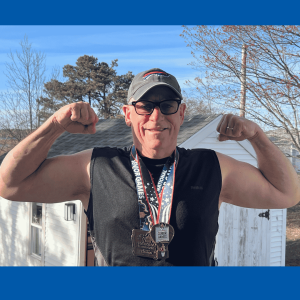
Photo courtesy Maximilian Cavalli.
All senior athletes experience illness, injuries or other setbacks. Many, like powerlifter and cyclist Maximilian Cavalli, say their fitness lifestyle helped them make a successful comeback.
Some challenges are more difficult to overcome, and Maximilian faced one of the toughest when he suffered a stroke while on the road for his sales job in 2016. He felt a little tired after a light evening workout in the hotel gym and woke up the next morning with part of his left side frozen.
According to the American Stroke Association, someone has a stroke every 40 seconds in the United States. It’s important to know the warning signs, because the faster a stroke is treated, the more likely a patient is to recover.
“…I learned a full recovery is incremental and takes time,” Maximillian says. “My daughter is an emergency room doctor, and she was very clear that 90 percent of the recovery from a stroke occurs in the first year. Anything after that is incremental.”
Instead of worrying about his fate, Maximilian got to work in rehab — and his persistence paid off. His doctors said that while most stroke survivors attain 75% recovery, they rated his at 97%.
The Brooklyn native credits his lifelong commitment to staying active — from running at the University of Maine to kayaking and competing as both a recreational and competitive cyclist — with keeping his body strong enough to respond well to the stroke. Still, he admits that life’s responsibilities had cut into his training time, and he wasn’t in the shape he ideally wanted to be.
It was later discovered that he needed PFO surgery for a congenital hole in his heart. Maximilian surprised his doctors at Brigham and Women’s Hospital in Boston with his fast rebound. “It was the same team that worked with football great Tedy Bruschi. Afterwards, they said my recovery was the fourth best that they’d ever witnessed, one of which was Tedy, and the other two were Olympians.”
Maximilian is grateful that his employer, Mannington Floors, provided six months of paid leave to support his recovery. The gesture has paid off for the 110-year-old company as he has become their national director of education market segments, saying his sport activities have contributed to his business success.
Finding Powerlifting in Senior Games
Maximilian’s Senior Games journey began in 2018 when a close friend who played basketball in the Maine Senior Games was competing while battling cancer.
Maximilian decided to compete in her honor in Maine, and then attended his first National Senior Games in 2019. He entered the Team Triathlon, where his bike segment helped win a gold medal in the 55+ category.
Maximilian came back to The Games in 2022 and 2023 to compete in Cycling Time Trials. When Powerlifting was added for the 2025 Games in Des Moines, he eagerly signed on. He had lifted weights for decades and was drawn to Powerlifting disciplines before the announcement. Now he could do the 10K Time Trial while also pouring his heart into lifting competitions.
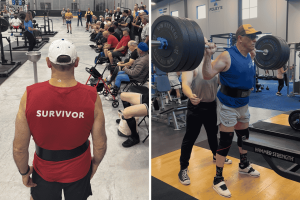
Left: Maximilian looking on the Powerlifting competition at the 2025 National Senior Games presented by Humana. Right: Maximilian lifting in the gym. Photo courtesy Maximilian Cavalli.
He was rewarded with a gold medal in Powerlifting and is confident he will top the podium again at the 2027 National Senior Games presented by Humana in Tulsa.
The two events are a perfect pairing for Maximilian. “I believe that cycling and lifting both support each other…in the bike riding, you’re strengthening your legs for lifting, and then the lifting is strengthening your legs for the bike.”
Deep Family Motivation and Inspiration
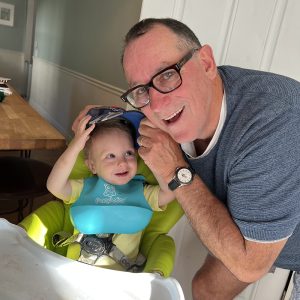
Maximillian and one of his grandchildren. Photo courtesy Maximilian Cavalli.
Maximilian credits his parents for giving him a foundation and an appreciation of family. “My father was blind, so as a result, I saw the challenges that he had to live with just going through life and figuring out how to send me to prep school and college,” he recalls. “He provided a vision to understand that you’re probably going to have to make pivots with your journey, and to make accommodations for yourself and be patient.”
The athlete also always wears a diamond pendant with the letter M that belonged to his mother, Mary. “The people that you carry are part of your life and who you are,” he stresses. “The first step is acknowledging that you’re blessed and then understand that you have a responsibility to be a light for other people.”
“I’m just so grateful that I have my beautiful wife, two children and five grandchildren, and that I can do all these things with them,” he notes joyfully. “They say, ‘My grandfather’s the strongest grandfather in the neighborhood!’. I have amazing joy in my life.”
He then adds, “I believe that God has given me these challenges to be a light for other people, to help them realize that they can be more than they think they can be.”
- Published in Athlete of the Month
Promise Made, Promise Kept
April 2026 Athlete of the Month
By Del Moon, NSGA Storyteller
Bonita Robins, 87
Topeka, Kansas
Bowling, Cornhole
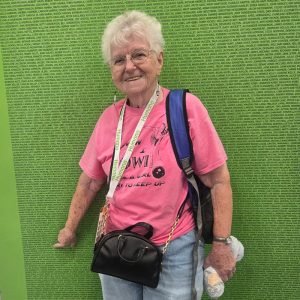
Bonita Robbins points to her name on the Humana name wall at the National Senior Games in 2025. Photo courtesy Bonita Robbins.
“Long Live the Challenge” is the motto of the National Senior Games, and the athletes who keep coming back to compete for decades are our best examples for active aging. 87-year-old Bonita Robins is amazed she has been bowling “every bit of 55 years” and has not missed a National Senior Games since 1995.
Bonita is a proud Kansas native, proclaiming, “I was born in Wamego, where the Wizard of Oz Museum is located.” Her journey is particularly inspiring because she shares she is not a natural athlete.
“Oh, heavens no,” she responds to the question. “At field day in middle school, I couldn’t run because I’d get a pain in my side when I started running, so that was it.” While she didn’t do much organized sports, her father wisely guided her to include physical activity in her life.
“He thought that girls needed to have something to do outside, and I was an only child, sitting in the house reading, doing stitchery crafts, that type of thing,” she recalls. “He thought I needed to be out in the sunshine, so he taught me how to pitch horseshoes.”
The activity struck a ringer, and it became the first sport she played regularly. Bonita didn’t begin bowling until after the second of her three children arrived in 1972. Her fitness routine became bowling in the winter and horseshoes in the summer, sometimes playing in as many as five bowling leagues at once.
She has earned local and state hall of fame recognition through her consistent participation and for serving on the local association board and helping run their senior tournaments for 20 years.
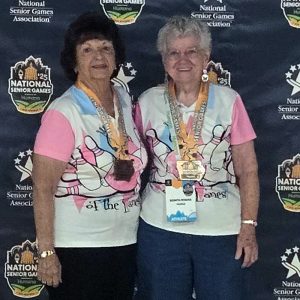
Photo courtesy Bonita Robbins.
She also became a certified coach to work with youth. “My Saturday mornings were spent at the bowling alley helping young kids improve their games,” she says. “I look back and think about all the kids that went on and took championships.”
Bonita began competing in the Kansas Senior Games when she aged up and has not missed a biennial National Senior Games since 1995. While she speaks proudly of the 19 national medals she has earned, she says maintaining her health and enjoying social connections through her sporting life are the real rewards. She also had an epiphany that shifted her focus to older adults.
The Senior Games Promise
Bonita says winning gold in her first National Senior Games in San Antonio made her stop and appreciate where she was in her life. “My partner and I were so shocked that we did that on our first try. We couldn’t believe we had done that,” she recalls.
“I looked at her and said, ‘You know what? I’m not real religious, but I’m going to make a vow to God right now. He has given me the privilege of winning this gold medal. I will do everything I can do in the future to promote Senior Olympics bowling, to get other people introduced into it, and follow it as long as I can.’ And that’s what I’ve done.”
When the Kansas Senior Games Advisory Council needed a secretary, she eagerly stepped into the role for 17 years, having had a long career in office administration. She also never misses a recruiting opportunity to tell others about Senior Games. The fact that Bonita has represented Kansas as a flag or sign bearer five times in the Parade of Athletes at Nationals testifies to her popularity and influence.
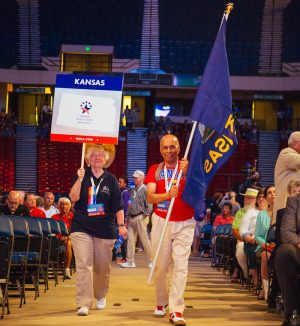
National Senior Games 2017 Parade of Athletes. Photo courtesy Bonita Robbins.
“This is all terrifically important to me,” she says earnestly. “I have made friends nationwide. I absolutely enjoy seeing them every two years. Sometimes it’s kind of hard to say goodbye when we leave, especially at our age now, because we don’t know if it will be the final goodbye. But you can’t replace that camaraderie. I tell everybody, you have no idea what it’s like until you experience it.”
Bonita also still competes in a second sport at Nationals, first with Horseshoes and now with Cornhole starting in 2022 after the former was discontinued. “I like cornhole. It involves your arm, eye and hand coordination. The bags are lighter than the horseshoes, too,” she explains. And, as years before, she was surprised to win two gold medals in her first try at the 2022 National Senior Games presented by Humana in Fort Lauderdale.
Through it all, Bonita is grateful to have had an active life with few medical problems and to have enjoyed perfect National Senior Games attendance for 30 years. Her advice to others at 87 is simple.
“Stay active. Try to eat healthy. Get a good night’s sleep. Because that’s very important for your body so it can repower for the next day. And every morning I wake up, I say, thank you God for another day.”
- Published in Athlete of the Month
Hoops & Hops
March 2026 Athlete of the Month
By Del Moon, NSGA Storyteller
Kinney Baughman, 72
Vilas, North Carolina
Basketball
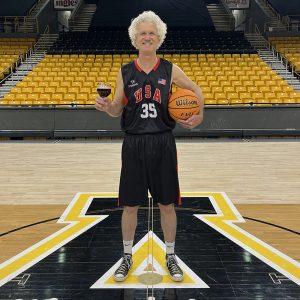
Photo courtesy Kinney Baughman.
Some people stand out in a room. In the midst of the boisterous action and noise of men’s Basketball at the 2025 National Senior Games presented by Humana, Kinney Baughman quietly drew our attention as he stood courtside. While Kinney is tall, it was his Einstein-esque hairdo, piercing eyes and beaming smile that struck us.
The kicker was glancing down to see that he was barefoot. Does he really play basketball barefoot?
“No, I just don’t like to wear shoes between games because I want my feet to dry out,” he replies with a laugh. “But yeah, I’m an old country boy from South Carolina. I grew up going barefoot and have always had a barefoot running style.”
Kinney reveals he’s a lifelong athlete. He enjoys running, but his main sport is basketball. He was the first from his small high school to obtain an athletic scholarship (to Appalachian State University) and went on to compete professionally in Europe for one year as a young adult.
Decades later, he found Senior Games and opened a new chapter that includes returning to international basketball competition as a masters athlete.
“I just never saw this coming,” he says. “If you told me that I’d still be playing competitive basketball on the level that I’m playing at 72 years old, I’d have said you’re out of your mind. All of a sudden, I find myself with this organization and making friends. It’s been great.”
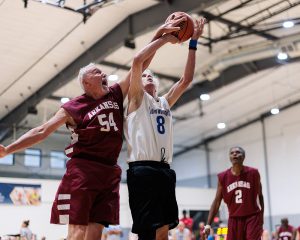
Kinney, #8, competing with the Land of Waterfalls team at the 2025 National Senior Games presented by Humana.
A Brush with Greatness, and the Country Boy Goes to Belgium
One college highlight was playing for Press Maravich, father of the legendary “Pistol Pete” Maravich, when the coach came to Appalachian State University from LSU.
“I idolized Pete because we’re about the same body type. I thought it was the greatest thing in the world that I was going to be playing for Press Maravich,” he recalls.
It did not turn out quite as he hoped at first. “I was recruited by the former coach, and I rode the bench most of that senior year,” he laments. But when his team was taking a beating by the Citadel later in the season, Maravich threw Kinney into the game in exasperation. He did not disappoint and played a significant role for the rest of the season. He even asked Kinney to join a team he was going to coach in Sweden after he graduated, but at the time, it didn’t work out.
After earning his philosophy degree, Kinney built log cabins and helped a close friend restore the Profile Trail on nearby Grandfather Mountain while waiting for his next inspiration. But the seed was planted, and three years later, Kinney was invited to play roundball for a pro team in Belgium – a life-altering experience.
“The year in Belgium was the best year of my life in so many ways – the culture, the language, the people, and the best beer in the world! For a redneck boy from Wagener, South Carolina, to go over there and have those experiences was just unreal.”
Kinney then obtained a teaching fellowship on his way to a masters degree from the University of Georgia, where he played intramural basketball to feed his sports fix. Kinney returned to North Carolina after earning his degree and eventually launched a 30-year career as a professor of philosophy and interdisciplinary studies at Appalachian State. He then transitioned to a technology career in Internet programming and computer support.
But he is better known as a pioneer in the craft beer brewing revolution of the ‘80s, and his journey to Belgium helped inspire him to try home brewing.
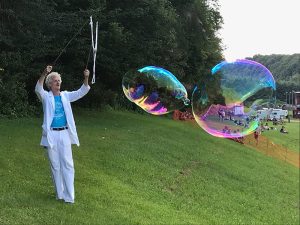
Kinney earned the nickname “Bubbleman” for delighting attendees at local festivals with giant bubbles. Photo courtesy Kinney Baughman.
“Bubbleman” Slam Dunks as a Brewmaster
“I ordered a beer-making kit from an ad in Mother Earth News and brewed my first batch of beer in 1980,” he says. “I wondered if you can make a beer as good as Budweiser at home. My beer came out really good, and I thought, ‘The hell with Bud – this is my ticket back to Belgium!’”
He did not return to Belgium, but his beer prowess led him to become brewmaster at the second craft brewery in North Carolina. Being a self-described gadgeteer, Kinney also invented an upside-down fermentation system and traveled around the country selling it. He then became an award-winning head craft brewer at the Tumbleweed Grille in Boone.
Kinney has also become known in the region as “Bubbleman” because he often brings a bubble gun to events like the High Country Beer Festival and whimsically blows bubbles for everyone.
Discovering A New Basketball Chapter Through Senior Games
The next turn in Kinney’s storied life came when he learned about the North Carolina Senior Games in 2007. After years of playing pickup games with other faculty, he was amazed he was on a team again, enjoying local and state competitions and winning medals.
Since playing in his first National Senior Games in 2015, Kinney’s teams have won two silver medals, so earning gold is high on his bucket list for Tulsa in 2027. “I want that so bad I can taste it!”
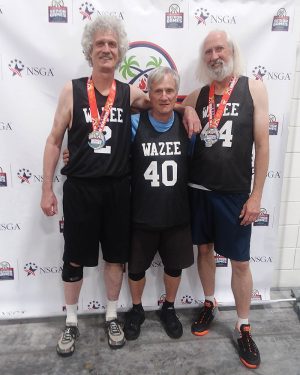
Kinney and teammates at the 2022 National Senior Games presented by Humana. Photo courtesy Kinney Baughman.
Injuries have almost convinced Kinney to quit at times, but the rewards have been worth it. “I didn’t realize how much being on a basketball team was in my DNA. There’s just a brotherhood there that’s unmatched,” he asserts.
Kinney is also stunned that his journey has led him back to playing basketball in Europe. At Nationals in 2022, Darrell Cavanaugh, the captain of the Capo Classics team Kinney played against, urged him to join his Team USA in the FIMBA championship series, informally called “The World Cup,” which draws from 250,000 masters players around the world. He will travel to Portugal this summer for his third international masters event.
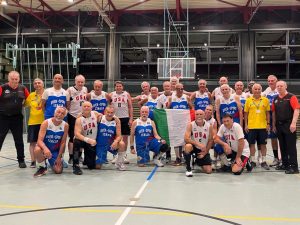
Team USA and Team Italy at an international masters basketball competition. Photo courtesy Kinney Baughman.
In recent years, Kinney was invited to join the North Carolina Senior Games Board of Directors, which he humbly accepted. “I was an ambassador for the local and state games already, and I’m kind of a big personality, so they knew they could count on me for a good media quote,” he says.
“Being asked to serve on this board was one of the greatest honors of my life,” he continues. “I love Senior Games, and I love all those people. And I’m lucky North Carolina has one of the strongest programs in the country.”
- Published in Athlete of the Month
This Pitcher is Throwing Strikes and Plot Twists
February 2026 Athlete of the Month
By Del Moon, NSGA Storyteller
Brenda “B.J.” Jones, 65
Clarksville, Tennessee
Softball
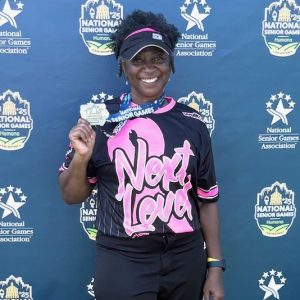
Image courtesy Brenda Jones.
Maintaining an active lifestyle is essential, but it’s just one aspect of robust aging. Finding social connections and keeping your brain engaged are also key to longevity.
Senior softball pitching ace Brenda Jones has known this intuitively for her entire life and is excited to now have time to explore her creative side as an author.
“I’ve been playing softball ever since I was like six years old, and I finally published my first book at the age of 58,” the Tennessee native shares. “It’s never too late to try something new that’s going to improve you.”
A Lifelong Love of Sports
Brenda, known by most as B.J., is proud to be a late-blooming author, but it’s clear her entire life has revolved around sports. She grew up in a blended family with 13 siblings in Union City, a small west Tennessee town with one high school. All she cared about was reading books and if there were enough kids around to play basketball and softball.
By the time she became a teenager, B.J. was playing on a mostly adult community softball team that went on the road in the summers. “We’d get in our cars and go to different places – Jackson, Tennessee, Cairo, Illinois, Dyersburg, Tennessee – just wherever we could find teams to play,” she recalls.
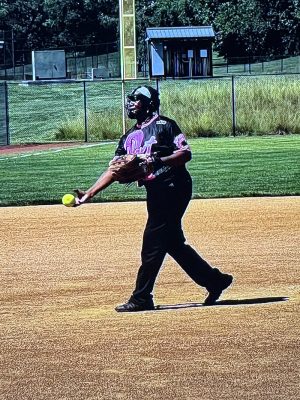
Image courtesy Brenda Jones.
There was always time to play ball, even throughout her 26-year career as a banking compliance officer and busy mother. She also found her wedding diamond on a diamond, so to speak.
“I went to watch some neighborhood guys play baseball, and that’s where I first saw this really cute guy, and he ended up becoming my husband, Anthony. We’re both pitchers, and he had a college career at Middle Tennessee State. We’ve been married for 42 years, so that was a nice perk!”
A competitive nature led B.J. to embrace the role of a pitcher. “You’re the captain of the team out there, right? Everything starts and ends with what you do on the mound,” she says. “The mental battle never stops. If I walk somebody, I have to push ‘reset’ from batter to batter and inning to inning. Pitchers can’t take what happened in the prior inning back to the mound. We have to remain engaged the entire time and focus on one batter at a time.” She then adds, “I pray a lot on the mound.”
“My accuracy is not always what it should be,” she continues with a growing smile. But when I’m on, there’s nothing more exciting than striking someone out looking. I love that!”
Finding “Extra Innings” with Senior Games
In her late 40s, B.J. was playing on a women’s league team and was invited to play in the Nashville qualifier for the 2011 National Senior Games presented by Humana in Houston. She turned 50 in time to join the team and fell in love with her team experience.
B.J. continued playing regional tournaments with various teams until she was invited to join the East Coast Gems in 2018. The team, now in the 60+ division and called Gems Next Level, has kept its core players and found success, winning division gold medals at the National Senior Games in 2023 & 2025. They also have won gold the past two years against strong competition at the Huntsman World Senior Games.
“I love my teammates. These ladies started out as my friends, and now they’re my family,” she says. “When we play in Nashville, I live 45 minutes from the ballfield and will host teammates and a barbecue. One time, I had eight of my teammates come stay at my house, and I loved every minute of it.”
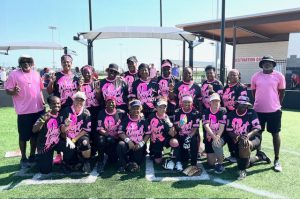
The Gems Next Level at the 2025 National Senior Games presented by Humana. Image courtesy Brenda Jones.
She says softball also taught her lessons about perseverance. “I ruptured my Achilles on my right foot during a softball game, and it was the hardest thing for me to be away from it,” she says. “But I appreciated the sport more, and it made me work harder to rehab so I could get back out here. So, even if a challenge comes, don’t be afraid of the challenge, because you can grow through it.”
The Author Emerges
B.J. has been writing poetry as a hobby since grade school, but during her banking career writing was mostly relegated to communications and analytical regulatory reports. Eventually, she was able to follow the dream of becoming an author and penned her first novel, “Not Yet a Woman,” which earned a Distinguished Favorite award for women’s literature in 2019.
Eight years later, she is still writing and has her own “W.C. Child” webpage. The third novel of her planned trilogy will be completed in 2026. She has also produced a spiritual guide and two books of poetry, but relishes being a storyteller. “I love the challenge. I like writing because I get to be somebody else through the characters.”
Speaking of being someone else, we asked why she uses W.C. Child as her pseudonym. “My father, Willmor Caldwell, never got a chance to see me publish a book. To honor him, my pen name stands for “Willmor Caldwell’s Child.”
Acting on a dream to become a writer in midlife has empowered Brenda to share advice with friends. “If you ever stop wanting to grow and take on new ideas, then you’re mentally defeated. It’s never too late,” she says, adding, “We also all need people around us. We were not meant to walk through this life alone. And even if we don’t always agree, I get to learn something about you, and you get to learn something about me.”
Watch an interview with Brenda at the 2025 National Senior Games presented by Humana below!
- Published in Athlete of the Month
Journey to Gold: How This Athlete Pivoted Through Setbacks
January 2026 Athlete of the Month
By Del Moon, NSGA Storyteller
James “Jim” DeGoey, 76
Fitchburg, Wisconsin
Recumbent Cycling
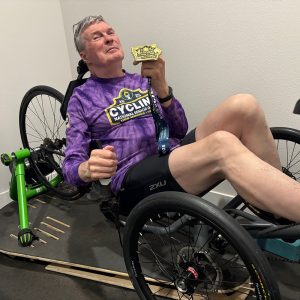
Image courtesy Jim DeGoey.
Recumbent Cycling Time Trials were introduced to the National Senior Games in 2022, providing a way for cyclists with physical limitations a way to compete using specially designed low-profile bikes.
76-year-old Jim DeGoey, a veteran of more than 150 competitive races since he took up cycling in midlife, is grateful to have this alternative pathway after a horrific hit-and-run accident nearly five years ago.
“On an early morning training ride, I was struck by a kid on an electric scooter and thrown over the handlebars. My helmeted head impacted the asphalt trail surface,” Jim recalls. “I suffered fractures in my neck and upper back, along with four fractured ribs. Subsequent spine surgery fused 15 vertebrae that left me with slouched shoulders and an immobile neck, but thankfully, no paralysis. It took almost a year of failed attempts to realize that I would no longer be able to ride my road bike, let alone race my time trial bike.”
The First Pivot: Runner to Cyclist
While Jim enjoyed riding his Schwinn bike as a kid, it was running that captured his imagination at 15. “The first race I ran was a two-mile cross-country race at the boarding school my parents sent me to,” he says. “I broke the school record by a minute and a half, and that ignited me to be a runner.”
Jim made his varsity cross-country and track teams, but says bad coaching turned him off. “The joke at the time was that he was practicing a training method called PTA – pain, torture and agony,” he says with a laugh. “The coach sat under a tree, chain-smoking cigarettes while we were doing hill repeats.” He quit the team and did not try to join any teams while attending the University of Wisconsin-Milwaukee.
He did, however, continue to run. A lot.
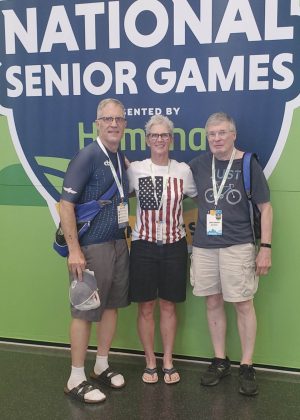
Right to left: Jim DeGoey, Tracy Drews (Jim’s coach), and Paul DeGoey (Jim’s bother). Image courtesy Paul DeGoey.
“I just ran just for exercise, and it got to the point that I was doing 100 miles a week,” he says. After becoming a freelance commercial graphic artist, Jim began competing in local road races. “I had no training. I had no coach. It was just the sheer joy of running.”
Jim only paused his pace to serve five years in the Army and four more as an active reserve. When he settled in Northern Virginia he hit the roads and trails again. “I didn’t compete at all. I was just running for fitness and fun for 20 years,” he explains.
As he approached 50, Jim had to pivot. “I developed a hiatal hernia, and my GP said my running was done and suggested I get on a bike. So I did, and when I went out on the bike trails, I’d get passed by ‘the hammerheads,’ the guys that were going as fast as they can. And I thought I can do that.”
Just like that, a competitive cyclist was born.
Jim initially self-coached and gradually joined a local bike team. Despite not finishing some races and rarely making the podium for a decade, he was determined to keep improving. By 2013, he reached a milestone and won his first cycling race, 50 years after his high school running triumph. Topping the podium fueled Jim to qualify for the 2015 National Senior Games presented by Humana with a goal of eventually winning a national championship.
Then, everything changed again with the crash.
A Life-Altering Setback and Ultimate Victory
Jim was determined to overcome his disability and new challenges. “Because I have a fused neck, I needed help to guide me across road intersections. If I want to look to the left or the right, I have to move my entire body,” he explains. “My regular bike just didn’t work out.”
There are two- and three-wheel recumbent designs, and the trike version turned out to be best for Jim, who quickly found the same joy of movement. “I started training in May 2022, and I’ve already logged 1,166 training sessions and almost 19,000 miles on it. It’s a part of my life.”
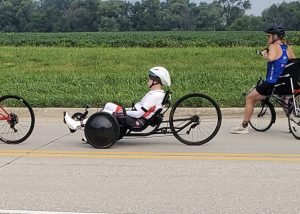
Jim lining up for the a Cycling Time Trial at the 2025 National Senior Games presented by Humana. Image courtesy Paul DeGoey.
With help and support from his brother Paul and coach Tracey Drews, Jim finally won his national championship when he captured gold in the Men’s 75-79 10K Recumbent Time Trials at the 2025 National Senior Games presented by Humana in Des Moines. He’s also working on a new goal: to write a book about his experiences.
“It’s titled ‘50 Years Between Victories,’ and it’s basically about how to resume an athlete’s lifestyle later in life,” he says with a hint of excitement.
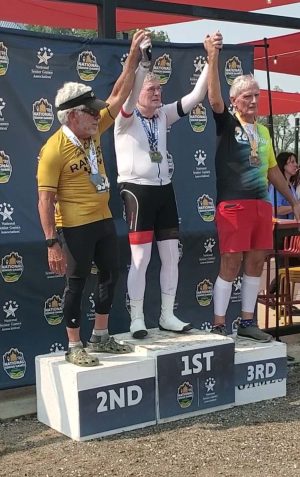
Jim topping the podium at the 2025 National Senior Games presented by Humana. Image courtesy Jim DeGoey.
“I’m getting my ACE certification as a health coach. I’m a former USA Cycling coach, but I’m not building training plans. The reality is that it is not about reliving the glory years; It’s about finding a new game plan. If you want to reignite your passion for activity, you have to look at it differently than you did in your 20s. You’ve got the opportunity now to use the wisdom of your more advanced age.”
Jim plans to make the free e-book available by mid-2026 and hopes it will help many people in the future. “As an advertising designer, my work may last for a month, and then it disappears,” he observes. “This is a lifelong legacy that I can share with my family, friends and acquaintances. That drives me more than just setting records or winning races.”
- Published in Athlete of the Month
This Running Couple is Still Going Steady
By Del Moon, NSGA Storyteller
Tim Vigil, 61
Rita Vigil, 58
Santa Fe, New Mexico
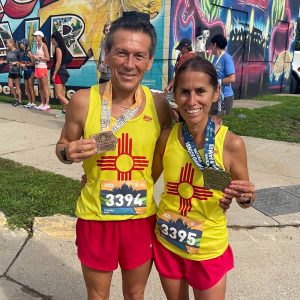
Tim and Rita Vigil pose with their medals after the 5K Road Race at the 2025 National Senior Games presented by Humana.
Tim and Rita Vigil love running almost as much as they love each other. They are living proof that you enjoy your best quality of life by doing all the right things, and they are still doing it together in their 35th year of marriage.
The prescription is deceptively simple: eat right, exercise regularly, have faith and maintain a positive outlook on life. It has served the couple well, as they have had few health issues and rebounded well from injuries in their running life.
Tim grew up in Colorado and became involved with track and cross-country in middle school. Rita, a New Mexico native, was prodded by her brother to start in high school. They met at Adams State College in Alamosa, Colorado, when both were on the cross-country team, and their friendship grew into a budding relationship. They married after college and continued running road races and marathons while pursuing careers and raising a family. Rita was a first-grade teacher and Tim became a district retail manager.
After the couple moved to Santa Fe, Rita’s brother once again urged them to compete in the New Mexico Senior Olympics in 2018. The couple made an immediate impact, racking up state medals with their performances in road races and mid-distance track events, often capturing gold and rarely missing a podium.
While they were overwhelmed with the magnitude of the 2019 National Senior Games presented by Humana held in Albuquerque, they were ready for the big stage. Since 2019, Tim has earned three gold, four silver and one bronze finish in national competition. Rita has done even better with four gold, four silver and five bronze finishes, and seems to be trending upward. At the 2025 Games in Des Moines, she streaked to first-place results in the 5K, 10K and 1500-meter races in the hotly-contested women’s 55-59 division.
Clearly, both are rising elite senior athletes bringing recognition back to New Mexico, and the couple was selected as the state’s flag bearers for the 2025 Parade of Athletes. As they tell us in the following edited conversation, Tim and Rita believe they were also chosen for their healthy outlook and the encouragement they give to their racing peers. That’s also why we selected them to be profiled, because they exemplify what pursuing your Personal Best life is all about!
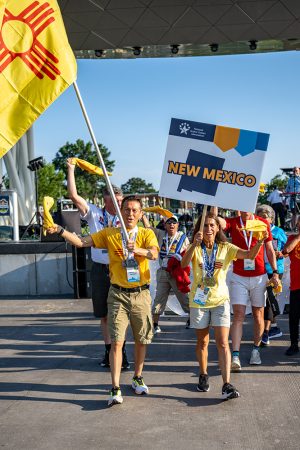
Tim and Rita Vigil proudly lead the New Mexico delegation during the Parade of Athletes at the National Senior Games in Des Moines, Iowa.
Tim and Rita, one thing that attracted our attention was your selection as New Mexico’s Flag Bearers for the 2025 Parade of Athletes in Des Moines. Why do you think you were chosen for the honor?
TIM:
When we came onto the senior scene in New Mexico, we recognized there are some really solid runners, but I don’t know that they had as many top finishes as we had, and we did it year after year in the state games and at the national games.
Overall though, I think they really felt like we exemplified New Mexico and the commitment to healthy aging. I’m 61 now and still running competitively, even against the younger guys. I mean, the top three finishers in my last 5K were 60-year-olds.
RITA:
It’s definitely an honor. I am glad to be involved with the Games, and I think we represent New Mexico very well, not just as athletes, but also helping and encouraging other senior competitors. Ceci Acosta, the New Mexico Senior Olympics director, can always count on us. It’s always an honor to represent New Mexico not only here but also at the National Senior Games. We love being involved and are always glad to help in any way we can.
Like Tim mentioned, there’s been a lot of different competitors throughout the years, but as far as I know, I don’t think there’s been that many New Mexican senior athletes that have placed as high in the road or track races as we have at nationals.
What was your impression of the National Senior Games and competing against the best people in your age group?
TIM:
Our first one was in Albuquerque in 2019, and it was absolutely fantastic. It was like being in a true championship with elite competition. I ran nationals in college and this was even beyond that. I was amazed, and honestly, super nervous because this was my first national competition since college. It was like I was a freshman in high school.
RITA:
We had not run track events since our college years, so I was kind of nervous and excited at the same time, too. It was a wonderful feeling to be back on the track and competing at the national level with some very competitive athletes. I prefer the road races, and that’s where I see myself placing in the top three, but I have started to really enjoy the track races. You have to compete against the best and that’s what we are up against every time we go to Nationals. There are some very talented senior athletes in every age group. I’ll be in the 60-64 age bracket at the next National Senior Games, and there are some tough competitors in that age group!
Everyone tells us you two were made for each other. How did you meet?
RITA:
We met at Adams State College in Alamosa, Colorado. Tim and I were part of the cross-country team there. I would see him on campus, sometimes in the computer lab, but mostly at practice. I was friends with his cousin, who was my roommate at the time. Tim invited us over just to have lunch at his little dorm apartment, and we became really good friends. After a few months, we started having feelings for one another and dated for three and a half years. We got engaged and then married right after I graduated from college. I married my best friend and love of my life, a match made in Heaven.
TIM:
Well, I was pretty introverted and started to break out of that shell in college. I wasn’t really looking for a relationship. But as we became friends, we started hanging out a lot more. I loved her big, beautiful smile – everybody compliments her on her smile. They compliment me on her smile. [Laugh] We really had a connection, and it just grew, and all of a sudden it was just like a rose blooming.
RITA:
We had a daughter a year after we got married, and we also had a son a few years later. I was a stay-at-home mom for 10 years. When my son was four, he was able to get into preschool, and that’s when I started my teaching career.
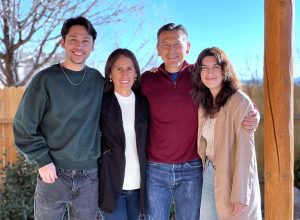
Vigil family photo. Courtesy Tim & Rita Vigil.
Did you always want to be a schoolteacher?
No, to be honest. My degree is in psychology with a minor in athletic coaching. It wasn’t until I was 32 that I decided to get my teaching certification. My kids were my priority. When they were old enough to attend school, that was when I started teaching. They attended the same school as where I taught, this was convenient and I loved that I could see them during the day.
I teach first grade and have also taught second grade. It makes me very happy when I see my students excited about learning, plus they keep me feeling young. I just like to see those ‘Aha moments’ when they get a certain concept or learn a new strategy. I tell them that they can do hard things when they work hard and not give up.
So you grew to love teaching and went back for your master’s degree. When was that?
In 2021. I decided I wanted to get my master’s degree so I can continue to improve as a teacher so I can better serve my students. I also wanted to move up to being a Level 3 teacher, which means a higher salary. I graduated this past May from New Mexico Tech with a Master of Science for Teachers degree. I am very proud of that!
Congratulations! Tim, where did your career run after college?
TIM:
My degree was going to be in math and computer sciences, and I had two classes left, but I had started working in convenience stores part-time to pay for college and to save money because we didn’t want to take out any loans to pay for our own wedding.
Right after our wedding, I got promoted to store manager for the Loaf n’ Jug convenience store chain, and we moved to Pueblo, Colorado. I was a district manager with Loaf n’ Jug until I left them and moved to Santa Fe in 2001. I was pretty much tired of convenience stores, so I accepted a job with a sports apparel company called Fans, which merged with Lids. I’ve been working under the Lids title for the last six years as a district manager.
Coaching has been an important part of your sports journey. Who has done it more?
I started while I was in college, and I was hired as an assistant coach at a high school in Sanford, it’s a small town in Colorado. The head coach there didn’t really know much about coaching track and field athletes. The next year, they asked me to be the head coach, and I did that for three more years.
When we moved to Walsenburg, I coached the cross-country team and was assistant track coach for three years there. Rita was my assistant cross-country coach for four years there. Then we moved to Santa Fe, and I helped Rita coach the junior high and high school cross-country and track teams here. Right now, I’m not doing any coaching due to my work schedule. I would do more if I could; I really enjoy developing young athletes.
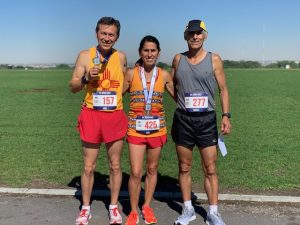
Tim & Rita Vigil with Rita’s brother, Senovio, who got the couple involved in Senior Games. Photo courtesy Tim & Rita Vigil.
You have your own senior athletic career to pursue, Tim, so you are devoting your time wisely. What’s your coaching experience, Rita?
RITA:
I started coaching when our son was in sixth grade. We both coached him through middle school and high school. I continued coaching at the high school level for 11 years. Tim was promoted at his work and due to his work schedule he was unable to continue helping me, so I had to hire another assistant coach.
I stopped coaching three years ago. It was a lot for me to be coaching while taking master’s classes, teaching full-time, and training for upcoming races. I do have a lot of free time now, and I can focus more on my training and prepare for upcoming races. I might consider coaching again if the right opportunity presents itself, but for now I’m really enjoying all this free time. [Laugh].
You’ve made many friends. Do you recognize that others are inspired by you?
TIM:
Absolutely. You know, the competitors I talk to are highly interested in the training that I do and what keeps me healthy. They follow me on Strava and Facebook so they can see my training, and I follow them back. So it’s just building those relationships. Every time we go to Senior Games or running events, we just enjoy spending time with them talking and getting caught up. It’s like, we’ve been friends since high school.
There’s something about this camaraderie thing.
You know, there’s always somebody out there that is in shape and ready to compete. You can learn and grow from meeting these new people, and I just enjoy seeing what they’re doing. I look at their training and compare it to mine and see what I can do to improve myself.
Do you feel you push each other as a couple to continue, or is it just because you love running and competing?
It’s a little bit of both. I’m on a seven-year streak without missing a day of running. I don’t want to say I’m motivated because motivation comes and goes, but it’s helped me build discipline in my training.
I would also say that if I had this kind of discipline when I was in high school and college, I would have been a much, much stronger and better runner. But that’s what keeps me going. And being able to talk to Rita about her training and how she feels. It’s just kind of self-supportive and influential between us both.
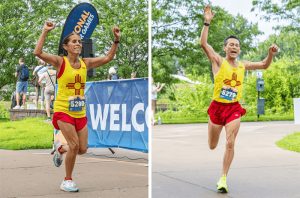
Rita and Tim’s finish line moments during the 10K Road Race at the 2025 National Senior Games presented by Humana.
Rita, would you agree that the reason why you guys haven’t been all that sick through the years is that you’ve been so active?
RITA:
Yeah, I think that is correct. Being active and eating healthy. You have to eat right in order to perform at your best. Most senior athletes don’t eat very healthy. And as you get older, you know, you really have to watch what you eat, you also have to incorporate strength training and listen to your body. Those little aches can turn into serious injuries.
Being disciplined and consistent is the key to running well when you’re in your 60s, 70s, 80s, 90s, even over 100. But for me, my faith is very important. I know God has given me a gift, and I want to use that gift to honor and to glorify His name. And a lot of people see that and are drawn to that, they come and ask for prayer or spiritual advice.
TIM:
I’m also a person of strong faith, and that’s what really motivates me and encourages me daily.
It’s a holistic thing, this aging. We don’t like to just talk about people’s athletic stuff because there’s a whole person there. And in order to successfully age, the activity is one part of it, but the social interaction is another part of it.
We totally agree, Tim. Everything you mention helps create a positive mental attitude, including your faith. So what would you tell people about the importance of putting this all together?
You know, I have a lot of great friendships with guys from college. When I see them today, some of them can barely even walk – they’re overweight and fell into bad habits. I just want people to understand that if you stay active, make healthy choices, stay positive, then your senior years don’t have to be in a wheelchair or a cane, or sedentary. Be out there, stay active! I put God first.
It doesn’t matter if you’re an elite runner, in the middle of the pack or the last one across the finish line. The bottom line is that you came across the finish line. How many people haven’t even started or are sitting on the couch?
We saw a nice quote on your Facebook page: “Commitment doesn’t happen in a day, it happens daily.” Is that your saying?
It’s a saying that’s been around a long time. Anybody can say I’m committed to doing this, but you know, three months later they’ve stopped. The only thing that builds that commitment is discipline, and discipline happens only when you do it regularly. Habits are built by doing it day after day after day.
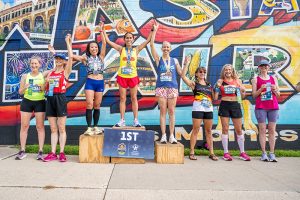
Rita Vigil atop the podium for the 5K Road Race at the 2025 National Senior Games presented by Humana.
Rita, do you have a fave expression?
RITA:
Yes. ‘The will to win means nothing without the will to prepare.’ We all want to run great races and post great times, but you have to put in the work if you want to win races. As a coach, I would always hear my athletes tell me, ‘I want to qualify for the state meet,’ and I would tell them, ‘You have to put in the work, show up every day, trust your coach, and trust the process.’ There are no shortcuts, and it’s not going to be handed to you.
Obviously, you both plan to be standing on the podium in about 20 years still doing this, right?
TIM:
That’s the beauty of Senior Games. You know, your ordinary person kind of dreads hitting that next age number. To me, it’s a new challenge going to a new age category. There’s always new opportunity!
- Published in News and Events, Personal Best Featured Athletes
Show and Tell: Retired Teacher Demonstrates Fitness and Physics
December 2025 Athlete of the Month
By Del Moon, NSGA Storyteller
Glenn Govertsen, 81
Missoula, Montana
Glenn Govertsen has an alter ego. He’s made physics cool to thousands of students across the country as “Mr. G,” host of a high-energy science show. The same infectious curiosity that fuels his passion for science has led Glenn to find new ways to stay active throughout his life.
“The important thing is to not stop questioning. Curiosity has its own reason for existing.” – Albert Einstein
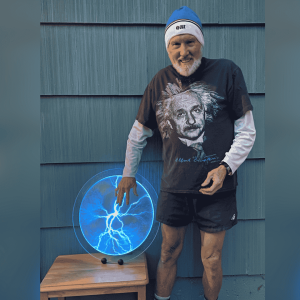
Image courtesy Glenn Govertsen.
Glenn Govertsen, a retired math and physics teacher and lifelong runner from Missoula, Montana, displays this Einstein quote on his Facebook page and says it represents his approach to life. True to form, when we asked why he decided to qualify and participate in the 2025 National Senior Games presented by Humana, he replied, “Curiosity.”
He then adds, “I realized, as all of us older people do, that time is shortening, and we just don’t know how long we’ll have the ability to take part in something. It was a desire to get to Senior Games at the national level because I hadn’t done it before.”
The Connecticut native set track records in the 440 and 880 events while earning his physics degree at Middlebury College in Vermont, followed by grad school in Bozeman, Montana. There, he fell in love with the West and pursued a 31-year career in high school teaching in Missoula. Being a golfer in the summer and a skier in the winter, Glenn chuckled, “Once you ski in powder, you don’t go back to Vermont.”
Running has been his staple for exercise and competition, and Glenn had to adapt to find events available in a rural state. While there were annual masters track meets in Montana, he needed more opportunities. “I never thought I’d be a distance runner, but road races were what was available back in the ‘70s and ‘80s,” he explains. “Then, I ran a half-marathon and thought, geez, maybe I could run a full marathon. I ran my first marathon in Seattle at age 42.”
Glenn completed 31 marathons by age 65, including multiple races in Portland, Chicago and Boston, where he knew people to host him. “I was a teacher and didn’t have money to just go so it usually depended on where I had a place to stay.”
Curiosity led him to investigate the Montana Senior Olympics, where he has been competing and consistently medaling in track and golf since 2019. Then, at the 2025 National Senior Games presented by Humana in Des Moines, Glenn earned a Bronze Medal in the Men’s 80-84 400-meter race for his efforts. “At this age, just running nonstop for any distance is a success,” he humbly quips.
The “Mr. G Science Show” Takes the Stage
Glenn has had the same curiosity and enthusiasm for teaching science as he’s had for his athletic pursuits. The passion to explain the importance of math and physics in his students’ lives inspired him to stage entertaining, understandable science demonstrations in class using everyday items to help his students “power their inner lightbulb.” No one was absent on the days he had a demonstration.
The passion continued after Glenn retired in 2004, so he assembled his most popular experiments, and the “Mr. G Science Show” was born. “After I retired, I was involved in a program in Montana helping unprepared teachers get some more science in the summer,” he recalls. “Then, I went to school assemblies and that evolved into the show.”
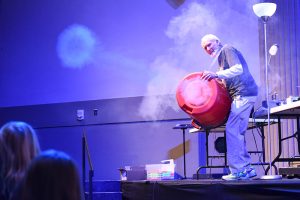
Image courtesy Glenn Govertsen.
He eventually found audiences around the country and beyond. “I was involved with physics teachers at the national level, and some professors at Florida Atlantic University in Boca Raton had math camps in the summer, and I would go and do my demonstration for the kids.”
One professor invited Glenn to bring his show to her hometown in Warsaw, Poland. “I got to go to Poland five times,” he says with some wonder still in his voice. “Some of it was my own cost, but it was well worth it.” You can watch a highlight reel of one of his 2014 visits here.
A Body in Motion…
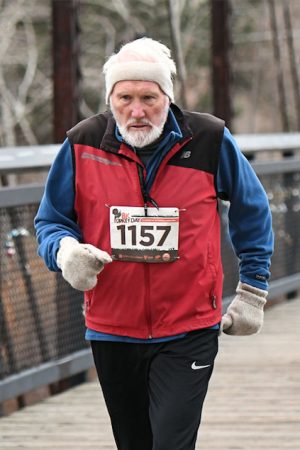
Image courtesy Glenn Govertsen.
Having an inquisitive mind has served him as an athlete. With limited coaching as a youth, Glenn had to read up and train himself. Through experience overcoming injuries and medical setbacks, he has made discoveries along the way.
“The most fascinating thing is that the body gets better as you use it,” he says. “When I started doing 50 to 60 miles a week, I found that I got better instead of just breaking down. That was a very important scientific thing to me.”
He also keeps a chart listing results and times for all his races, broken down by five-year intervals. “I see it as a science experiment. Of one. With no control group,” he says humorously.
While Mr. G has applied his mind to learning the mechanics of his sports, he doesn’t overthink it and takes a holistic view of the physical, mental and social benefits. “When we read about aging, we realize that those are pieces of a healthy life, especially to have social interactions,” he observes. “I’ve met some very interesting people, and we all have our own stories. I appreciate the camaraderie more than anything.”
- Published in Athlete of the Month
Skilled and Chilled: “Drea C” Takes the Pressure Off on the Track
November 2025 Athlete of the Month
By Del Moon, NSGA Storyteller
Andrea Collier, 59
Orlando, Florida

Photo courtesy Andrea Collier.
Many athletes have to overcome feelings of anticipation and stress when they compete. The pressure to perform can be even more intense for elite athletes who chase medals and records after months and years of serious training and preparation.
Not rising star Andrea Collier, 59, a former Florida State University trackster who tells us returning to competitive running after nearly three decades actually relieves her stress. It must work, because there’s a #1 next to her name in every running event she has entered in the past three National Senior Games. She still holds the American record in the hotly contested Women’s 55-59 100-meter event she set in 2023.
Balancing Work, Family and Elite Track
The reason Andrea, who sports the nickname Drea C, feels so “chill” goes beyond the confidence built through practice and experience. She says it’s a relief from the challenges she faces balancing a demanding work life and family with her growing senior track career.
Since 2010, she has worked for the Federal Emergency Management Agency (FEMA), and 2025 has proven to be her most challenging juggling act yet. “I’ve had some pretty tough assignments where I’ve had to work seven days a week with 12-hour days,” she explains. “For the first time, coming from a work assignment for almost two months nearly destroyed me physically and mentally. When I’m working those kind of hours, there’s no way in the world I can work out.”
The Florida native considered dropping out of the prestigious World Masters Indoor Championships, which were held earlier this year for the first time in the U.S. in Gainesville, Florida. However, she managed to compete with limited preparation. The midyear loss of a favorite uncle also weighed heavily on her heart, but she says her track family has rallied her through the season. “It was tough, but I had a lot of people praying for me and talking with me.” She is not a member of a track club and is grateful that some athletes have offered to help her train at times.

Andrea racing at the 2023 National Senior Games presented by Humana.
A Year of Surprises and Challenges
Andrea’s 2025 track season actually began unexpectedly while she was on a FEMA assignment to Alaska. “The USATF Alaska Association put on a couple of indoor meets and they were really, really nice to me. That got me back on the right track.” Her competition calendar has since been full with masters events, several state Senior Games and the 2025 National Senior Games presented by Humana in Des Moines.
Another unusual opportunity was linked to Andrea’s previous work. Since she was a probation officer for the Florida Corrections Department for more than a decade, Andrea discovered she was eligible to compete in the 2025 World Police & Fire Games, a multi-sport event for first-responder athletes held in Birmingham, Alabama, in June.
“That was amazing,” she recalls. “People came from all over the world. [For the relays] you can actually have a mixture of teammates from other countries- it’s not like just four members from USA, and that was unique. I’ve never experienced anything like that before, so that was nice.”

Andrea of some of her track family. Photo courtesy Andrea Collier.
More Than Medals
While she has enjoyed great success since returning to competitive track in 2015, she equally values the social benefits from having a track family and the simple fact that running is her happy place.
“Track is fun for me,” she says. “I have the competitive fire, and the camaraderie with the athletes is very important. Some of us have really become good friends, and we support each other outside of track. And I think it definitely can improve your health and decrease your stress levels.”
Andrea then adds with a light laugh, “I have been told I never lose. Trust me, I lose a lot more than you think. I’m a hurdler – that’s my favorite event – and there’s a young lady that has come up and entered that arena within the past few years. I have not beaten her yet and I’m okay with that, because iron sharpens iron and we have very competitive races.”
The banner event season concludes when she travels to Santiago, Chile, this month for the World Masters South American Championships, where she hopes to refine her hurdling skills in an endless drive for improvement.
“Honestly, I don’t really focus on the medals, I just try to do better than I did before,” she says. “I try to prepare myself to be ready to give it my best shot. And, you know, whatever happens, happens. I am more concerned with ‘Did I execute everything in the race the way I needed to?’ If I did, and I feel like I gave 100%, that’s all I can do.”
She pauses and adds, “I like challenging myself, and track is challenging- but I don’t back away from something like that.”
- Published in Athlete of the Month
Born to Coach
By Del Moon, NSGA Storyteller
Donald Widener, 68
Suffolk, Virginia

Donald Widener at his induction ceremony for the Black Tennis Hall of Fame. Courtesy Donald Widener.
Not everyone knows what they want to do with their life as a young teen, but Donald Widener did – with a little help from his sister and a perceptive coach.
Donald almost didn’t make it out of the hospital – he was a premature baby and the doctors discussed euthanizing him. Coming from a poor Black area of Cleveland, the standards for care were different before the Civil Rights Act. However, Donald’s mother and grandmother would have none of that and brought him home in a shoe box.
Early youth was difficult as Donald fought to overcome numerous issues with delayed development of walking, speech and learning abilities. He doggedly progressed and was playing basketball and touch football as a pre-teen. A horrific leg break while playing football affected his ability to jump and shoot. That’s when his younger sister Carmen encouraged him to come play with her in a summer tennis camp. As you will discover in the following edited conversation with Donald, she had a humorous ulterior motive.
But going to tennis camp was a big thing and he leaned into learning the sport, interacting with the other kids and practicing longer after sessions. That’s when the coach told 13-year-old Donald he saw something in him and offered him a job to coach that same camp the next summer. At that moment he knew he wanted to play and coach tennis professionally one day.
Donald made good on the dream, playing tennis throughout a 27-year Navy career, often starting programs wherever he was based. He became a certified coach and launched his own coaching business while also working at a string of coaching opportunities, including directing one of Arthur Ashe’s initiatives called An Achievable Dream serving underprivileged kids in Newport News, Virginia, and tennis teaching pro for five years at the University of William & Mary. While there, he brought the ACEing Autism program to the school, which helps children with autism grow through tennis. He is currently coaching at a high school in Suffolk, Virginia, and coaches youth to compete in United States Tennis Association (USTA) Junior Nationals. He proudly speaks of his team winning a championship in 2024.
When a friend steered Donald to Senior Games, he felt a path had opened. He had taken students to national events but never played in one himself. He fell in love with the people and atmosphere at the 2017 National Senior Games presented by Humana and is excited to continue to attend for as long as he can play.
Donald Widener’s journey is remarkable as he found that the best way to improve himself was to teach and serve others, many from difficult backgrounds like his. He has transformed a profession into a purpose-driven mission. For that, he was recently recognized with induction into the Black Tennis Hall of Fame. (Of course, his sister nominated him!) It’s a testimony to a man who has pursued his Personal Best for a lifetime and sees more to do ahead. Be like Donald!
Congratulations on your induction into the Black Tennis Hall of Fame, Donald! In your nomination bio, your sister, Carmen, says that you were a premature baby and the doctors actually talked about euthanizing you. What happened in your early life?
I think you ought to recognize the times then. Our American medical system was not always fair for folks. Remember the Tuskegee experiment and different modalities of how we treated some with grace and care and others with not so much. So I think at that gestation period, 1957, I was a preemie and considered to be a Black boy who wasn’t going to make it. They told my mom, ‘He’s not going to be of any credit to you. You will take care of him for the rest of your life and he won’t be of any societal gain.’
So she said nope, nope, nope. My mom at that point was 15 years old, but she had enough wisdom and foresight. My grandmother, who stood about three feet tall, was a giant in what she said and what she did and what she meant. So they said no, and they brought me home in a shoe box and my grandmother started administering the things that we call hometown remedies.
I had a lot of issues with speech and language and developmental delays and things like that. I couldn’t walk, but over time I watched my sister do it and then I followed her lead.

Donald Widener and his sister, Carmen. Courtesy Donald Widener.
Your sister is a major influence on your life, since she states she first taught you to play tennis.
Yes, I was 13 and she was playing in a summer program that Arthur Ashe, Charlie Parserels and Sheridan Snyder started called the National Junior Tennis League at that point. Now it’s called National Junior Tennis and Learning. They wanted to bring tennis to underserved communities who otherwise wouldn’t see it, wouldn’t have it, wouldn’t have available options to get it.
The funny story is that she kept telling me, ‘Come to tennis, come to NJTL.’ But her real motive was that I was going to be there to help her pick up balls, because she was tired of chasing them. [Laugh]
I had already been playing basketball and thought I was pretty good at doing things with the ball. It was the same balance and eye coordination that helped me develop the ability to walk. But I also played touch football in the street and one day I caught a ball and was backing into the end zone when my left foot stepped into a sewer hole when I got pushed out of bounds. You know that cereal Rice Krispies, right? Snap, crackle, and pop is what I heard. My left leg was broken in three places and in a cast for eight weeks.
Ouch!
After I healed, every time I twisted my ankle, it took longer to heal. Jump shots were issues.
Basketball was not good. So that was when my sister said, ‘Come to tennis. Help me pick up balls.’
When I went there I found out there were girls there, and it was fun. I was in the sun and they gave us snacks. I got a free racket and a T-shirt. People were nice to me. The place was on a college campus in Cleveland. It was fun and I went back every day. So that’s how I got started playing, and I started coaching the next year.
What? You became a coach at 14?
Yes. I practiced a lot. I was there before everybody and I was still hitting on the wall when everybody left. The coach said to me, ‘Come back next year, I want you to coach.’ I said, ‘Coach what?’ [Laugh] He said, ‘Coach tennis. There’s something about you. Come and do a summer job. It’ll be fun, and you’re going to teach what you need to learn.’
I couldn’t wait for the summer to come. And I got this hunger for it. And I just wanted more and more and more.
Your enthusiasm recalling this makes us think you knew even then that coaching is what you wanted to do the rest of your life. Did that occur to you?
Yes. I wanted to be on the tennis court, having fun, working with kids. And the reality of it is that kids learn from kids best. And so when coach would teach me, I would take that and internalize it and say it in a kid’s way.

Donald in his element, coaching youth. Photo courtesy Donald Widener.
Did you get to play tennis in college?
I was not a good student in high school. Some days I went in the front door and out the back door. I still had educational delays and just felt like education was not something that I was good at.
I did finish high school, and community college scholarships were available for tennis and other sports. But you got to be in class. You got to be a B student. I wanted to play tennis, but I didn’t think I’m ready for that. So I talked to a Navy recruiter and wanted to be a submariner.
The Navy was my calling card to get out of Cleveland and do something bigger for my life and bigger in terms of service. John Kennedy said, ‘Ask not what the country can do for you, ask what you can do for your country.’ And that for me was a calling to my heart.
I rode in the Navy’s first ballistic nuclear submarine called George Washington. I realized it was fun, but it wasn’t what I needed to be. So I entered medical training with a specialty in tissue banking and dialysis, and I ran the Navy’s dialysis units. I did some dialysis work in the Persian Gulf War theater. I served in the Navy for 27 years.
Were you playing tennis all during that time?
Yes, I was playing tennis the whole time. Every base I went to, we always had tennis courts.
We had a program called MWR, which stands for morale, welfare and recreation. We had tennis courts, but no tennis programming. So every place I went I would start a tennis program. I had the passion for teaching.
Funny story is that I met my wife in California. She was also in the Navy and had finished her portion of medical training. I was an underclassman and she was dating somebody at the time. So we ran into each other again 3,000 miles away in Virginia and I told her we met before and she replied, ‘No we didn’t’ and was wondering ‘Who’s that guy?’ That was 42 years ago!

Donald Widener and his wife at the Veterans Golden Age Games. Photo courtesy Donald Widener.
After the Navy and getting married you got involved with a number of interesting tennis programs. Your bio mentions you participated in something called An Achievable Dream for the next nine years. What is that?
An Achievable Dream is one of Arthur Ashe’s initiatives that helped grow tennis. I was a USTA certified pro and they called me to come work the program in Newport News, Virginia.
They would take 100 kids out of elementary school, not all good kids, not all bad kids, for the summer program. We give them education and lunch. The kids who were problematic in school went back into the school institution, same school, with no problems. They were in class.
The whole goal is beyond tennis, it’s elevating the human condition via education, culture and soft skill stuff. You know, yes or no, shaking hands, taking kids on trips. The area that these kids grew up in was a tough area. Michael Vick and Alan Iverson came from there. It’s important for these kids to have their own individual achievable dream.

Donald with professional tennis players Serena Williams, James Blake and others at an Achievable Dream event.
From there you were at the University of William & Mary from 2013 to 2018. What was your job there?
They wanted me to be the assistant coach for men’s varsity tennis, and at first I felt that that wasn’t my calling because a lot of the kids that go there are privileged and they would ask me the same questions – ‘Where’s your degree? Who did you play for?’ But I did know that I needed to do something different. So I went there for five years as the head teaching pro.
The U.S. Tennis Association also had a thing called early development centers. USTA felt that tennis was behind because we didn’t have the track of developing any younger players in a consistent fashion.
I asked about bringing some kids in that can’t afford to be in the school. My boss said we could have one or two, but he said we don’t want to make this a YMCA and don’t want a whole bunch of people running around who can’t pay. And I was like, well, we’re a public university and should serve the community. So I was able to do that program while there.
Your bio also mentions you ran a program called ACEing Autism during that time. We assume you brought that program to the university. What was it like working with those students?
Yes, ACEing Autism was a national tennis program for young people with autism, and mine was the first in Virginia. [Coaching] is different. When you share information with them, how they translate that may be different than what you intended. So you have to [speak intentionally] and do more [demonstrations].
A child with autism may be with you in a moment and the next second they’re somewhere else. But when they’re engaged, they’re engaged. So patience is paramount.
Donald, it’s amazing how you overcame your challenges and made yourself better by dedication to helping and teaching others.
Yeah. I say all the time, we’ve got to figure out ways to take care of each other better. We do it either proactively or reactively, but we’ve got to do what we can to better the human condition.
We’ve got to do what we can. Arthur Ashe said it best – do the best you can with what you got, where you are.

Coach Donald and his championship-winning team. Courtesy Donald Widener.
So we finally talk about Senior Games where we first saw you compete in 2017 in Birmingham.
I heard about it through a friend and I had never been in a national competition in my life. I’ve been to national events with kids that I coached but never done it for myself.
In coaching, we got to remember what it feels like to be on the field of competition and what it feels like to embrace the W or L, and to just understand you’re winning because you’re there.
It’s great seeing folks at all The Games, to converse with them, have laughs, travel, and say I’ll see you in two years. That’s beautiful, and it gives me something to look forward to, rather than sitting in the now and not having an answer for what’s happening tomorrow.
It’s just a beautiful pathway to be forever young. I think somebody made a song about that, right?

Courtesy Donald Widener.
Yes, Rod Stewert appreciates you recalling his song. In that spirit, there was a recent study that states tennis can extend life expectancy by 10 years for people who play it regularly. Do you feel like you’re 10 years younger than your age?
Yes. I tell people my age, and they don’t believe me.
In the medical component, you’ve got to have movement for your joints. For example, women who have no weight-bearing activities have osteoporosis later in life because they just didn’t do enough walking or weightlifting or enough sports that challenge the body and the skeletal system to perform, to improve.
Clearly, your philosophy goes beyond the physical into the social and emotional benefits as well.
So the whole thing is not just coaching the mechanics. It’s the holistic, always whole-person. I need to know how you best learn before I can offer you anything.
I play for the passion of it, for the fun of it, and I really want to win, never in a disparaging manner. We always win or lose with the same grace. We can teach people how to share and how to be more connected in life via sport. How beautiful is that?
It’s amazing how far you’ve come and what you’ve been able to do for others – and what it’s done for you. You communicate very well given your past issues. You must feel terribly gratified.
I guess I don’t do badly for a kid with a speech impediment! [Laugh] There’s tremendous gratitude. I feel incredibly blessed to be able to have any of this happen in my life. My wife, our kids, the kids that we have come in contact with…we have a school system of 600 kids and they all call me dad because their biological fathers aren’t always active.
So I feel all this privilege, all that’s the grace of God. But He says to me, ‘I’m not done with you yet. There’s still more work to do.’
- Published in Personal Best Featured Athletes
Davis Johnson is Going the Distance for Disc Golf
October 2025 Athlete of the Month
By Del Moon, NSGA Storyteller
Davis Johnson, 75
Monson, Massachusetts

From the time he laid hands on his first Frisbee in 1965, Davis Johnson became obsessed with throwing it as far as he could. That would lead to getting his name into the Guinness Book of World Records as the first person to throw the disc more than 400 feet (412 to be exact) and made further history by competing in the first recognized disc golf tournament in 1975.
He’s still helping advance the sport 50 years later, both as an organizer and competitor. His wife, Joan Simmons, is the event coordinator for 25 sports for the annual Massachusetts Senior Games and encouraged Davis to be the tournament director for Disc Golf in 2016. He still serves in that capacity and even co-designed the local disc golf course in Wilbraham where they compete.
In a way, Davis wrote his own ticket to the 2025 National Senior Games presented by Humana, because the level of sport participation at the state level often determines when a sport can be offered nationally. Davis eagerly competed in the debut of Disc Golf in Des Moines, winning gold in a field of four in the 75-79 age group. “One guy, Jerry Brown, was a serious challenger and gave me a good run for the money,” he says. “I was only two strokes ahead after the first round and kind of sweating a little bit. I had a real advantage over him in a variety of shot choices but I have to give him tribute for keeping it very close.”
A Pioneer in the Sport
Davis marvels about his role in the formative age of competitive disc throwing and how the sport has grown internationally with both informal play and professional tournaments. He says that in the beginning, there were various games created for the flying disc, but Disc Golf really took off as the dominant sport when the disc basket pole was invented.
“The way we played before was to set up object courses in various places hitting rocks or trees. It was a cross between golf and miniature golf,” he recalls. “Ed Headrick was the Johnny Appleseed of the game, and he went all over the country pioneering disc golf courses. His basket was the real catalyst for getting the sport going because there was no longer an argument whether a disc has gone into a basket or not.”
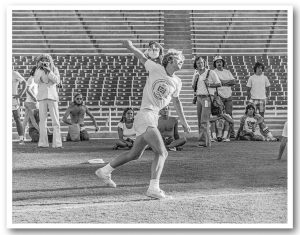
Davis Johnson competing in the 1975 World Frisbee Championships. Image courtesy Davis Johnson.
He is proud to have participated in the 1975 World Frisbee Championships held in the Rose Bowl in Pasadena. His distance record for throwing a disc over 400 feet, considered by players as the “4-Minute Mile” of the sport, was not recognized by Guinness immediately. “I held both the indoor and the outdoor records since 1974,” he explains. “But it was not put in the book until 1978 because I did it with a non-Wham-O disc. In those days, they were the domineering company in the game, and if you didn’t throw a Frisbee (created by Wham-O), you didn’t get in. Now there are dozens of disc golf companies around the world making discs.”
His record was broken by fellow MIT student and friendly rival John Kirkland. “I held it for almost five years, and John broke it in a tournament in Texas,” he says. “However, he used a slightly more advanced disc. I still hold that record for classic discs, so technically it has not been broken. But as they say, records were made to be broken.” Davis recounts his early history in this article for The Flying Disc Museum: A Far-Out History of Throwing Far.
The Advantages of Disc Golf
Davis finds several reasons for the growth of Disc Golf. “For one thing, people are daunted by ‘ball golf’ as we call it because it’s difficult and can be frustrating. Disc golf is much easier for the layperson to pick up, and it’s also far less expensive,” he explains.
“The discs are reasonably priced – many courses now are pay-for-play, but you’re probably going to spend no more than $10 for a round. It’s informal, fun and really inclusive, and we are trying hard to get more women into the sport.”
Instead of clubs, he says most players use 15 or 20 discs to make shots. “There are specialty discs that will go one direction or another, and you have your putters, and your mid-range would be your irons, and then you have your drivers, which are less predictable but go a lot farther,” he says.
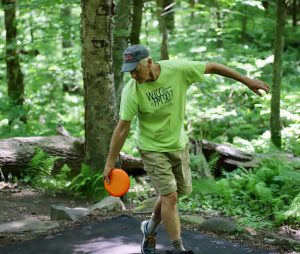
Davis Johnson preparing for a throw. Image courtesy Davis Johnson.
Davis, a published poet and songwriter who edited Victor Malafronte’s “The Complete Book of Frisbee” in 1998, is retired after a 30-year career teaching writing, speech and journalism at Springfield Technical Community College. He has also worked as a radio weathercaster, motivational speaker and author of a children’s book. But he has always found time to get out in nature and fling discs around, and he believes Disc Golf is here to stay in the National Senior Games.
“I got in so early I’m number 44 in the Professional Disc Golf Association (PDGA), and there are now over 200,000 members,” he notes. “Those people are aging just like me, and I think the senior competition will become a lot more challenging and fun.”
Davis summarizes that it is the people that he loves most about being in his sport. “If you had disc golf people running the world, we’d have a lot more egalitarian and peaceful world, because people treat each other well in this sport.”
- Published in Athlete of the Month