

68 is the New 40?
Seniors Who Exercise Can Shave a Quarter-Century—Or More—Off Of Their Age
National Senior Games Association Survey Reveals Vital Stats on Fitness Age of Athletes
BATON ROUGE, La. (June 30, 2015) – Just in time for the start of the 2015 National Senior Games presented by Humana, The National Senior Games Association (NSGA) — a Multi-Sports Council Member of the United States Olympic Committee — today released the results of a survey of more than 4,200 competing senior athletes which revealed that exercise cut the fitness age of participants by nearly a quarter-century, from 68 to 43.
The athletes, all of whom qualified for the 14th biennial National Senior Games taking place July 3-16th in Bloomington/Minneapolis/St. Paul, completed a fitness age test developed by researchers at the Norwegian University of Science and Technology. Based on the concept that physical fitness is essential to a long life and good health, the online fitness age test calculates individuals’ fitness age based on a few simple questions such as gender, waist size and exercise routine.
“The Fitness Age survey is unique in that the questions highlight important risk factors associated with disease and disability,” said Pam Peeke, MD, MPH, FACP, Trustee, National Senior Games Foundation Board. “People with a good Fitness Age tend to have lower waist sizes, higher aerobic capacity and optimally healthy lifestyle habits. All of these factors are taken into consideration in the calculation of the Fitness Age.”
The survey also revealed specific US states where senior athletes had the greatest difference between their actual ages and fitness ages. The top 10 states include:
| State | # of Respondents | Avg. Age (state) | Avg. Fitness Age |
| Washington | 102 | 66 | 39 |
| Georgia | 87 |
66 |
40 |
| California | 363 | 66 | 40 |
| Idaho | 89 | 67 | 42 |
| Nevada | 79 | 68 | 43 |
| Arizona | 136 | 69 | 44 |
| Florida | 322 | 69 | 44 |
| Connecticut | 72 | 66 | 43 |
| Massachusetts | 71 | 65 | 42 |
| Missouri | 96 | 65 | 42 |
The state of Washington has the “youngest” senior athletes with an average fitness age of 39, followed by Georgia and California, which tied for the second overall spot with average fitness ages of 40. In these top 10 states, the most popular sports ranged from track and field to cycling, swimming and pickleball.
“The National Senior Games athletes are living proof that you can make a dramatic impact on slowing the aging process by staying fit,” said Peeke. “It’s absolutely never too late for anyone to get more fit and improve their overall health. It’s as simple as assuming the vertical and walking each day.”
The results of this survey come just a few days ahead of the 2015 National Senior Games presented by Humana, the largest multi-sport qualified competition event in the world for men and women 50 and older. Nearly 10,000 athletes are expected to compete in more than 800 events, over 13 days at 26 sport venues throughout the Twin Cities metro region.
For more information on the Fitness Age test please visit www.worldfitnesslevel.org
###
About The National Senior Games Association
The National Senior Games Association (NSGA) is a nonprofit member of the United States Olympic Committee that promotes health and wellness for adults 50 and over through education, fitness and sport. NSGA governs the 2015 National Senior Games presented by Humana, the largest qualified multi-sport event in the world for seniors. NSGA sanctions member state organizations across the country that host Senior Games or Senior Olympics to provide seniors with quality sports activity. For more information, please visit www.NSGA.com
NSGA Communications and Media Contact:
Del Moon
Ne**@**GA.com
225.202.5719
- Published in Press Releases
The Long Run – June 2015
Game On!Athletes – Remember to Check In Before sharing several cool updates, we want to remind athletes going to the 2015 National Senior Games presented by Humana that you need to check in at the Minneapolis Convention Center to obtain your credential before your competitions. You will get a packet that also includes the Official Commemorative Program and other useful information, and you will be able to check out all of the exhibits and activities that will be going on there throughout The Games.
Please note that coaches, spouses, partners or friends may not check-in for another athlete. Each athlete must check in individually. 2015 Games Daily News Online to Debut July 3Extra! Read All About It! Everyone will be able to enjoy finding news, features, photos and information links updated daily during The 2015 National Senior Games presented by Humana. The news staff and editors will include interns and faculty from the University of Minnesota School of Journalism and Communication, made possible by a grant from the Minneapolis Star-Tribune. Photography and videography will be provided by interns and faculty from Brooks Institute, a highly regarded California visual arts college. Brooks students have captured our official photographs for each National Senior Games since 2009. Visit and bookmark NSGA.com/2015-games-daily-news.aspx beginning Friday, July 3 through July 16. Each Daily edition will also be archived and available to view on our website long after The Games are history.
|

Association NewsInteractive “Personal Best Empower Hour” Programs at The Games What really is a person’s “personal best”? Experts and athletes will hold interactive discussion at NSGA’s Personal Best Empower Hour events during the 2015 National Senior Games presented by Humana. On Monday, July 6 from 3-4 pm, bestselling author, nutrition/senior fitness guru, National Senior Games Foundation Trustee, and National Senior Games triathlete
Dr. Pam Peeke leads informative and informal discussion and storytelling with featured “Personal Best” athletes and the audience. On Saturday, July 11 from 3-4 pm, Shellie Pfohl, executive director for the President’s Council on Fitness, Sports and Nutrition will moderate the second Empower Hour with Council member Dr. Stephen McDonough as a special guest.
The programs will be held on The Goodman Group Main Stage in The Village: A Health and Wellness Expo and Athlete Experience at the Minneapolis Convention Center. Admission is free and open to the public. Door prizes will be given out.  The Personal Best Tour visited the Indiana State Games in May for a presentation to The Horstman Family of bowlers. Inspired by patriarch Carl Horstman, seven family members have followed to participate in state and national Senior Games. Find their profile, and read more about our visit to Evansville in our tour blog on the Personal Best webpage. |
HUMANA Heroes: Athlete of the MonthUnexpected Plot Twists In her mid-50s, independent filmmaker Jane Pittman was looking for her next documentary subject. A friend suggested she check out the nearby NOVA United Senior Women’s Basketball Association, in which more than 50 women between the ages of 50 and 76 from all around the metro Washington, DC region practice and compete. At the time, four NOVA teams were gearing up to qualify for the 2013 National Senior Games presented by Humana, and the fascinated Pittman decided that the diverse backgrounds of the players, with their joy and intensity to be part of a team on a mission, would make for a dynamic film. As she warmed up to the idea, the ghosts of old memories and unfulfilled dreams welled up. Pittman was once a promising star of her high school basketball team, but the pressure and expectations were too much to bear at the time. She ran off the court during a tournament and put her athletic career behind her. Or, so she thought. The plot suddenly twisted as old passions awoke, and she wanted to play again as a senior. “I had not played in 43 years,” Jane recalls. “But once I started my research, I couldn’t stand on the sidelines. After joining in, I had such a strong reaction that I realized maybe the hook of the movie could be about my experience of coming back to the hoop within the story of this league and these women.” The decision was a good one. The film, Coming Back To The Hoop, debuted in late 2014 and has already been selected and screened at numerous film festivals. To date, it has earned three awards and two additional nominations. Pittman will also screen the movie and comment about her experience at the Minneapolis Convention Center village during the 2015 Games in Minnesota. Read the Complete Jane Pittman Story Here We’re always looking for great athlete stories. Submit yours or nominate a fellow athlete who inspires you at our Athlete of the Month page at NSGA.com! |

Senior Health and WellnessStarkey Better Hearing Athlete Profiles
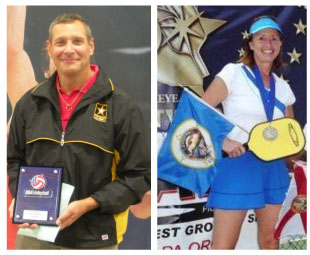
This month, Starkey Hearing Technologies, the Official Hearing Partner of the 2015 National Senior Games presented by Humana, wants to spotlight two Senior Games athletes as their Minnesota Better Hearing Athletes. Volleyball player Bob Stanek and pickleballer Rachael Kroog were fit with custom Starkey hearing aids in April.
You will enjoy learning more about these featured athletes. Please follow the link below to read the article, and if you are going to Minnesota for The Games stop by the Starkey Hearing Technologies booth when you visit The Village.
Starkey Better Hearing Athletes SAFE Screenings Return for 2015 National Senior Games
Physical therapists will be providing Senior Athlete Fitness Exam (SAFE) fitness screenings during The Games at The Village: A Health and Wellness Expo and Athlete Experience sponsored by AstraZeneca Diabetes. SAFE is a research and service activity intended to promote continued health and wellness in senior athletes while continuing to learn more about the benefits of staying active with aging. Dr. Becca Jordre, a board certified Geriatric Specialist and faculty member with the University of South Dakota, has been conducting the program at the National Senior Games and at selected state Games since 2011. Jordre has coordinated with physical therapists and physical therapy students in the Twin Cities region to offer the SAFE throughout the National Senior Games in Minnesota. “We’ve paired with the University of Minnesota Physical Therapy Department, Live your Life Physical Therapy, and other local PTs who are eager to help with the SAFE this summer. We’ve developed a way to e-mail individual SAFE results to participating athletes the same day they are screened and will have past results available for those who participated in Cleveland in 2013 so they can compare from past years.” SAFE includes screening athletes for cardiovascular risk factors, strength, flexibility and balance and takes approximately 20 minutes to complete. Athletes who participate will receive feedback on their results as they relate to known normative data and will be alerted to any detected risks for disease or injury. All testing and results are kept entirely confidential. |

NSGA Online Merchandise StoreGet Games Gear in Minnesota or at Home You’ve probably heard the expression “Been there…Done that…Got the T-shirt” before. For those of you athletes going to The Games in Minnesota, today’s mantra is “Going there…Doing that…Getting T-shirts and lots of other gear to remember what a great time I had!”
The official merchandise for the 2015 National Senior Games presented by Humana will have its main store located in The Village at the Minneapolis Convention Center. As before, you have the option to customize your selections on the spot, which was a big hit when introduced in 2013. There will also be merchandise stands at many of the sport venues during competition. Even if you’re not going, you can still order NSGA and 2015 Games items on The NSGA Store at NSGA.com. |

- Published in Newsletter
“Unexpected Plot Twists” – June 2015 Athlete of the Month
Jane Pittman, 60, Alexandria, Virginia

In her mid-50s, independent filmmaker Jane Pittman was looking for her next documentary subject. A friend suggested she check out the nearby NOVA United Senior Women’s Basketball Association, in which more than 50 women between the ages of 50 and 76 from all around the metro Washington, DC region practice and compete. At the time, four NOVA teams were gearing up to qualify for the 2013 National Senior Games presented by Humana, and the fascinated Pittman decided that the diverse backgrounds of the players, with their joy and intensity to be part of a team on a mission, would make for a dynamic film.
As she warmed up to the idea, the ghosts of old memories and unfulfilled dreams welled up. Pittman was once a promising star of her high school basketball team, but the pressure and expectations were too much to bear at the time. She ran off the court during a tournament and put her athletic career behind her. Or, so she thought. The plot suddenly twisted as old passions awoke, and she wanted to play again as a senior.
“I had not played in 43 years,” Jane recalls. “But once I started my research, I couldn’t stand on the sidelines. After joining in, I had such a strong reaction that I realized maybe the hook of the movie could be about my experience of coming back to the hoop within the story of this league and these women.”
 Pittman (in cast) poses with her 2013 team and Coach Simone Edwards (center).The decision was a good one. The film, Coming Back To The Hoop, debuted in late 2014 and has already been selected and screened at numerous film festivals. To date, it has earned three awards and two additional nominations. Pittman will also screen the movie and comment about her experience on July 9 during the 2015 Games in Minnesota.
Pittman notes that her own emotional story is just one of many layers, including portrayals of other players as the film follows them to Cleveland for the 2013 National Senior Games. Another thread involves former WNBA star Simone Edwards, who coached two NOVA teams. An earlier portion of the film follows Edwards to her hometown in Jamaica, where she is an inspiration and a hero. “Simone was in a transition period after being an assistant coach at George Mason University,” Pittman explains. “She was invited out to a NOVA United practice to see what it was about, and she got pulled into it just as I was.”
Coming Back To The Hoop does not deliver a Hollywood ending, as Pittman sustains an injury early into the 2013 competition. However, she says the pain and disappointment of the moment has only inspired her more. “That’s life. You never know what will happen,” she observes. “Yes, I wanted to excel and win a gold medal. But there were so many positives – being introduced to senior sports and playing basketball again, to have the experience of meeting this group of women and to be at the National Senior Games. And I’m still playing and coming to Minnesota with my Solid Gold 55+ team.”
- Published in Athlete of the Month