

Skilled and Chilled: “Drea C” Takes the Pressure Off on the Track
November 2025 Athlete of the Month
By Del Moon, NSGA Storyteller
Andrea Collier, 59
Orlando, Florida

Photo courtesy Andrea Collier.
Many athletes have to overcome feelings of anticipation and stress when they compete. The pressure to perform can be even more intense for elite athletes who chase medals and records after months and years of serious training and preparation.
Not rising star Andrea Collier, 59, a former Florida State University trackster who tells us returning to competitive running after nearly three decades actually relieves her stress. It must work, because there’s a #1 next to her name in every running event she has entered in the past three National Senior Games. She still holds the American record in the hotly contested Women’s 55-59 100-meter event she set in 2023.
Balancing Work, Family and Elite Track
The reason Andrea, who sports the nickname Drea C, feels so “chill” goes beyond the confidence built through practice and experience. She says it’s a relief from the challenges she faces balancing a demanding work life and family with her growing senior track career.
Since 2010, she has worked for the Federal Emergency Management Agency (FEMA), and 2025 has proven to be her most challenging juggling act yet. “I’ve had some pretty tough assignments where I’ve had to work seven days a week with 12-hour days,” she explains. “For the first time, coming from a work assignment for almost two months nearly destroyed me physically and mentally. When I’m working those kind of hours, there’s no way in the world I can work out.”
The Florida native considered dropping out of the prestigious World Masters Indoor Championships, which were held earlier this year for the first time in the U.S. in Gainesville, Florida. However, she managed to compete with limited preparation. The midyear loss of a favorite uncle also weighed heavily on her heart, but she says her track family has rallied her through the season. “It was tough, but I had a lot of people praying for me and talking with me.” She is not a member of a track club and is grateful that some athletes have offered to help her train at times.

Andrea racing at the 2023 National Senior Games presented by Humana.
A Year of Surprises and Challenges
Andrea’s 2025 track season actually began unexpectedly while she was on a FEMA assignment to Alaska. “The USATF Alaska Association put on a couple of indoor meets and they were really, really nice to me. That got me back on the right track.” Her competition calendar has since been full with masters events, several state Senior Games and the 2025 National Senior Games presented by Humana in Des Moines.
Another unusual opportunity was linked to Andrea’s previous work. Since she was a probation officer for the Florida Corrections Department for more than a decade, Andrea discovered she was eligible to compete in the 2025 World Police & Fire Games, a multi-sport event for first-responder athletes held in Birmingham, Alabama, in June.
“That was amazing,” she recalls. “People came from all over the world. [For the relays] you can actually have a mixture of teammates from other countries- it’s not like just four members from USA, and that was unique. I’ve never experienced anything like that before, so that was nice.”

Andrea of some of her track family. Photo courtesy Andrea Collier.
More Than Medals
While she has enjoyed great success since returning to competitive track in 2015, she equally values the social benefits from having a track family and the simple fact that running is her happy place.
“Track is fun for me,” she says. “I have the competitive fire, and the camaraderie with the athletes is very important. Some of us have really become good friends, and we support each other outside of track. And I think it definitely can improve your health and decrease your stress levels.”
Andrea then adds with a light laugh, “I have been told I never lose. Trust me, I lose a lot more than you think. I’m a hurdler – that’s my favorite event – and there’s a young lady that has come up and entered that arena within the past few years. I have not beaten her yet and I’m okay with that, because iron sharpens iron and we have very competitive races.”
The banner event season concludes when she travels to Santiago, Chile, this month for the World Masters South American Championships, where she hopes to refine her hurdling skills in an endless drive for improvement.
“Honestly, I don’t really focus on the medals, I just try to do better than I did before,” she says. “I try to prepare myself to be ready to give it my best shot. And, you know, whatever happens, happens. I am more concerned with ‘Did I execute everything in the race the way I needed to?’ If I did, and I feel like I gave 100%, that’s all I can do.”
She pauses and adds, “I like challenging myself, and track is challenging- but I don’t back away from something like that.”
- Published in Athlete of the Month
Born to Coach
By Del Moon, NSGA Storyteller
Donald Widener, 68
Suffolk, Virginia

Donald Widener at his induction ceremony for the Black Tennis Hall of Fame. Courtesy Donald Widener.
Not everyone knows what they want to do with their life as a young teen, but Donald Widener did – with a little help from his sister and a perceptive coach.
Donald almost didn’t make it out of the hospital – he was a premature baby and the doctors discussed euthanizing him. Coming from a poor Black area of Cleveland, the standards for care were different before the Civil Rights Act. However, Donald’s mother and grandmother would have none of that and brought him home in a shoe box.
Early youth was difficult as Donald fought to overcome numerous issues with delayed development of walking, speech and learning abilities. He doggedly progressed and was playing basketball and touch football as a pre-teen. A horrific leg break while playing football affected his ability to jump and shoot. That’s when his younger sister Carmen encouraged him to come play with her in a summer tennis camp. As you will discover in the following edited conversation with Donald, she had a humorous ulterior motive.
But going to tennis camp was a big thing and he leaned into learning the sport, interacting with the other kids and practicing longer after sessions. That’s when the coach told 13-year-old Donald he saw something in him and offered him a job to coach that same camp the next summer. At that moment he knew he wanted to play and coach tennis professionally one day.
Donald made good on the dream, playing tennis throughout a 27-year Navy career, often starting programs wherever he was based. He became a certified coach and launched his own coaching business while also working at a string of coaching opportunities, including directing one of Arthur Ashe’s initiatives called An Achievable Dream serving underprivileged kids in Newport News, Virginia, and tennis teaching pro for five years at the University of William & Mary. While there, he brought the ACEing Autism program to the school, which helps children with autism grow through tennis. He is currently coaching at a high school in Suffolk, Virginia, and coaches youth to compete in United States Tennis Association (USTA) Junior Nationals. He proudly speaks of his team winning a championship in 2024.
When a friend steered Donald to Senior Games, he felt a path had opened. He had taken students to national events but never played in one himself. He fell in love with the people and atmosphere at the 2017 National Senior Games presented by Humana and is excited to continue to attend for as long as he can play.
Donald Widener’s journey is remarkable as he found that the best way to improve himself was to teach and serve others, many from difficult backgrounds like his. He has transformed a profession into a purpose-driven mission. For that, he was recently recognized with induction into the Black Tennis Hall of Fame. (Of course, his sister nominated him!) It’s a testimony to a man who has pursued his Personal Best for a lifetime and sees more to do ahead. Be like Donald!
Congratulations on your induction into the Black Tennis Hall of Fame, Donald! In your nomination bio, your sister, Carmen, says that you were a premature baby and the doctors actually talked about euthanizing you. What happened in your early life?
I think you ought to recognize the times then. Our American medical system was not always fair for folks. Remember the Tuskegee experiment and different modalities of how we treated some with grace and care and others with not so much. So I think at that gestation period, 1957, I was a preemie and considered to be a Black boy who wasn’t going to make it. They told my mom, ‘He’s not going to be of any credit to you. You will take care of him for the rest of your life and he won’t be of any societal gain.’
So she said nope, nope, nope. My mom at that point was 15 years old, but she had enough wisdom and foresight. My grandmother, who stood about three feet tall, was a giant in what she said and what she did and what she meant. So they said no, and they brought me home in a shoe box and my grandmother started administering the things that we call hometown remedies.
I had a lot of issues with speech and language and developmental delays and things like that. I couldn’t walk, but over time I watched my sister do it and then I followed her lead.

Donald Widener and his sister, Carmen. Courtesy Donald Widener.
Your sister is a major influence on your life, since she states she first taught you to play tennis.
Yes, I was 13 and she was playing in a summer program that Arthur Ashe, Charlie Parserels and Sheridan Snyder started called the National Junior Tennis League at that point. Now it’s called National Junior Tennis and Learning. They wanted to bring tennis to underserved communities who otherwise wouldn’t see it, wouldn’t have it, wouldn’t have available options to get it.
The funny story is that she kept telling me, ‘Come to tennis, come to NJTL.’ But her real motive was that I was going to be there to help her pick up balls, because she was tired of chasing them. [Laugh]
I had already been playing basketball and thought I was pretty good at doing things with the ball. It was the same balance and eye coordination that helped me develop the ability to walk. But I also played touch football in the street and one day I caught a ball and was backing into the end zone when my left foot stepped into a sewer hole when I got pushed out of bounds. You know that cereal Rice Krispies, right? Snap, crackle, and pop is what I heard. My left leg was broken in three places and in a cast for eight weeks.
Ouch!
After I healed, every time I twisted my ankle, it took longer to heal. Jump shots were issues.
Basketball was not good. So that was when my sister said, ‘Come to tennis. Help me pick up balls.’
When I went there I found out there were girls there, and it was fun. I was in the sun and they gave us snacks. I got a free racket and a T-shirt. People were nice to me. The place was on a college campus in Cleveland. It was fun and I went back every day. So that’s how I got started playing, and I started coaching the next year.
What? You became a coach at 14?
Yes. I practiced a lot. I was there before everybody and I was still hitting on the wall when everybody left. The coach said to me, ‘Come back next year, I want you to coach.’ I said, ‘Coach what?’ [Laugh] He said, ‘Coach tennis. There’s something about you. Come and do a summer job. It’ll be fun, and you’re going to teach what you need to learn.’
I couldn’t wait for the summer to come. And I got this hunger for it. And I just wanted more and more and more.
Your enthusiasm recalling this makes us think you knew even then that coaching is what you wanted to do the rest of your life. Did that occur to you?
Yes. I wanted to be on the tennis court, having fun, working with kids. And the reality of it is that kids learn from kids best. And so when coach would teach me, I would take that and internalize it and say it in a kid’s way.

Donald in his element, coaching youth. Photo courtesy Donald Widener.
Did you get to play tennis in college?
I was not a good student in high school. Some days I went in the front door and out the back door. I still had educational delays and just felt like education was not something that I was good at.
I did finish high school, and community college scholarships were available for tennis and other sports. But you got to be in class. You got to be a B student. I wanted to play tennis, but I didn’t think I’m ready for that. So I talked to a Navy recruiter and wanted to be a submariner.
The Navy was my calling card to get out of Cleveland and do something bigger for my life and bigger in terms of service. John Kennedy said, ‘Ask not what the country can do for you, ask what you can do for your country.’ And that for me was a calling to my heart.
I rode in the Navy’s first ballistic nuclear submarine called George Washington. I realized it was fun, but it wasn’t what I needed to be. So I entered medical training with a specialty in tissue banking and dialysis, and I ran the Navy’s dialysis units. I did some dialysis work in the Persian Gulf War theater. I served in the Navy for 27 years.
Were you playing tennis all during that time?
Yes, I was playing tennis the whole time. Every base I went to, we always had tennis courts.
We had a program called MWR, which stands for morale, welfare and recreation. We had tennis courts, but no tennis programming. So every place I went I would start a tennis program. I had the passion for teaching.
Funny story is that I met my wife in California. She was also in the Navy and had finished her portion of medical training. I was an underclassman and she was dating somebody at the time. So we ran into each other again 3,000 miles away in Virginia and I told her we met before and she replied, ‘No we didn’t’ and was wondering ‘Who’s that guy?’ That was 42 years ago!

Donald Widener and his wife at the Veterans Golden Age Games. Photo courtesy Donald Widener.
After the Navy and getting married you got involved with a number of interesting tennis programs. Your bio mentions you participated in something called An Achievable Dream for the next nine years. What is that?
An Achievable Dream is one of Arthur Ashe’s initiatives that helped grow tennis. I was a USTA certified pro and they called me to come work the program in Newport News, Virginia.
They would take 100 kids out of elementary school, not all good kids, not all bad kids, for the summer program. We give them education and lunch. The kids who were problematic in school went back into the school institution, same school, with no problems. They were in class.
The whole goal is beyond tennis, it’s elevating the human condition via education, culture and soft skill stuff. You know, yes or no, shaking hands, taking kids on trips. The area that these kids grew up in was a tough area. Michael Vick and Alan Iverson came from there. It’s important for these kids to have their own individual achievable dream.

Donald with professional tennis players Serena Williams, James Blake and others at an Achievable Dream event.
From there you were at the University of William & Mary from 2013 to 2018. What was your job there?
They wanted me to be the assistant coach for men’s varsity tennis, and at first I felt that that wasn’t my calling because a lot of the kids that go there are privileged and they would ask me the same questions – ‘Where’s your degree? Who did you play for?’ But I did know that I needed to do something different. So I went there for five years as the head teaching pro.
The U.S. Tennis Association also had a thing called early development centers. USTA felt that tennis was behind because we didn’t have the track of developing any younger players in a consistent fashion.
I asked about bringing some kids in that can’t afford to be in the school. My boss said we could have one or two, but he said we don’t want to make this a YMCA and don’t want a whole bunch of people running around who can’t pay. And I was like, well, we’re a public university and should serve the community. So I was able to do that program while there.
Your bio also mentions you ran a program called ACEing Autism during that time. We assume you brought that program to the university. What was it like working with those students?
Yes, ACEing Autism was a national tennis program for young people with autism, and mine was the first in Virginia. [Coaching] is different. When you share information with them, how they translate that may be different than what you intended. So you have to [speak intentionally] and do more [demonstrations].
A child with autism may be with you in a moment and the next second they’re somewhere else. But when they’re engaged, they’re engaged. So patience is paramount.
Donald, it’s amazing how you overcame your challenges and made yourself better by dedication to helping and teaching others.
Yeah. I say all the time, we’ve got to figure out ways to take care of each other better. We do it either proactively or reactively, but we’ve got to do what we can to better the human condition.
We’ve got to do what we can. Arthur Ashe said it best – do the best you can with what you got, where you are.

Coach Donald and his championship-winning team. Courtesy Donald Widener.
So we finally talk about Senior Games where we first saw you compete in 2017 in Birmingham.
I heard about it through a friend and I had never been in a national competition in my life. I’ve been to national events with kids that I coached but never done it for myself.
In coaching, we got to remember what it feels like to be on the field of competition and what it feels like to embrace the W or L, and to just understand you’re winning because you’re there.
It’s great seeing folks at all The Games, to converse with them, have laughs, travel, and say I’ll see you in two years. That’s beautiful, and it gives me something to look forward to, rather than sitting in the now and not having an answer for what’s happening tomorrow.
It’s just a beautiful pathway to be forever young. I think somebody made a song about that, right?

Courtesy Donald Widener.
Yes, Rod Stewert appreciates you recalling his song. In that spirit, there was a recent study that states tennis can extend life expectancy by 10 years for people who play it regularly. Do you feel like you’re 10 years younger than your age?
Yes. I tell people my age, and they don’t believe me.
In the medical component, you’ve got to have movement for your joints. For example, women who have no weight-bearing activities have osteoporosis later in life because they just didn’t do enough walking or weightlifting or enough sports that challenge the body and the skeletal system to perform, to improve.
Clearly, your philosophy goes beyond the physical into the social and emotional benefits as well.
So the whole thing is not just coaching the mechanics. It’s the holistic, always whole-person. I need to know how you best learn before I can offer you anything.
I play for the passion of it, for the fun of it, and I really want to win, never in a disparaging manner. We always win or lose with the same grace. We can teach people how to share and how to be more connected in life via sport. How beautiful is that?
It’s amazing how far you’ve come and what you’ve been able to do for others – and what it’s done for you. You communicate very well given your past issues. You must feel terribly gratified.
I guess I don’t do badly for a kid with a speech impediment! [Laugh] There’s tremendous gratitude. I feel incredibly blessed to be able to have any of this happen in my life. My wife, our kids, the kids that we have come in contact with…we have a school system of 600 kids and they all call me dad because their biological fathers aren’t always active.
So I feel all this privilege, all that’s the grace of God. But He says to me, ‘I’m not done with you yet. There’s still more work to do.’
- Published in Personal Best Featured Athletes
Understanding Ageism and How You Can Promote Age Inclusivity
By Andrew Walker, MPH; NSGA Director of Health & Well-Being
Older adults often experience ageism—being stereotyped or discriminated against in ways that negatively impact their health and well-being. In recognition of Ageism Awareness Day, the American Society on Aging (ASA) recently shared key findings on the impact of ageism:
The Impact of Ageism
- Financial well-being: Older workers face longer periods of unemployment, hiring discrimination and fewer professional development opportunities.
- Health care: Ageism in medicine can lead to misdiagnosis, denial of treatment options and inadequate management of pain or mental health conditions.
- Media representation: Only an estimated 5–10% of marketing budgets target people over 50, despite their growing influence and spending power.
- Perception and longevity: Older adults with positive self-perceptions of aging live, on average, 7.5 years longer than those with negative perceptions. Optimism and positive views of aging are directly linked to better health outcomes.
- Mindset matters: “The single most important factor in determining longevity—more important than gender, income, social background, loneliness, or functional health—is how people think about and approach the idea of old age,” notes Dr. Becca Levy.
Senior Games events across the U.S. celebrate age inclusivity. They showcase how active aging enhances personal well-being and strengthens communities. Together, we are role models for what it means to thrive at every age—and our collective voices are powerful advocates for a more age-inclusive society.

How You Can Amplify an Age-Inclusive Society
- Share knowledge: Follow and share ASA resources and posts to raise awareness about ageism.
- Tell your story: Help others understand what aging really looks like. What do people get wrong about your age or experience?
- Model inclusivity: Use ASA’s communication guide to highlight how age-inclusive thinking benefits everyone.
- Promote positive images: Share realistic, inspiring photos of older adults being active, like the ones we share on the National Senior Games Facebook page. You can also explore highlights from the 2025 National Senior Games presented by Humana in the photo gallery.
As a member of the Senior Games movement, you are breaking barriers, challenging outdated perceptions and redefining what it means to age actively.
In solidarity with the American Society on Aging, we encourage everyone to take one action this month to amplify the value of a more age-inclusive society. Together, we can change the narrative on aging.
- Published in Health & Well-Being
Davis Johnson is Going the Distance for Disc Golf
October 2025 Athlete of the Month
By Del Moon, NSGA Storyteller
Davis Johnson, 75
Monson, Massachusetts

From the time he laid hands on his first Frisbee in 1965, Davis Johnson became obsessed with throwing it as far as he could. That would lead to getting his name into the Guinness Book of World Records as the first person to throw the disc more than 400 feet (412 to be exact) and made further history by competing in the first recognized disc golf tournament in 1975.
He’s still helping advance the sport 50 years later, both as an organizer and competitor. His wife, Joan Simmons, is the event coordinator for 25 sports for the annual Massachusetts Senior Games and encouraged Davis to be the tournament director for Disc Golf in 2016. He still serves in that capacity and even co-designed the local disc golf course in Wilbraham where they compete.
In a way, Davis wrote his own ticket to the 2025 National Senior Games presented by Humana, because the level of sport participation at the state level often determines when a sport can be offered nationally. Davis eagerly competed in the debut of Disc Golf in Des Moines, winning gold in a field of four in the 75-79 age group. “One guy, Jerry Brown, was a serious challenger and gave me a good run for the money,” he says. “I was only two strokes ahead after the first round and kind of sweating a little bit. I had a real advantage over him in a variety of shot choices but I have to give him tribute for keeping it very close.”
A Pioneer in the Sport
Davis marvels about his role in the formative age of competitive disc throwing and how the sport has grown internationally with both informal play and professional tournaments. He says that in the beginning, there were various games created for the flying disc, but Disc Golf really took off as the dominant sport when the disc basket pole was invented.
“The way we played before was to set up object courses in various places hitting rocks or trees. It was a cross between golf and miniature golf,” he recalls. “Ed Headrick was the Johnny Appleseed of the game, and he went all over the country pioneering disc golf courses. His basket was the real catalyst for getting the sport going because there was no longer an argument whether a disc has gone into a basket or not.”
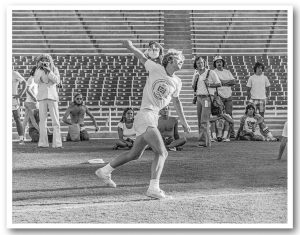
Davis Johnson competing in the 1975 World Frisbee Championships. Image courtesy Davis Johnson.
He is proud to have participated in the 1975 World Frisbee Championships held in the Rose Bowl in Pasadena. His distance record for throwing a disc over 400 feet, considered by players as the “4-Minute Mile” of the sport, was not recognized by Guinness immediately. “I held both the indoor and the outdoor records since 1974,” he explains. “But it was not put in the book until 1978 because I did it with a non-Wham-O disc. In those days, they were the domineering company in the game, and if you didn’t throw a Frisbee (created by Wham-O), you didn’t get in. Now there are dozens of disc golf companies around the world making discs.”
His record was broken by fellow MIT student and friendly rival John Kirkland. “I held it for almost five years, and John broke it in a tournament in Texas,” he says. “However, he used a slightly more advanced disc. I still hold that record for classic discs, so technically it has not been broken. But as they say, records were made to be broken.” Davis recounts his early history in this article for The Flying Disc Museum: A Far-Out History of Throwing Far.
The Advantages of Disc Golf
Davis finds several reasons for the growth of Disc Golf. “For one thing, people are daunted by ‘ball golf’ as we call it because it’s difficult and can be frustrating. Disc golf is much easier for the layperson to pick up, and it’s also far less expensive,” he explains.
“The discs are reasonably priced – many courses now are pay-for-play, but you’re probably going to spend no more than $10 for a round. It’s informal, fun and really inclusive, and we are trying hard to get more women into the sport.”
Instead of clubs, he says most players use 15 or 20 discs to make shots. “There are specialty discs that will go one direction or another, and you have your putters, and your mid-range would be your irons, and then you have your drivers, which are less predictable but go a lot farther,” he says.
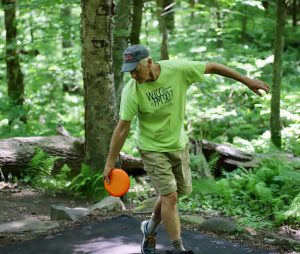
Davis Johnson preparing for a throw. Image courtesy Davis Johnson.
Davis, a published poet and songwriter who edited Victor Malafronte’s “The Complete Book of Frisbee” in 1998, is retired after a 30-year career teaching writing, speech and journalism at Springfield Technical Community College. He has also worked as a radio weathercaster, motivational speaker and author of a children’s book. But he has always found time to get out in nature and fling discs around, and he believes Disc Golf is here to stay in the National Senior Games.
“I got in so early I’m number 44 in the Professional Disc Golf Association (PDGA), and there are now over 200,000 members,” he notes. “Those people are aging just like me, and I think the senior competition will become a lot more challenging and fun.”
Davis summarizes that it is the people that he loves most about being in his sport. “If you had disc golf people running the world, we’d have a lot more egalitarian and peaceful world, because people treat each other well in this sport.”
- Published in Athlete of the Month