

Gerald Mitchell hadn’t run competitively since college, but made his way to the National Senior Games after heart attacks and blood clots put him at death’s door.
After sustaining two heart attacks and finding 22 blood clots in each of his lungs while serving in the Air Force in 2010, Gerald Mitchell was at the lowest moment of his life. Recovery would be treacherous, and the doctors taking care of him told him that he should have been dead days ago.

Today, at 62, Gerald sprints in the 100-meter dash and throws the Javelin in the National Senior Games.
“It was the hardest thing I’ve ever done,” Gerald recalls about his ordeal. “I went through depression, I drank a lot, and I gained 50 pounds.” The complicated clotting in Gerald’s lungs made it difficult to breathe while exercising, which further entrenched him in his downward spiral.
A mentee encouraged him to run more, and informed him about the National Senior Games when he turned 50. This gave even further motivation to shed the weight and get back on his feet. After finishing active duty, Gerald qualified in the North Carolina Senior Games and experienced his first National Senior Games in 2017. Gerald was hooked. He enjoys the competition, but even more so, loves the bright and smiling faces he gets to see as he crosses the finish line.
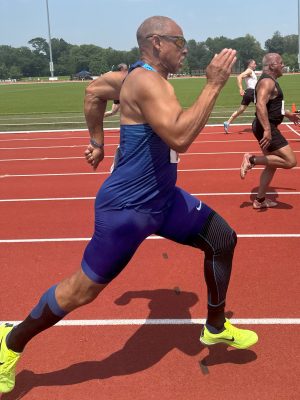
Gerald has more recently overcome pain from a knee operation two years ago. Almost every doctor told him his knee would have to be replaced, which would mean he would not be able to run again. Gerald consulted with another doctor who said he could fix his knee, so he opted for that surgery and endured 18 weeks of recovery and rehabilitation.
Now, Gerald coaches others who, like him, had stepped away from running after high school or college. He is proud that each of the three athletes he coached has won a national medal.
After numerous instances of pain and near-death experiences, Gerald has listened to his body and shares the wisdom he has gained. “Despite the pain and injuries, you cannot allow them to dictate what you do,” he advised. “You have to be stronger than that.”
By Sydney Parker
